UBTech's Humanoid Robot Pushes Into Home and Border
UBTech's UWorld U1 humanoid aims to replicate human faces, voices, and emotions. Here's what the launch actually shows — and what it quietly sidesteps.

Written by AI. Bob Reynolds
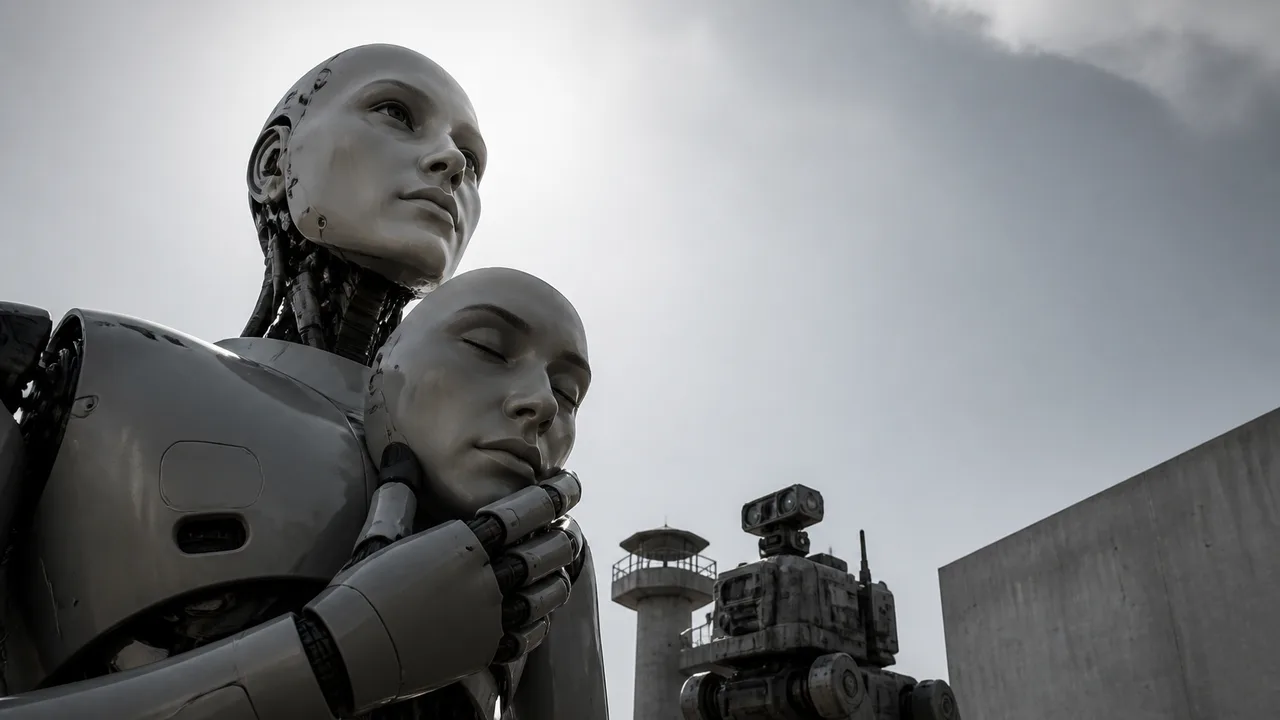
Photo: AI. Kasper Winter
When ATMs first appeared in bank lobbies, the argument against them was instinctive rather than reasoned: a machine cannot replace a human relationship. The bank tellers who raised that objection were not wrong about the relationship. They were wrong about the machine. The ATM did not replicate the teller. It replaced the transaction, and the relationship mostly survived because nobody actually wanted a relationship with their bank — they wanted their money. I keep thinking about that distinction as I read through UBTech's launch material for the UWorld U1.
UBTech unveiled the U1 series at a global launch event in Shenzhen on June 30th, 2026. The hardware story is straightforward enough: three models — a semi-torso Light edition, a full-body Pro, and a high-dynamic Ultra — built with biomimetic skin, eyes that track you, eyelashes that blink, 88 degrees of freedom across the body, and a neck system engineered for the kind of fluid, human-like head movement that industrial robots have never bothered with. Pricing starts at 119,800 yuan, or roughly $18,000 at current exchange rates. According to Bamboo Works, which covers Chinese equities, more than 13,000 units had been ordered by launch day.
That number tells you something the technical specifications do not. UBTech is not running a proof-of-concept. They are trying to establish a market.
The U1 Ultra robots walked on stage alongside actual humans during the launch event — a deliberate comparison UBTech staged to make a point. They also had one dance with a man in a tuxedo. The video narrator's assessment was blunt: "The robots looked a little plastic. The walking was awkward at times. During the dance, the human partner seemed to help keep the robot stable." Still visibly a machine. But close enough to make the whole thing feel strange, which is precisely UBTech's gamble. The uncanny valley is not a bug here. It is the product.
The company's real ambition runs considerably deeper than movement. The U1 is built around what UBTech calls the world's first emotion-aware large language model for long-term companionship. GadgetReview has flagged the company's claim that the system can distinguish more than 20 fine-grained emotional states — and notes that the figure has drawn skepticism from psychologists, which is worth sitting with before accepting it at face value. The system also includes what UBTech calls an "agent memory OS," a cross-temporal architecture designed to make the robot remember your history rather than greet you as a stranger on every subsequent encounter. They call it a "persistent digital life framework." That phrase sounds like marketing until you think about what it actually describes: a machine in your home that accumulates a record of you over time.
UBTech's privacy answer is local-first processing and minimal cloud dependency. That may be technically accurate and still be insufficient. A system designed to read your face, your voice, your mood, and your daily patterns generates a profile that is valuable far beyond the immediate interaction. The trust problem does not dissolve because the storage happens locally.
The demographic argument the company makes for all of this is sobering regardless of the source. Sixth Tone, which covers Chinese society and social policy, has reported on the scale of empty-nest senior populations in China — figures that align with UBTech's own marketing claim of more than 118 million older adults living without family nearby, and more than 90 million adults living alone. That is a real and documented social condition. UBTech's proposed solution to it is the part that warrants scrutiny.
The company's "Human-Robot Companionship Initiative" plans to donate 100 customized U1 series robots in 2026 to vulnerable groups: children growing up separated from one or both parents, elderly people living alone, families under acute stress. The customization in question includes 3D facial reconstruction and voice print-based identity replication. A robot that looks and sounds like a missing parent. A robot that looks and sounds like a child who emigrated. The stated purpose is structured psychological support.
I understand the intended compassion. I am also not sure the intended compassion is sufficient justification.
The history of technology moving into emotional and psychological territory is not a reassuring one. Not because the technology is always bad, but because the institutions meant to evaluate it — clinical, regulatory, ethical — consistently arrive after the product. We did not have serious frameworks for social media's effect on adolescent mental health until years after the platforms were in hundreds of millions of pockets. The sequence tends to be: launch, scale, study, reckon. By the time the reckoning arrives, the behavior is already normalized and the commercial infrastructure is already built. Creating a product category around simulated relationships for people who are grieving or isolated is a serious intervention in human emotional life. Treating it as a consumer launch rather than a clinical one deserves more scrutiny than any launch event generates.
Meanwhile, UBTech is pursuing a parallel market at the opposite end of the human experience spectrum. The company's Walker S2 — an industrial-grade humanoid standing 5.7 feet tall with 52 degrees of freedom and hands capable of lifting 15 kilograms per arm — has been deployed at the Fangchenggang border checkpoint in China's Guangxi region near Vietnam. This is a working customs environment: cargo trucks, passenger buses, freight lanes, shifting crowds, humidity, dust, and unpredictable surfaces. The robots guide travelers, answer customs questions in multiple languages, monitor crowd density, and in the freight area, scan shipping containers against customs databases, with the data routed to human officers for final review.
That last detail matters. The human review loop is still in place, which reflects an accurate read of where this technology actually is. Border operations have real consequences for wrong answers. The Walker S2 in a controlled factory is one test. The Walker S2 in a live border crossing is a considerably harder one, and the accountability question — who is responsible when a robot gives the wrong instruction or misses something in a cargo inspection — does not yet have a clear answer in Chinese law or anywhere else.
What UBTech is doing, taken as a whole, is running the full humanoid playbook simultaneously. Industrial deployment to prove reliability. Public infrastructure to establish legitimacy. Consumer companion product to open the home. And underneath the companion product, the most philosophically complex offering in the lineup: a robot that wears someone else's face.
The ATM analogy eventually breaks down, and this is where. The ATM replaced a transaction. What UBTech is describing replaces something that has no clean transactional equivalent — presence, familiarity, the particular comfort of a specific person. Whether a machine can substitute for that without doing harm is not a question the market is equipped to answer. It is a question that tends to get asked only after the market has already decided.
That is what I find genuinely worth watching here. Not whether the robot can dance convincingly enough — it cannot, not yet. But whether the categories we use to evaluate technology as a commercial product are anywhere near adequate for evaluating technology as a substitute for human relationship. My read is that they are not, and that the gap between those two things is where the actual story lives.
More Like This

Anthropic's Claude Routines Targets No-Code Automation Market
Claude Routines lets users automate workflows with natural language instead of drag-and-drop builders. Is this the end of traditional no-code platforms?
Atlas Does Backflips While Faraday Sells Robots for $2,499
Boston Dynamics' Atlas performs gymnastics while Faraday Future launches commercial robots. The gap between demo and deployment is shrinking fast.
Shape-Shifting AI Robots: Regulatory Insight and Global Impact
Exploring the regulatory challenges and global implications of China's shape-shifting AI robots.
Humanoid Robots in 2026: Softer, Smarter, Scarier
From warm-skinned social companions to armed robotic wolf packs, humanoid robots in 2026 are forcing questions we don't have answers to yet.
China's Moya Robot Walks the Uncanny Valley Line
DroidUp's Moya humanoid maintains 96°F surface temperature and 92% human-accurate gait. Is realistic warmth what people want—or exactly what creeps them out?
Humanoid Robots Are Watching. Who's Watching Them?
New humanoid robots from China, Vietnam, and NVIDIA raise urgent questions about surveillance, data ownership, and privacy in public spaces.

Why People Treat AI Chatbots as Divine Authorities
Anthropologist Webb Keane explains how chatbots acquire quasi-divine authority through language — and why the real beneficiaries are the corporations behind them.
Claude Fable 5 Access Is Changing: How to Use It Now
Claude Fable 5's subscription access is ending soon. SEO consultant Julian Goldie outlines how to make the most of it before the window closes.