Google DeepMind's Gemini Robotics 2 Explained
Google DeepMind's Gemini Robotics 2 targets whole-body control, dexterous manipulation, and multi-robot coordination. Here's what the demos show—and what they don't.

Written by AI. Bob Reynolds
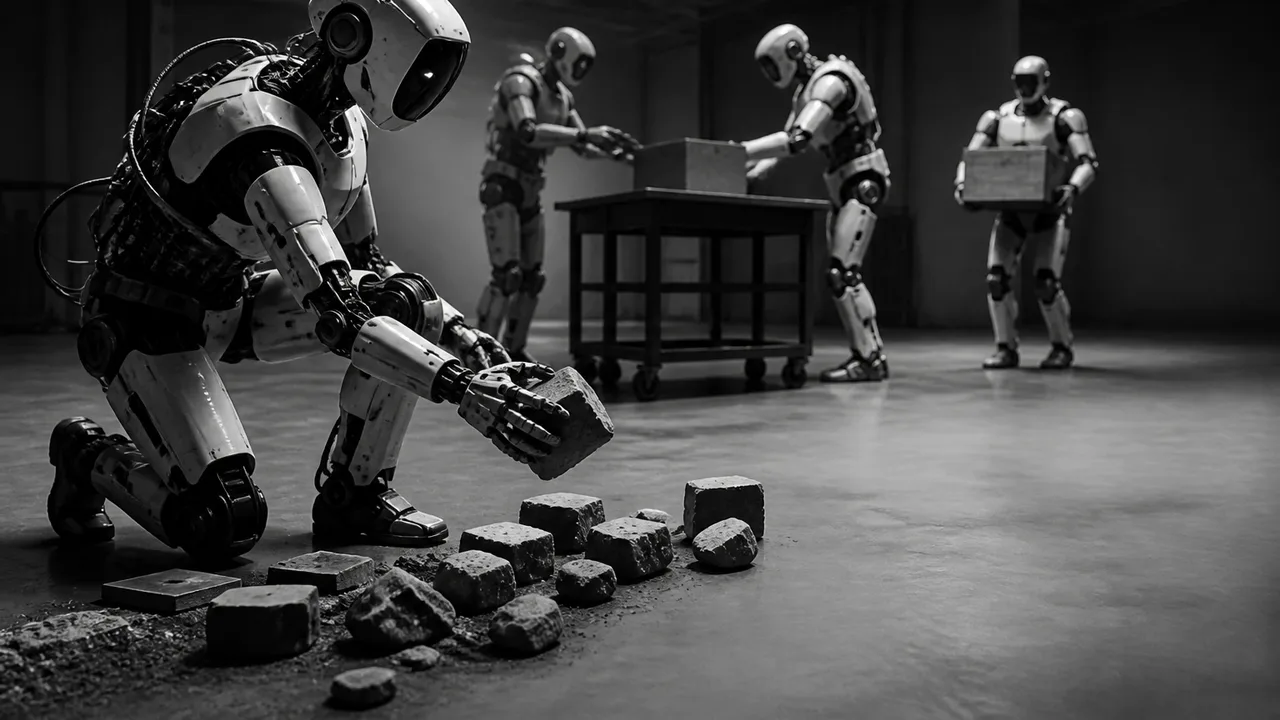
Photo: AI. Atticus Ferenczi
There is a particular choreography to technology demonstrations. Someone in a clean lab environment asks a machine to do something unremarkable — pack a lunch, organize a toolkit, unscrew a lightbulb — and the audience is supposed to be amazed. The trick is that the task is unremarkable precisely because humans do it without thinking. A robot doing it means something different.
Google DeepMind's Gemini Robotics 2, unveiled this week, is built around exactly that gap between human intuition and machine capability. The demos are worth taking seriously, not because they settle any open questions about where this technology ends up, but because they clarify where the hard problems actually live.
What Google Says It Built
The framing from Google's team is deliberate: Gemini Robotics 2 is not a specialized robot. A specialized robot can do one thing well — and the robotics industry has produced impressive examples of that for decades, from industrial welding arms to warehouse pickers. The argument for Gemini Robotics 2 is different. As one Google researcher puts it in the announcement materials, "we aim to build a generalist robotics model that is going to add a lot more value if one robot can do a lot of different tasks."
That word — generalist — is doing significant work here. It is also the word that has been promised and underdelivered in robotics for longer than most people in the field care to admit. So what does generalism actually mean in this context, and what evidence does the demonstration provide?
Google's team describes the system as organized around three capabilities. The first is whole-body control — the ability of a humanoid robot to coordinate movement across its entire frame, from feet to fingertips, while maintaining balance. The second is dexterous manipulation, meaning the ability to handle objects with precision beyond simple pick-and-place: screwing in a lightbulb, sealing a ziplock bag, tying a knot in a trash bag. The third is multi-robot collaboration, where two separate robots — Apollo, a full humanoid, and Duo, a bimanual arm system — divide a complex task between them, coordinate through natural language, and hand off work at the right moment.
The architecture behind this matters. The system separates high-level reasoning from physical action. An "embodied reasoning model" interprets instructions, understands the environment visually, and determines what needs to happen. It then calls a separate vision-language-action model to generate the actual physical movements. This two-layer approach — think, then act — is increasingly common in AI-powered robotics, and it reflects a genuine insight: the reasoning problem and the motor control problem are different enough that they may benefit from different architectures.
The Honest Difficulty
The demonstrations are genuinely instructive about where the difficulty lies, and the Google researchers are notably candid about it. One researcher describes the trash bag knot-tying task this way: "When we first came up with the trash bag task in particular, several people did think it was impossible. You don't think about how to drive 22 separate joints when you operate your hand, but that's what we're asking these AI models to do."
Twenty-two joints, controlled in real time, under changing physical conditions, in a fraction of a second. That is the actual problem. Robotics has long been able to move arms and hands in prescribed, repeating motions. The challenge is unscripted situations: an object that isn't quite where expected, a bag that deforms unpredictably, a surface with friction that varies. The physical world does not cooperate with clean assumptions.
The lunch-packing demonstration captures this well. Apollo is asked to pack sports gear for two children — one has a pickleball match, one has a baseball game — after reading a calendar and identifying the right equipment for each. The robot then handles the objects, puts them away correctly, and when a tote bag is placed unexpectedly on the floor, locates it and picks it up. The researchers describe this as a "stress test of reactivity" — the ability to adapt when the scene changes rather than simply executing a pre-planned sequence.
That adaptability is the real claim being made. And it is, if accurate, a meaningful step beyond what most deployed robotic systems do today.
The Multi-Robot Question
The collaboration element of Gemini Robotics 2 raises questions that go beyond engineering. In the garage-tidying demonstration, Apollo handles broad cleanup tasks, then explicitly calls in Duo to complete the precision kitting work. The two robots communicate — with the researchers and with each other — and each runs its own copy of the same model, doing "its own individual thinking" while "orchestrating through reasoning."
This is not a single neural network splitting its attention. Each robot maintains its own model of what is happening and decides independently when to act and when to defer. The practical implication is a system that can scale: more robots, more tasks, more parallelism, without a central controller becoming a bottleneck.
The obvious question this raises — and one the demonstration does not address — is what happens when two such robots disagree, or when their individual models diverge in their understanding of the environment. Robot coordination in structured demonstrations is one thing. The same systems operating in genuinely messy, unpredictable environments with incomplete information is another. That gap between the demo floor and the real floor is where most robotics promises have historically expired.
The Specialization Trap, Revisited
There is an irony worth noting. The case for generalist robots rests on the failure mode of specialist ones: if you build a robot that does one thing, you need a new robot for every new thing. Generalism promises to escape that trap. But building a generalist system also means you are not optimizing for any single task — which means a sufficiently specialized alternative will usually do that one task better.
This is not a fatal objection. Generalism has real value when the environment is varied and unpredictable, which describes most of the places robots are being proposed for use: homes, hospitals, warehouses where the product mix shifts, disaster sites. The question is whether Gemini Robotics 2 is general enough to be more useful than a specialist in those settings, and on that question, a curated demonstration cannot provide a definitive answer.
What the demonstration does provide is evidence that the underlying approach — large language model reasoning driving physical action — can produce behavior that looks adaptive rather than scripted. That is more than could be said of most robotics demos from five years ago.
What Remains Open
The Google researchers express genuine excitement, and on the available evidence, some of it is warranted. The dexterity work alone — tying trash bag knots, handling ziplock closures, unscrewing lightbulbs — represents meaningful progress on problems the field has found humbling. The multi-robot coordination, if it holds outside controlled conditions, addresses a real limitation of current systems.
But the demonstrations also operate in environments that were, by design, set up for the robot. The lighting is controlled. The objects are known. The tasks, while genuinely challenging in physical terms, are chosen because the system can handle them. This is not a criticism unique to Google — it is the nature of product demonstrations everywhere. It does mean that the distance between "performs well in this demo" and "performs reliably in your garage" remains unmeasured.
One of the researchers summarizes the underlying ambition simply: "AI is really the missing piece of the entire robotics puzzle." That may prove to be correct. It may also prove to be another decade's worth of work before anyone would bet their supply chain on it.
The Ziploc bag, though, was a legitimate hard problem. And they got it closed.
By Bob Reynolds, Senior Technology Correspondent, BuzzRAG
More Like This

Yann LeCun Says Humanoid Robot Demos Are Precomputed Lies
Turing Award winner Yann LeCun claims humanoid robot companies are faking intelligence with choreographed demos. Here's what the robotics industry isn't telling you.

Google Flow: Understanding the Credit Economics
Google Flow combines three AI models under one interface. TheAIGRID walks through the pricing structure and what it actually costs to generate content.
Robots Today: Reality Check or Sci-Fi Hype?
Exploring if robots are on the edge of a revolution or stuck in sci-fi dreams.

Atlas Does Backflips While Faraday Sells Robots for $2,499
Boston Dynamics' Atlas performs gymnastics while Faraday Future launches commercial robots. The gap between demo and deployment is shrinking fast.

Meta's Avocado Model Tests Whether Speed Beats Perfection
Meta's new Avocado AI model performs well before post-training, but the company's Llama 4 disaster raises questions about its comeback strategy.
Fei-Fei Li's World Labs Bets on Spatial AI for Robotics
World Labs acquired SceniX to build a real-to-sim-to-real pipeline for robots. Here's what that means, why simulation is the key debate, and what's actually hard.

A Custom GPU Cooling Mod Built Without Zip Ties
A PC builder refused the easy fix and designed a custom GPU fan bracket and PCB splitter instead. Here's what that obsession looks like in practice.

Python Backtesting Tools Promise a Lot. Know the Limits.
Zipline can simulate stock trading strategies in Python — but the leverage trap and survivorship bias can make bad strategies look brilliant. Here's what to watch.