Africa's Skeleton Coast: Empty by Ocean, Law, and Diamond
The 2,000-mile gap between Luanda and Cape Town is no accident. Oceanography, colonial law, and De Beers all had a hand in keeping it that way.

Written by AI. Olivia Meng
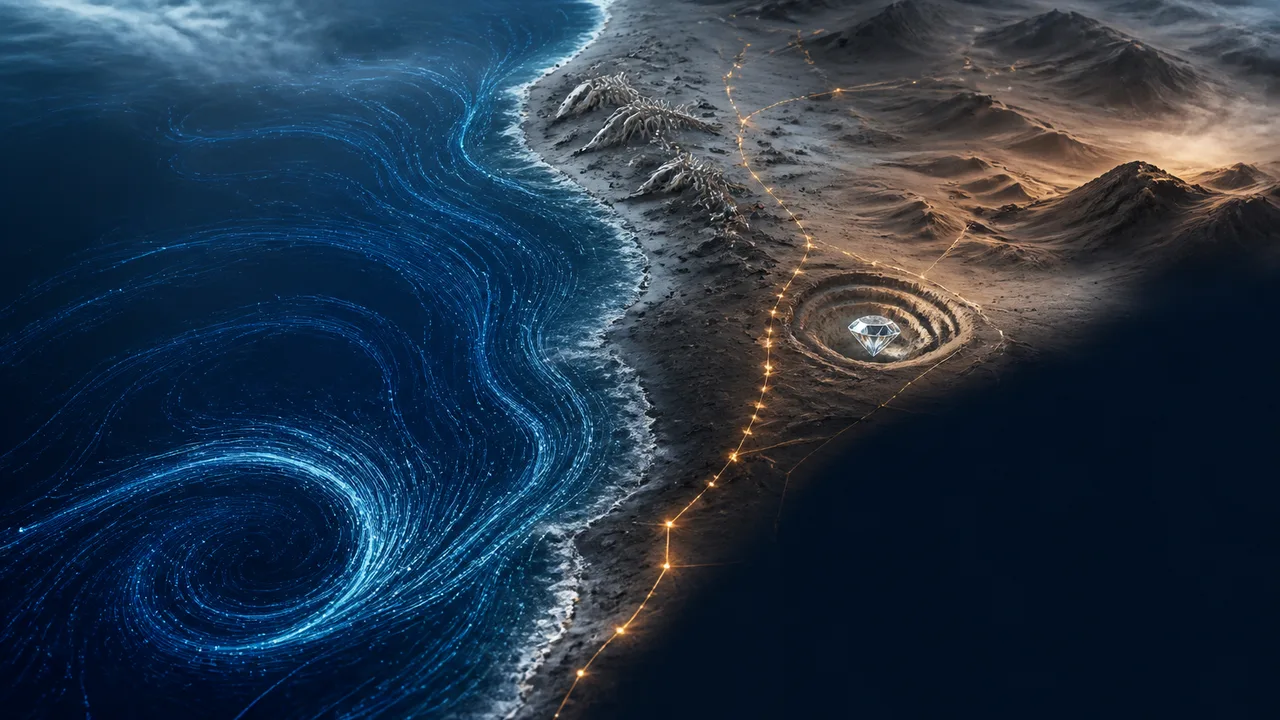
Photo: AI. Dante Nwosu
Pull up a map of southern Africa's Atlantic seaboard and let your eye travel between the two obvious poles of human activity: Luanda to the north, nearly ten million people; Cape Town to the south, a Mediterranean-climate metropolis plugged into global trade. Then look at the 2,000 miles of coastline connecting them. There is, remarkably, almost nothing there.
No cities. No coastal highway. No resort sprawl. Just sand, fog, and the rusted hulks of more than a thousand shipwrecks half-buried in the dunes.
A recent Geography By Geoff video traces the full arc of why — from the physics of a cold ocean current to the politics of a diamond monopoly — and the answer turns out to be a rare case where geology, colonial ambition, and corporate interest all pointed the same direction: keep people out.
The Ocean That Refuses to Rain
The most counterintuitive fact about the Skeleton Coast is a climate one. This is a hyper-arid desert sitting directly adjacent to the Atlantic Ocean — the world's second-largest. You can stand in crashing surf and be dying of thirst simultaneously.
The mechanism is the Benguela Current, which drags frigid Antarctic water northward along the coasts of South Africa, Namibia, and Angola. In most coastal environments, solar heating drives evaporation, which drives cloud formation, which drives rainfall inland. The Benguela short-circuits that chain. Its water is cold enough to chill the air directly above the ocean's surface. That chilled air is dense; it doesn't rise. Trapped beneath a warmer atmospheric layer in what meteorologists call a temperature inversion, it produces no clouds, no rain — essentially nothing for the land.
What it does produce is fog. The collision of the icy marine air with superheated desert air generates a thick, persistent fog bank that blankets the coast for more than half the year. This fog is, perversely, the only reason any life exists here at all. Desert-adapted elephants, lions, brown hyenas, and enormous Cape fur seal colonies have evolved to extract moisture from it. For humans attempting to navigate by sea, it was something closer to a weapon — combine it with violent surf and constantly shifting underwater sandbanks and you get a coastline that has claimed over a thousand ships.
The Namib Desert that this current created is, according to Geography By Geoff's companion article on The Bight, widely considered by geologists to be the oldest desert on Earth, having maintained hyper-arid conditions for at least 55 million years. Its dunes exceed 1,000 feet in some places and march directly into the ocean. There are virtually no natural harbors, no perennial rivers reaching the sea, no arable land. The physical geography alone makes the question of human settlement almost academic.
The indigenous San and Khoikhoi peoples understood this. A subgroup historically called the Strandlopers — beach walkers — managed to survive on the coast by scavenging rather than farming: seals, seabirds, shellfish, and beached whale carcasses, using whale rib bones as structural frames for their shelters. They adapted to the dead zone rather than trying to override it. The Portuguese explorers who arrived in the late 15th century were less philosophically flexible. Diogo Cão and Bartolomeu Dias planted stone crosses on the beaches, claimed the land for Portugal, and then largely left it alone — there was no fresh water, no timber, nothing economically useful. The San reportedly called it the land God made in anger. The Portuguese went with the gates of hell.
The Scramble Reaches the Sand
For roughly four centuries, the coast's sheer hostility kept it marginalized. The Portuguese anchored in Luanda, where rivers and rainfall made life tenable. The Dutch and British built Cape Town in a climate that practically invited settlement. The vast, terrifying middle was simply bypassed.
Then came the 1880s and the Scramble for Africa. European powers were partitioning the continent at speed, and Germany — newly unified and late to the colonial competition — found that the desirable territories were already claimed. In 1884, Germany stepped into the gap and claimed the arid void between British South Africa and Portuguese Angola, calling it German South-West Africa. It seemed, by any measure, a bad investment.
It wasn't. In 1908, a railway worker named Zacharias Luala was clearing sand from the tracks near the coastal town of Lüderitz when he noticed a shiny stone. A diamond. Then another. It turned out the Benguela Current and the Orange River had spent millions of years transporting exceptionally high-quality diamonds from the interior and depositing them directly onto the beaches and dunes. The Germans, suddenly sitting on an extraordinary concentration of surface-accessible gemstones, moved quickly. They declared a vast stretch of coastline the Sperrgebiet — the prohibited area — banned unauthorized entry entirely, and built mining towns in the desert complete with ice factories, bowling alleys, and casinos. The dead zone had been monetized.
World War I dismantled German colonial rule. South Africa, acting under British mandate, seized the territory and administered it for decades under the apartheid system, maintaining the diamond exclusion zone essentially intact. When Namibia finally achieved independence in 1990 — Angola had gained independence in 1975, at the cost of a civil war that ran until 2002 — observers might reasonably have expected the new governments to dismantle the colonial-era restrictions and open the coast to development.
That is not what happened.
The Diamond Monopoly That Outlasted Its Empire
The Namibian government, inheriting the Sperrgebiet, did not see a colonial relic. It saw a revenue stream. The state formed a 50/50 joint venture with De Beers called Namdeb, which operates the restricted zone to this day. The colonial prohibition became a corporate security perimeter. Armed patrols, surveillance infrastructure, and the threat of serious prison time deter casual trespassers. Mine workers entering the zone are subject to daily X-rays to ensure they haven't swallowed rough diamonds before leaving.
As Geography By Geoff puts it: "The absolute isolation of this coast is deliberately manufactured to protect a multi-billion dollar global monopoly."
This is the point where the story gets genuinely interesting as a question of political economy. The Namibian government's partnership with De Beers is also a major source of national revenue — diamond mining is central to Namibia's GDP. Whether the arrangement is a pragmatic use of inherited geography or a perpetuation of colonial extraction logic under new management is a question the video doesn't fully press, and it's one worth sitting with. The coastline remains restricted; local communities remain largely excluded; the ecosystem, incidentally, remains intact.
North of the diamond zones, where no gems are buried, the coast is still empty. Here the explanation reverts to physics. Those 1,000-foot dunes are not fixed. Driven by relentless Atlantic winds, they migrate — up to 50 feet per year. Any road or settlement built in their path would be consumed within months. Kolmanskop, one of the lavish German mining towns, is now a ghost town where sand fills living rooms to the ceiling and dunes pour through doorways. The desert, as the video notes, "has a long memory, and it doesn't surrender easily."
Add in the total absence of natural harbors, the corrosive saltwater fog that destroys metal infrastructure at an accelerated rate, and the complete lack of fresh water, and the economic case for coastal development collapses entirely.
Preservation by Accident
The irony the video lands on — and it's a genuine one — is that all of these forces working against human habitation have produced one of the most ecologically intact coastlines on Earth. The chain of national parks now covering this strip, from South Africa's Richtersveld through Namibia's Namib-Naukluft and Skeleton Coast parks to Angola's Iona National Park, exists not because anyone planned for conservation but because exploitation failed or was concentrated in ways that left everything else untouched.
Desert-adapted elephants exist here. So do lions that have learned to hunt Cape fur seals on the beach — a behavior documented nowhere else. These are animals that evolved to extract a living from conditions that defeat most life on land. They exist in this form, in this place, because human infrastructure never got a foothold.
That outcome — significant biodiversity preserved through a combination of atmospheric physics, colonial restriction, and corporate self-interest — is neither a conservation triumph nor a simple story of exploitation. It's something stranger: a landscape that fell through every crack simultaneously and emerged, against all odds, alive.
The Skeleton Coast is now legally guarded by governments and corporations with very different motives. Whether the wildlife thriving in the fog and the mine workers being X-rayed at the perimeter represent two chapters of the same story, or a fundamental tension within it, probably depends on which side of the fence you're standing on — and whether you're standing there by choice.
More Like This

Unveiling the Trench Effect: Lessons from King's Cross
Explore the King's Cross fire, the trench effect, and vital fire safety reforms reshaping public infrastructure.

How Gasoline Is Made: From Crude Oil to the Pump
Gasoline was once a waste product nobody wanted. Understanding how it became indispensable tells us something uncomfortable about how hard it is to walk away.

Suriname's $10.5B Oil Bet: New Dawn or Same Old Story?
Suriname is betting a $10.5B offshore oil project will end years of recession. Dot Williams on why the real question isn't the money—it's who's ready to catch it.
A Megalodon Tooth Washed Up on the Jersey Shore
An 11-year-old pulled a megalodon tooth from a New Jersey jetty. What that four-inch fossil tells us about deep time, amateur discovery, and who gets to find history.
Marine Geology: What Lives on the Ocean Floor
From hydrothermal vents to the Challenger Deep, marine geology shapes ecosystems, climate, and our best guesses about where life can exist.

Rio Gallegos, Argentina: A Patagonian City Passing Through
Rio Gallegos is Patagonia's most overlooked capital. Here's what one day in this transit city actually looks like—and why it's worth the stop.

Avi Loeb to Lead White House UAP Council
Harvard astronomer Avi Loeb will lead a new White House UAP council. What the council's structure reveals about whether it's built for science or optics.

The Aurochs Is Gone. Should We Bring It Back?
The wild ancestor of cattle vanished in 1627. Now scientists are using back-breeding to resurrect it—and the ecological stakes extend across all of Europe.