BuzzRAG Daily Digest — 2026-09-10

Curated by AI. Callum Pierce
Today’s trendline runs from a closely guarded military-space launch to record semiconductor sales and a high-stakes argument over crypto rules. Politics, cinema, music and games add a more human layer, while online debate continues to test the claims made by the AI industry.
A classified military launch takes flight
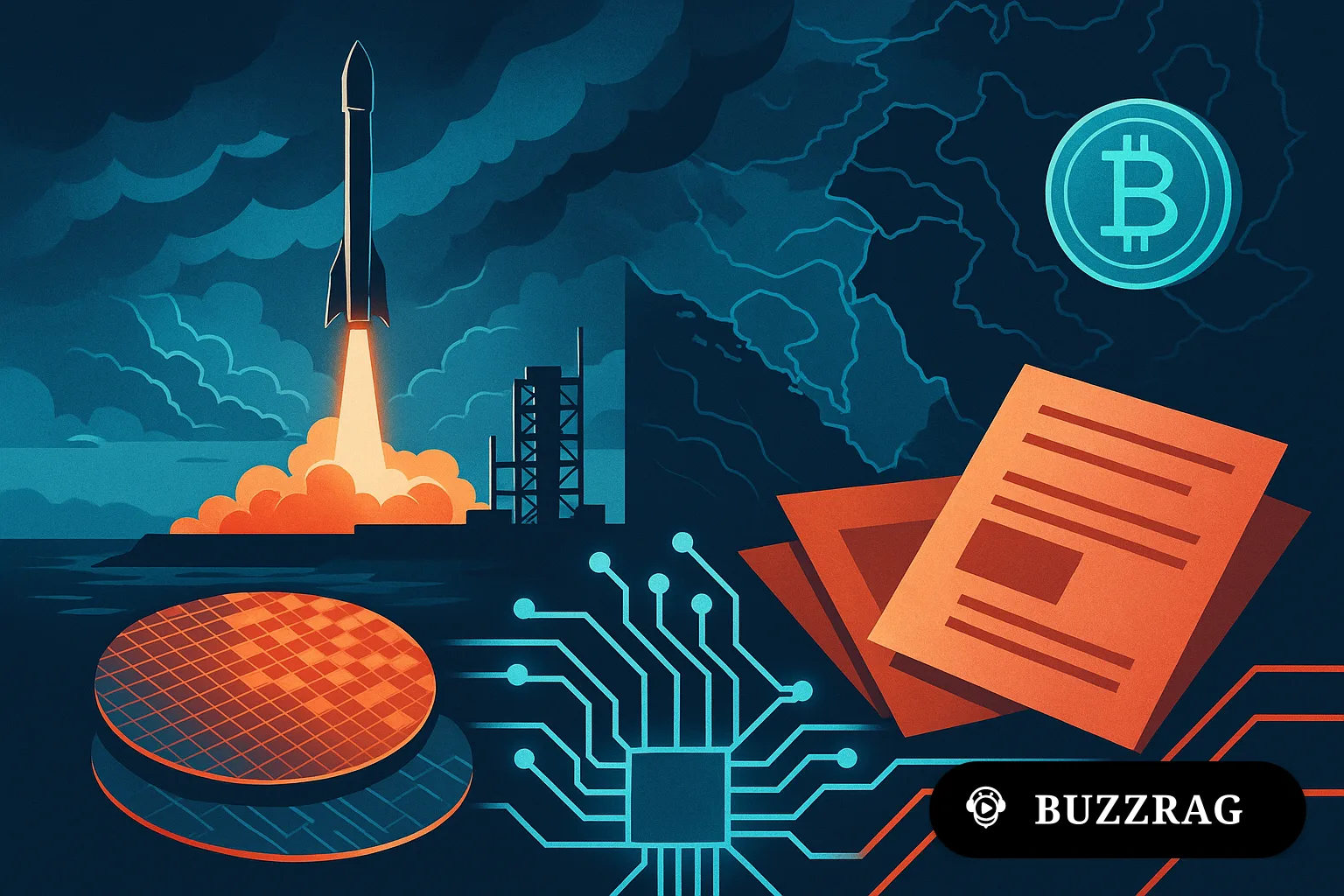
A commercial rocket is scheduled to carry the classified USSF-153 mission for the U.S. Space Force on September 10, with live coverage expected to track the launch. The mission’s payload and precise objectives are not public, making the visible spectacle of liftoff more informative than the details of what is being placed in orbit.
The launch is another marker of how closely national-security space work is now intertwined with private launch providers. Public information is likely to remain limited to the rocket, launch window, range activity and basic orbital facts. Viewers can follow those signals, but should be wary of treating speculation about the payload or mission purpose as confirmed reporting. The event also underscores the strategic importance of dependable access to space as military communications, surveillance and other capabilities increasingly depend on orbital infrastructure.
TSMC posts a sharp August revenue jump
Taiwan Semiconductor Manufacturing Company reported that August revenue rose by more than 53% year over year to a record monthly level. The result offers a fresh snapshot of demand flowing through the world’s most important contract chipmaker, whose factories supply processors for smartphones, data centres, advanced computing and artificial-intelligence systems.
Monthly revenue is only one measure, and it does not by itself reveal the company’s margins, product mix or how durable the current surge will be. Still, the scale of the increase highlights the unusual strength of the semiconductor cycle after years of shortages, inventory corrections and heavy investment in AI hardware. Investors will be watching upcoming guidance and quarterly results for evidence that demand is broadening beyond accelerated computing, as well as signs that geopolitics, export controls and the cost of building new fabs could constrain further growth.
A $5,000 election promise raises questions
A proposal to give every American $5,000 if Republicans win the midterm elections is drawing attention for both its scale and its political timing. The reported plan, presented during a midterm convention speech, would carry an estimated cost of about $1.2 trillion and immediately invite questions about eligibility, funding and whether such a payment could be enacted through existing government authority.
At this stage, the proposal should be treated as a political pledge rather than an approved programme. A nationwide transfer of that size would require congressional action, a credible financing mechanism and careful consideration of inflation, administration and constitutional constraints. It also raises familiar ethical concerns about linking a direct financial benefit to an electoral outcome. The next test will be whether party leaders and lawmakers turn the headline-grabbing promise into detailed legislation, or whether it remains primarily a campaign message designed to dominate the political conversation.
A wartime drama finds tension in the forecast
A new film revisits the days before D-Day through the work of meteorologist James Stagg, whose weather assessments helped shape the decision over when Allied forces should launch Operation Overlord. Andrew Scott plays a figure whose authority rested not on battlefield command but on the difficult task of making a high-consequence call with incomplete and shifting information.
The review describes the production as slick, watchable and occasionally cheesy, with a theatrical quality that reflects its stage origins. That approach gives the story a contained tension: maps, forecasts and arguments become stand-ins for the enormous military operation waiting offshore. It also appears to leave some of the wider moral and historical complexity underexplored. The film’s strongest material lies in the uncertainty of the decision itself, and in the pressure placed on specialists whose cautious advice could frustrate commanders while potentially saving thousands of lives.
A major game partnership appears to be ending
Reports that a leading console platform is separating from influential game creator Hideo Kojima have prompted a wave of online reaction. The response reflects more than fan attachment to a single developer: it points to the unusual cultural weight that auteur-led game projects can acquire when their creators become closely associated with a platform’s identity and ambitions.
The available discussion leaves important details to be established, including the exact status of the relationship, existing contractual commitments and what happens to any projects already in development. A split could affect release plans, ownership questions and the creative direction of future work, depending on the agreements involved. It also exposes the tension between games as personal artistic projects and games as large corporate investments, where hardware strategies, budgets and commercial timetables can ultimately outweigh the preferences of celebrated individual creators.
Crypto rules may advance beyond one key vote
Coinbase chief executive Brian Armstrong says U.S. cryptocurrency regulation could move forward regardless of the outcome of the Clarity Act. His argument suggests that the industry sees several possible legislative and regulatory routes, rather than treating one bill as the sole gateway to a clearer framework for digital assets.
The claim is an assessment from an industry leader, not evidence that a particular law will pass. The central disputes remain familiar: which tokens should fall under securities rules, which agency should supervise different markets, how stablecoins should be regulated and what protections consumers and investors should receive. A bill’s failure could slow progress or force lawmakers to rewrite provisions, while passage would still leave regulators with years of implementation work. The direction of travel will depend on bipartisan support, lobbying pressure and whether policymakers can balance innovation with enforcement after a volatile period for the sector.
A veteran electronic voice returns with new work
A new release from Japanese musician Haruomi Hosono is receiving attention for the way it extends a career built across pop, electronic music, ambient sound and experimental composition. The album’s title, “The Beautiful World: Yours Sincerely,” points toward a reflective project, though the wider appeal lies in how Hosono continues to make open-ended music without being confined to a single genre or era.
Reviews of late-career work by foundational artists often become conversations about legacy as much as sound. In Hosono’s case, that legacy spans influential group work, film and television scoring, studio experimentation and a persistent interest in the meeting point between technology and everyday life. The new record offers listeners a chance to hear how those interests have evolved rather than simply replayed. Its reception will likely turn on whether the album feels like a genuine continuation of that curiosity or a retrospective shaped mainly by the weight of its creator’s history.
An online claim tests the limits of AI criticism
A social-media post arguing that OpenAI lacks mathematicians capable of understanding its own output has circulated through a technology discussion forum. The phrasing is deliberately provocative, but the item as presented is a claim and a prompt for debate, not substantiated evidence about the company’s staffing, research process or ability to evaluate mathematical systems.
The underlying concern is legitimate even if the headline is not: advanced models can produce confident mathematical answers that are difficult to verify, and organizations building them need rigorous evaluation, formal methods and domain expertise. That challenge does not require assuming that a company has no qualified mathematicians; it requires asking how those experts are integrated into product development and how failures are detected before release. Readers should separate criticism of model reliability from unsupported claims about an entire research organization. The useful next step is concrete evidence: documented benchmarks, reproducible errors and transparent descriptions of review practices.
Why a major electronics group invested in Mistral
A new analysis is examining why Samsung backed Mistral, the European artificial-intelligence company. The question reflects a broader shift in corporate AI strategy: large technology groups are increasingly placing several bets across model developers, infrastructure providers and application companies rather than relying on a single dominant partner.
For Samsung, such a relationship could provide access to models, engineering talent or commercial options as AI becomes central to phones, appliances, chips and cloud services. For Mistral, backing from a global electronics manufacturer could expand distribution and create opportunities to optimize models for devices and enterprise workloads. The precise terms and strategic commitments matter, however, and an investment does not necessarily guarantee product integration or exclusivity. The partnership will be judged by what it produces in practice: usable systems, stronger distribution, and a sustainable position in an increasingly expensive and crowded AI market.
The next round of evidence will come from launch results, company filings, legislative detail and the fine print behind the technology partnerships now attracting attention. Across all of these stories, the headline is only the opening move; the substance lies in what can be verified after the excitement fades.