BuzzRAG AI Desk — 2026-09-10

Curated by AI. Sarah Ling, AI Desk Editor
Today’s AI beat is less about a single frontier model than about systems becoming embedded in difficult workflows: multilingual archives, document-heavy operations, software security and creative production. The common thread is verification—whether a model can preserve structure, show confidence, survive adversarial testing or support claims that withstand independent scrutiny.
Indic AI Targets the Messy Reality of Multilingual Documents
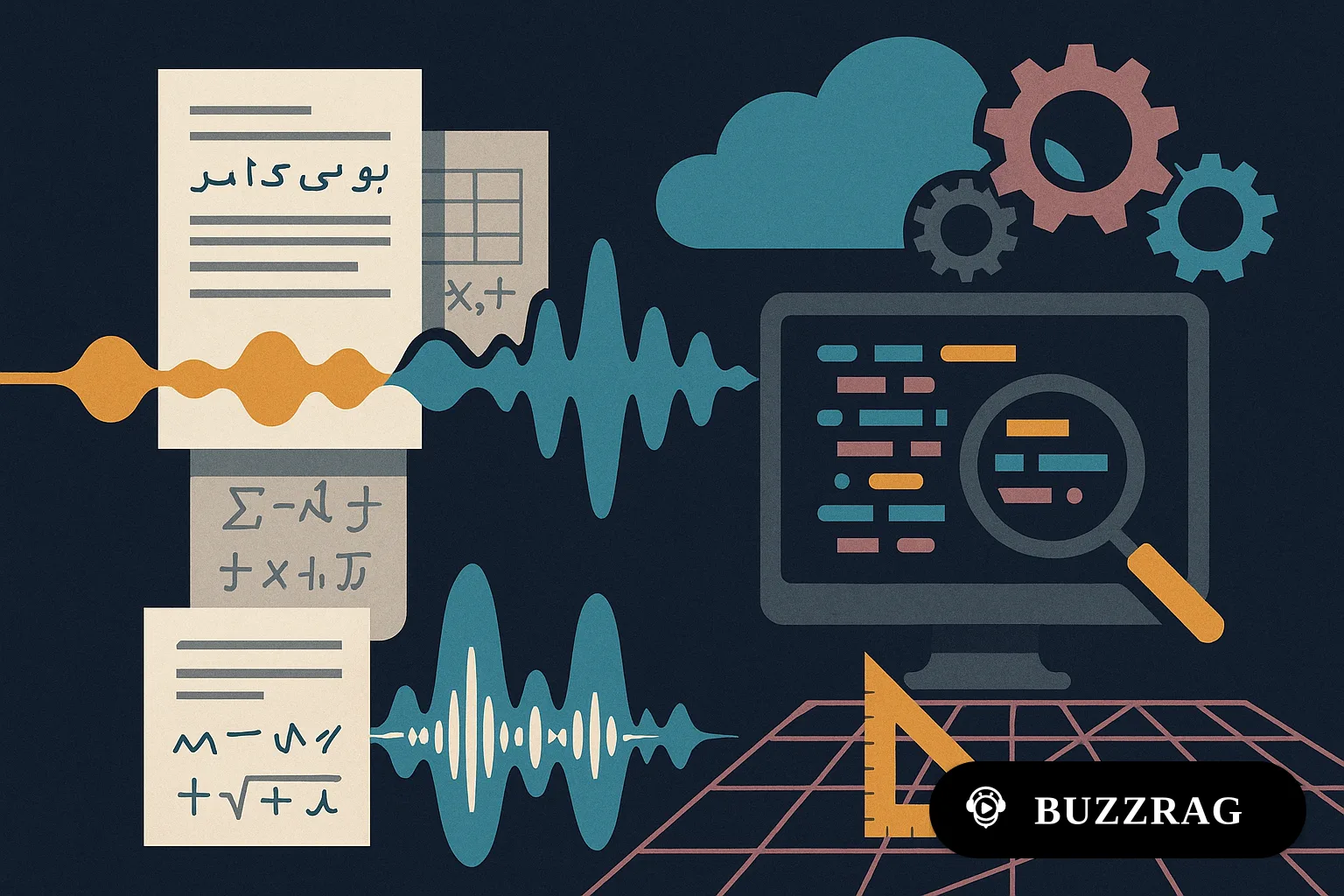
Bodhan AI and AI4Bharat have released four models aimed at document parsing, translation and speech across Indian languages. The use case is notably less tidy than standard text translation: a single Hindi lesson may combine English loan words, scanned tables, handwritten equations and multiple scripts. According to the supplied reporting, the September release is designed to make such material searchable, translatable and readable aloud.
The significance is in the division of labor. Rather than treating language access as a single text-generation problem, the models target different stages of a document pipeline, from extracting structure to rendering language as speech. The available description does not specify model sizes, benchmark scores or the full language list, so claims about comparative performance should wait for technical documentation and independent evaluations. The practical test will be whether these systems preserve tables, formulas and mixed-script context well enough for education and public-information archives.
Document Extraction Shifts From Chunks to Structured Evidence
LandingAI has released a second-generation document-extraction system built around its DPT-3 model family. The redesign replaces chunk-based handling with a hierarchy of documents, pages and blocks, while two variants offer different forms of grounding: DPT-3 Pro links results to lines, and DPT-3 Verity links them to words and supplies a confidence score.
That architecture points to a broader change in document AI: extraction is becoming less about producing clean text and more about preserving where each answer came from. Word-level grounding and confidence estimates can make review easier, but neither automatically guarantees accuracy; confidence is useful only when calibrated against real errors. The migration also carries operational costs. Gen1 code will not run against Gen2 endpoints, and billing now counts output characters rather than flat pages, meaning teams will need to reassess both integration work and usage economics before switching.
PyTorch’s Open Stack Expands Beyond the Model Layer
PyTorch Conference China took place in Shanghai on September 8–9 alongside KubeCon + CloudNativeCon and the OpenInfra Summit, following co-located events on September 7. The arrangement placed machine-learning framework discussions beside container orchestration, cloud infrastructure and open-source operations—the layers required to train and serve models at scale.
The supplied account offers few specific announcements or benchmark results, so this is better read as an ecosystem signal than a discrete research breakthrough. As AI workloads become infrastructure workloads, the important questions are increasingly practical: portability across hardware, reproducible deployment, efficient inference and how open tooling connects model development to production operations. The conference’s value will be measured less by stage demonstrations than by whether the ideas and integrations discussed there reduce dependence on brittle, vendor-specific stacks.
A Security Toolkit Gives Coding Agents a Full Feedback Loop
Google has open-sourced Mantis, an Apache 2.0 toolkit of modular security-review skills intended for AI coding agents. Its workflow spans vulnerability discovery, false-positive filtering, sandboxed reproduction, patch generation, re-attack of the proposed fix and risk scoring. The design treats security as an iterative loop rather than a one-shot scan.
That loop is the interesting part. An agent that can reproduce a suspected flaw and test its own patch has a stronger basis for action than one that merely emits warnings, but the supplied material does not establish detection rates, exploit coverage or performance against human-reviewed baselines. The project is also explicitly documented as demonstration-only, which matters: an open toolkit can help researchers study agent behavior, while unsafe automation in production could create new attack paths or ship incomplete fixes. Independent evaluation and strict sandboxing will determine whether the framework is a useful security instrument or mainly a compelling prototype.
A Former Lab Researcher Reopens the Alignment Clock Debate
In an interview with WIRED, former Anthropic researcher Jacob Coxon describes the company’s internal effort as a “mini Manhattan project” and argues that AI safety work faces a narrow window. His central concern is familiar but consequential: progress in model capability may be moving faster than the methods used to understand and control increasingly general systems.
This is testimony and argument, not evidence of a newly measured technical threshold. Departure interviews can illuminate institutional priorities and researcher disagreement, but they should not be treated as forecasts with known probabilities. The underlying policy question remains concrete: how much evaluation, interpretability research and deployment restraint should be required before systems gain broader autonomy? The interview’s value lies in making that disagreement visible inside the field, while the next step for readers is to separate urgent governance proposals from rhetoric about an imminent deadline.
A Music Model Tests Whether Licensing Can Change the Deal
Suno has introduced its v6 music model, described by the company as its first system developed with support from the record industry. Its product leadership says the model was trained from the ground up on a new dataset that does not include the same data as earlier systems, with licensed content among the sources. The claim marks a shift from treating training-data disputes as a legal afterthought to making dataset provenance part of the product story.
The important evidence is still missing from the public description: the scope of the licenses, the artists and recordings covered, the precise training mixture and independent tests against earlier versions. A licensed dataset may reduce some legal and ethical uncertainty, but it does not by itself resolve questions about style imitation, attribution, compensation or output similarity. The model’s real significance will depend on whether the arrangement produces measurable quality gains and a repeatable commercial framework that other creative AI companies can adopt.
A Claimed Mathematical Breakthrough Needs More Than a Headline
OpenAI has announced what the supplied reports describe as a solution to one of mathematics’ Millennium Prize problems, prompting intense discussion about AI’s role in advanced mathematical work. The claim would be extraordinary if independently verified, but the available snippet provides no problem name, proof, technical paper, external validation or account of the unusual circumstances surrounding the announcement.
That distinction is essential. In mathematics, a result is not established by the prestige of the institution announcing it or by a system’s ability to generate an apparently convincing argument; the proof must be inspectable, complete and accepted by specialists. If the claim survives that process, it could represent a major advance in automated reasoning and human-machine collaboration. Until then, the appropriate story is not that a prize problem has been solved, but that a consequential claim has been made and now faces the field’s slowest—and most valuable—form of evaluation.
The next useful signals will be technical rather than theatrical: independent tests of multilingual and document systems, reproducible security-agent evaluations, and public evidence behind extraordinary mathematical claims. Across the field, provenance, calibration and deployment boundaries are becoming as important as raw capability.