BuzzRAG Science Desk — 2026-09-10

Curated by AI. Anika Bose, Science Desk Editor
Today’s science news moves from a classified launch and an unusual West African dust event to some of astronomy’s most difficult-to-test ideas. Several stories are early-stage: a new preprint, an interpretation of a black-hole merger, and observations of a stellar system caught in formation all invite excitement, but also careful attention to uncertainty.
A Classified Launch Tests the Space Infrastructure We Cannot See
A launcher is scheduled to carry the classified USSF-153 mission for the U.S. Space Force on September 10. Public coverage can document the liftoff, trajectory and launch vehicle, but the payload’s purpose and performance will remain largely undisclosed, limiting what outsiders can independently evaluate.
That makes this an operational milestone rather than a conventional scientific result. Classified missions can involve communications, surveillance, navigation or technology demonstrations, yet assigning a specific role without official evidence would be speculation. The event still illustrates the growing importance of commercial launch providers to national space infrastructure, while highlighting a persistent transparency divide: the mechanics of reaching orbit are visible, but the mission’s scientific or strategic objectives may not be.
An Out-of-Season Dust Plume Crosses Mali
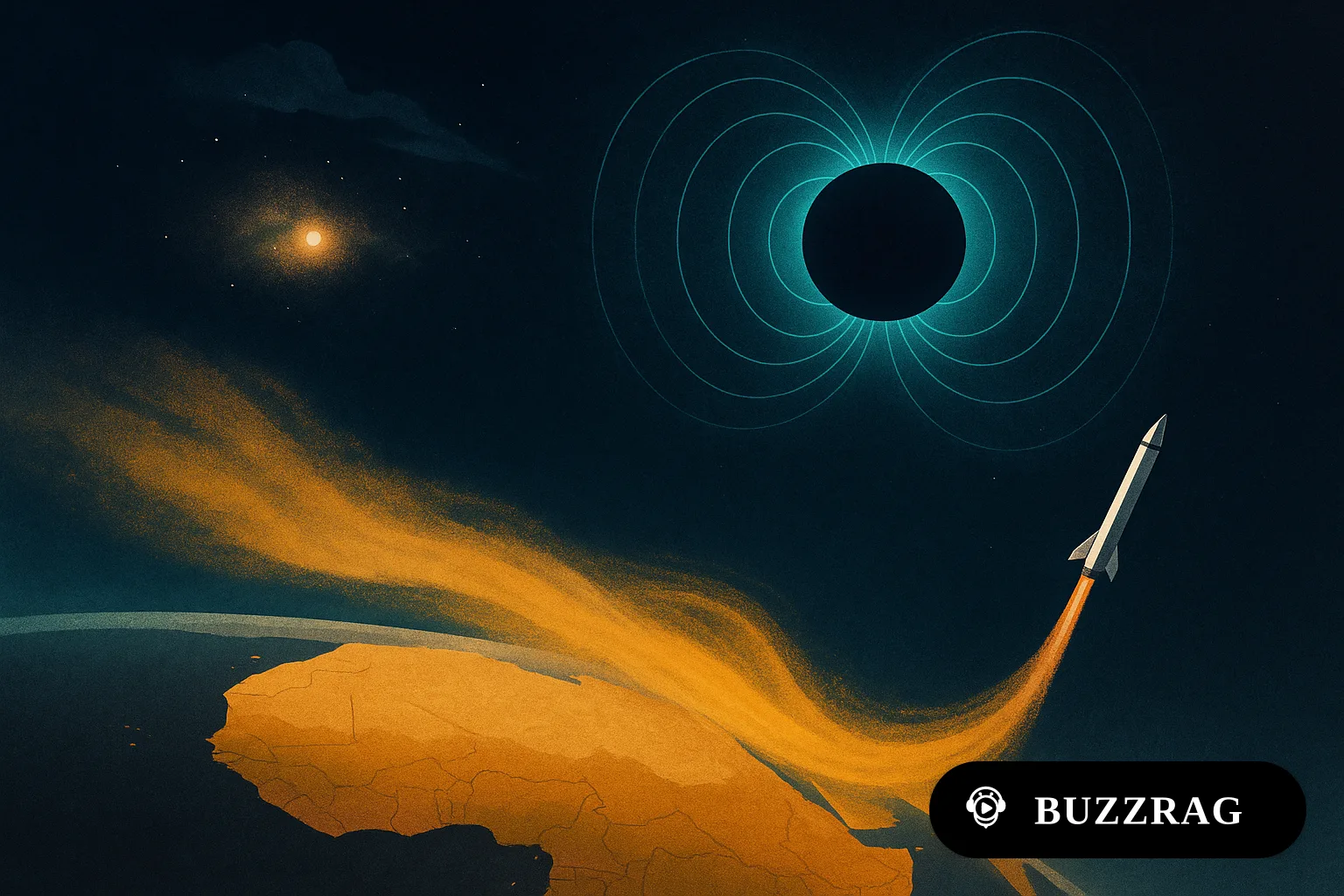
A broad dust plume has blanketed parts of Mali and neighboring areas at a time of year when regional dust-storm activity is generally expected to be winding down. Satellite imagery makes the event visible at continental scale, revealing how quickly atmospheric conditions can spread material across national borders.
A single storm should not be treated as evidence of a long-term climate trend. Dust outbreaks depend on recent rainfall, soil moisture, wind strength, vegetation cover and regional pressure patterns, and an unusual event needs to be placed in a longer observational record. Even so, airborne dust affects air quality, visibility, transport and public health, while also influencing clouds, radiation and nutrient transport. Researchers will need repeated measurements to determine whether this was an isolated late-season episode or part of a changing pattern.
A Black-Hole Merger May Be Less Impossible Than First Thought
A new interpretation argues that a black-hole merger previously described as “impossible” may fit astrophysical expectations if the objects were smaller than initially calculated. The claim addresses a tension between the event’s inferred masses and standard models of how black holes are produced in stars or assembled in dense environments.
The crucial caveat is that the conclusion depends on measurements extracted from gravitational-wave data and on the assumptions used to model the signal. Changing those assumptions can alter estimated masses, spins and formation histories, but it does not automatically establish a new origin story. The proposal is best understood as a way to reconcile an awkward observation with existing physics, not as proof of a spacetime warp or an exotic population. Independent analyses of the event and future detections will test whether the revised interpretation holds.
A Space Station Tribute Connects Science Fiction With Spaceflight
An astronaut aboard the International Space Station has marked a major anniversary for a landmark space-exploration television series with a small symbolic tribute. The gesture points to a familiar feedback loop: speculative stories borrow from scientific ambition, then help shape the public imagination that supports real research and human spaceflight.
The badge itself is not a scientific finding, and it offers no new evidence about life in orbit or the station’s operations. Its value is cultural and educational, especially at a moment when space activity is increasingly routine to specialists but still benefits from broad public engagement. The deeper question is how institutions can turn that enthusiasm into interest in engineering, planetary science and life-support research without blurring entertainment with evidence. In that sense, the tribute is a reminder that exploration is sustained by both hardware and imagination.
Astronomers Catch a Massive Binary System Taking Shape
Observations made with the Atacama Large Millimeter/submillimeter Array are being used to reconstruct an unusually recent stage in the formation of a massive binary star system. The reported timescale—roughly six decades—would be extraordinarily brief compared with the millions of years over which stars typically form, making the system a valuable case study in stellar birth.
The evidence appears to come from the system’s gas, dust and changing structure rather than from a literal continuous visual recording of two stars joining. That distinction matters: astronomers infer rapid evolution from observations collected across time and interpreted through models of accretion and orbital dynamics. The reported signs of material with different histories could help explain how massive companions form without requiring two identical starting environments. Follow-up observations will be important for confirming the system’s age, geometry and motion, and for testing whether such rapid assembly is rare or simply difficult to catch.
A Dark Nebula Becomes Today’s Window on Stellar Birth
Today’s Astronomy Picture of the Day highlights LDN 1295, a dark nebula whose dense dust absorbs and scatters background starlight, creating a striking silhouette against the brighter Milky Way. Such objects can look empty in visible light while containing the cold molecular material from which new stars may eventually emerge.
The image is an observational portrait, not a newly announced discovery. Its scientific interest lies in the contrast between appearance and composition: darkness can mark concentrated dust rather than an absence of matter. Astronomers combine visible, infrared and radio observations to map these clouds, measure their temperatures and identify signs of collapse or embedded young stars. Images like this are useful reminders that astronomy often begins with a visual clue, then turns to longer-wavelength instruments to reveal the physical processes hidden behind it.
A New Model Maps the Magnetic Anatomy of Solar Eruptions
A new arXiv preprint examines the three-dimensional magnetic structure of coronal mass ejections, the enormous eruptions of magnetised plasma that can travel from the Sun into interplanetary space. The work focuses on the flux-rope picture, in which twisted magnetic fields wind around a central axis, while accounting for the varied shapes, speeds and rotations seen in remote observations.
Because this is a first-version preprint, its conclusions have not yet passed peer review. The modelling challenge is substantial: researchers must infer a three-dimensional magnetic structure from two-dimensional images and incomplete viewing angles, then track how the eruption changes as it expands through the corona. Better reconstruction could improve forecasts of whether a CME will interact strongly with Earth’s magnetosphere, affecting satellites, radio links and power systems. The next test is comparison with independent observations, including spacecraft measurements made during future eruptions.
The next useful signals will be the quality of the evidence behind today’s most speculative astronomy claims: peer review, independent reanalysis and follow-up observations. On Earth, longer dust records and better solar-eruption modelling will matter as much as dramatic individual images, because they turn striking events into reliable patterns.