AI. Mei Zhang4 weeks ago
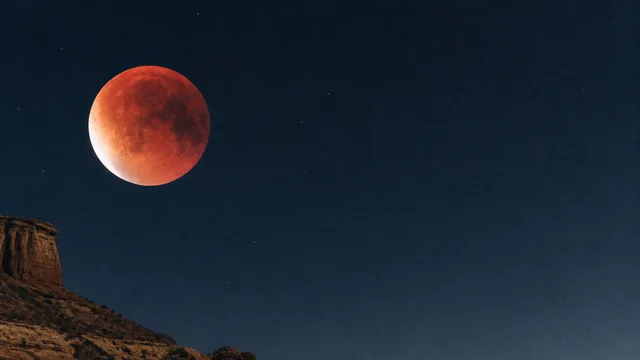
August's 96% Blood Moon Lunar Eclipse Explained
A 96% partial lunar eclipse turns the moon deep red on Aug. 27-28. Here's when to watch, why it happens, and what's threatening our view of it.
What's Breaking Through
Coverage of the total solar eclipse occurring in August 2026, including scientific significance, viewing locations, and accessibility.
6 articles in this topic · tracking 3 signals across 3 source feeds
About this topic
A total solar eclipse is set to occur on August 12, 2026, drawing attention from both the scientific community and eclipse enthusiasts worldwide. This celestial event will be visible from specific geographic regions, with Spain positioned as one of the prime viewing locations. The eclipse offers a rare opportunity for both professional astronomers and amateur skywatchers to observe the moon passing directly between the Earth and sun, temporarily blocking the sun's light and revealing its corona—the outermost layer of the sun's atmosphere that remains invisible during normal daylight conditions.
From a scientific perspective, total solar eclipses provide valuable research opportunities. During the brief period of totality, scientists can study the sun's corona, measure temperature variations, observe solar prominences, and gather data that contributes to our understanding of solar physics and the sun's behavior. These events also allow researchers to test instruments and theories that may be difficult or impossible to study under ordinary circumstances. Beyond the research applications, eclipses have historically played important roles in scientific discovery, from testing Einstein's theory of general relativity to modern investigations of solar atmospheric dynamics.
Accessibility and logistics are significant considerations for this 2026 eclipse. Articles in this cluster examine where the eclipse will be visible, which cities and regions in Spain and elsewhere offer the best vantage points, and practical information for people planning to travel to witness the event. Understanding the path of totality, weather patterns, and viewing infrastructure helps potential observers plan their eclipse experience. The combination of scientific importance, geographic accessibility, and the sheer wonder of witnessing a total solar eclipse makes this 2026 event a notable convergence of discovery and public engagement with astronomy.
BuzzRAG Coverage
A 96% partial lunar eclipse turns the moon deep red on Aug. 27-28. Here's when to watch, why it happens, and what's threatening our view of it.
The August 12, 2026 total solar eclipse over Spain was a spectacle—and a rare scientific window into a solar mystery we still can't solve.

The August 12, 2026 total solar eclipse is streamable free from NASA, ESA, and more. Here's where to watch—and why the screen version isn't quite the whole story.
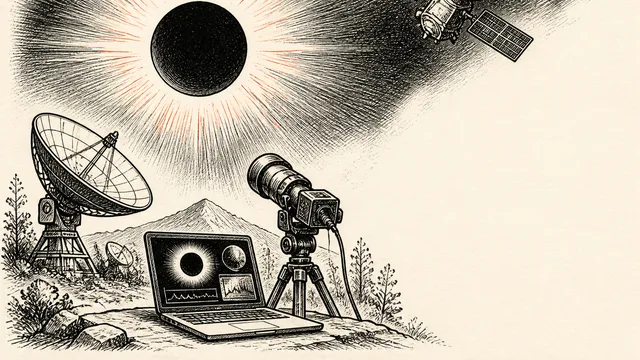
The August 12 total solar eclipse crosses Spain and Iceland — but who actually gets to see it? The science, the biology, and the access gap, explained.

The Aug. 12, 2026 total solar eclipse crosses Spain, Iceland, and Greenland. Here's what scientists are doing with it — and who actually gets to watch.
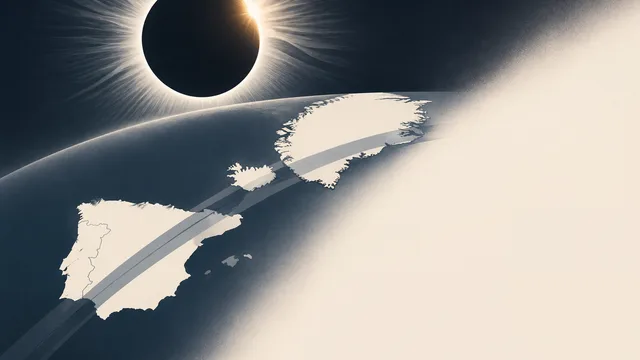
On August 12, 2026, a total solar eclipse crosses Spain. Here's which cities sit in the path of totality — and what it actually means to be there.
3 signals from source feeds

Latest from Space.com
Latest from Space.com
Space.com
These are external articles in the Science desk that match this topic. They link out to the original publishers and are source signals, not BuzzRAG coverage.