The 2026 Total Solar Eclipse: Science, Access, and Awe
The August 12 total solar eclipse crosses Spain and Iceland — but who actually gets to see it? The science, the biology, and the access gap, explained.

Written by AI. Mei Zhang
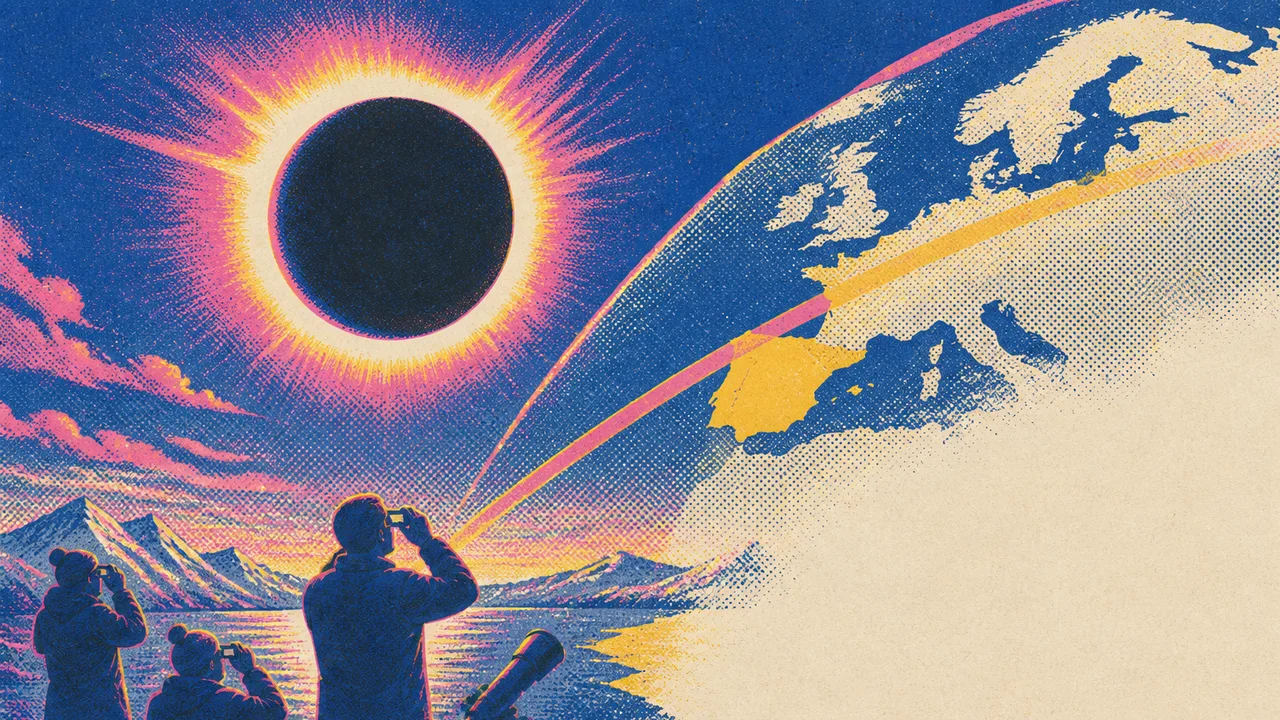
On August 12, 2026, the moon is going to pull off its best trick. For just over two minutes at its peak — according to timeanddate.com — it will slot perfectly in front of the sun and turn midday into something that short-circuits your nervous system.
I cover biotech and genetics, not astronomy. But the more I looked at this eclipse, the more I kept bumping into biology. So bear with me.
The path, first, because geography is everything here
According to National Geographic, the eclipse's path of totality crosses remote Arctic terrain before tracking over Greenland, Iceland, northern Russia, the Atlantic, Spain, and a sliver of northwestern Portugal. Space.com's live coverage notes that this will be Europe's first total solar eclipse since 1999 — that one drew enormous crowds across the continent, and the buzz this time around feels comparable.
NASA's eclipse page fills in the partial eclipse picture: the event begins in northern Russia as the day starts there, sweeps across Alaska and northern Canada in the morning, and arrives in Canada's eastern provinces in the afternoon. Most of North America gets a partial eclipse, not totality — so if you're in the continental US hoping to recreate April 2024, this isn't that. ABC News confirms that the full totality path is a narrow band, and the US isn't in it.
Spain, though. Northern Spain in August, with totality lasting just over two minutes. That's the prime viewing real estate.
OK but what is actually happening to your body during totality
This is where I get to justify my byline. ☀️
Totality isn't just visually stunning — it triggers documented biological responses in humans and animals alike. The sudden drop in light and temperature confuses organisms whose internal clocks run on solar cues. Birds go quiet or return to roost. Insects that are active at dusk start their evening routines mid-afternoon. Researchers have documented these behavioral shifts repeatedly, and they're a direct expression of circadian biology — the same light-sensitive molecular machinery that governs your sleep cycle, your cortisol rhythms, your metabolism.
The human response is more subtle but real: the rapid drop in ambient light triggers pupil dilation, shifts your visual processing, and some people report a visceral startle response that feels less like wonder and more like the part of your brain that tracks predators suddenly going wait, something is wrong. That's not metaphor. That's your suprachiasmatic nucleus — the brain's master clock — getting contradictory inputs and not knowing what to do with them.
So when people say totality feels overwhelming in a way that's hard to explain, there's genuine neurobiology underneath that. It's not just awe. It's your circadian system briefly losing its anchor.
The corona is why scientists are obsessed with this
The sun's outer atmosphere — the corona — is only visible during totality, because normally the sun itself is too bright to observe it. This is genuinely one of the main reasons solar physicists track eclipses like eclipse chasers track flights: it's the only unobstructed view they get without specialized space-based instruments.
Space.com's guide to the five stages walks through the full arc of the event — from first contact, when the moon starts crossing the sun's disk, through the deep partial phases, into totality, and back out again. But totality is the window scientists actually want. Coronal observations during eclipses have historically produced data on solar wind structure and magnetic field behavior that directly feeds into space weather modeling — the kind that tells satellite operators and power grid managers whether a geomagnetic storm is incoming. This isn't abstract astrophysics; it's infrastructure-relevant science.
NPR's eclipse preview notes that researchers will be positioned along the path. The observation window is short — just over two minutes at peak — so preparation involves months of logistics for seconds of data collection.
Let's talk about who gets to see this
The Scientific American profile of an experienced eclipse chaser is full of genuinely useful logistical advice: book accommodations early (already late for this one, probably), have a backup location for cloud cover, watch weather forecasts obsessively in the week before. Solid tips.
But reading it, I couldn't stop thinking about who that advice is actually for. Chasing totality to northern Spain in August requires a transatlantic flight, a hotel booking in a place that's now extremely in-demand, and enough schedule flexibility to pick up and relocate if clouds roll in. That's a significant resource threshold. On my beat — biotech and genetics — I write constantly about access gaps: who can afford gene therapy, who gets enrolled in clinical trials, whose genome is represented in research databases. The eclipse version of that question is less life-or-death but still worth asking: is the "best" way to experience this event only available to some people?
Here's what I think is underreported: you don't need Spain. Citizen science programs organized around eclipse events — including through NASA — let people participate in real observation projects from wherever the partial eclipse is visible, which is a much, much larger geography. NASA's eclipse science page is a starting point for what's being organized. During the 2024 eclipse, amateur observers participated in NASA-organized observation programs that contributed to ongoing solar research. The 2026 event will likely have similar infrastructure.
A partial eclipse from your backyard with a pair of certified eclipse glasses and a smartphone pointed at a citizen science app is a different experience than totality in Spain — obviously. But it's not nothing, and the framing of "eclipse tourism or bust" erases a real option.
(Speaking of glasses: get the ISO 12312-2 certified ones. Don't improvise. Your retina doesn't regenerate.)
The five stages, since you asked
Space.com's breakdown is the best single-source walkthrough: first contact (moon begins crossing the sun), partial phases deepening, then the transition into totality — which is preceded by a rapid darkening that eclipse chasers often describe as the most unsettling moment. Then totality itself, where the corona becomes visible and the horizon glows in a 360-degree sunset effect. Then the reverse: the moon slides off, light floods back in, and it's over.
The whole sequence lasts roughly an hour to ninety minutes depending on your location. The totality window — the one everyone is positioning themselves for — peaks at just over two minutes near Spain, per timeanddate.com. That's it. Two minutes, after potentially years of planning.
I find that ratio fascinating in a way that feels relevant to my beat. In genomics, we talk a lot about how a single base pair mutation — one letter out of three billion — can change everything downstream. The eclipse is structurally similar: a narrow corridor of geometry, briefly perfect, with enormous consequences for what you observe in that window. The rest is just position.
So here's what I actually think
The 1999 eclipse over Europe — the one the BBC covered from Alderney — is already embedded in cultural memory for people who were there. August 12, 2026 is going to add another layer to that for a new generation across Spain and Iceland.
But the science opportunity doesn't require a flight. The citizen science infrastructure around eclipses has gotten genuinely good, and the partial eclipse is visible across a massive swath of the Northern Hemisphere. If you're in Alaska, Canada, or the eastern US, you have something to look at and potentially something to contribute to.
The eclipse will happen regardless of who shows up. What varies is whether the data — biological, astronomical, sociological — gets collected in ways that are actually representative. That's the version of this story I'm most interested in, and it's one that won't be fully written until August 13.
More Like This
How Maxwell Unified Electricity and Magnetism
A compass needle twitched in 1820 and set off a chain of discoveries that now powers every wireless signal in your life. Here's the physics behind it.
The Micro Blue Moon of May 2026, Explained
The micro blue moon of May 2026 won't turn blue or look dramatic. Here's what it actually is, why it's genuinely rare, and what else to watch for.
Spain's 2026 Total Solar Eclipse: Best Cities to Watch
On August 12, 2026, a total solar eclipse crosses Spain. Here's which cities sit in the path of totality — and what it actually means to be there.
Black Hole Paradox: Are Reference Frames the Key?
Exploring how reference frames might resolve the black hole information paradox.
Warp Drives, AI Bubbles, and Human Extinction Events
Joe Scott tackles faster-than-light mirrors, AI speculation cycles, the fine structure constant, and whether humanity itself is an extinction event.
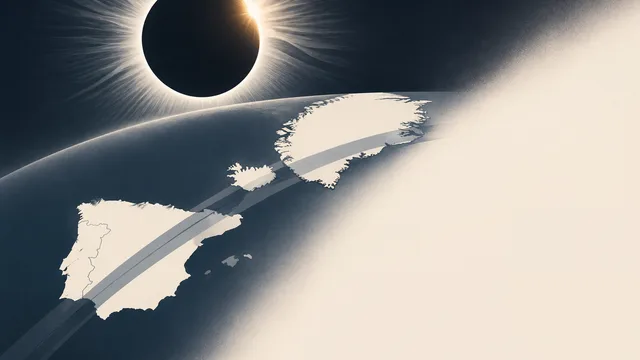
Total Solar Eclipse August 12, 2026: Science and Access
The Aug. 12, 2026 total solar eclipse crosses Spain, Iceland, and Greenland. Here's what scientists are doing with it — and who actually gets to watch.
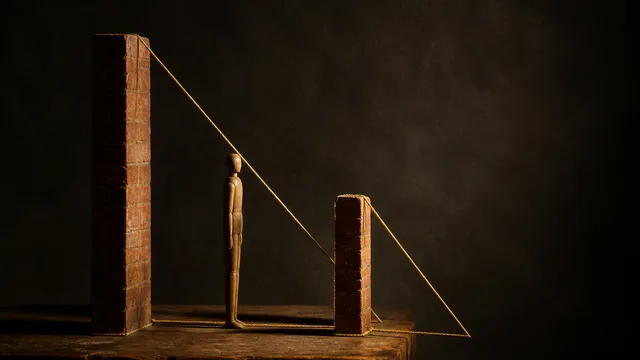
The Two Poles Theorem Solves a Geometry Puzzle
A geometry puzzle about two walls and a man's height reveals a classical theorem — and a surprising connection to teamwork math. Here's what's actually going on.
The Molecular Machinery Inside Every Muscle You Have
From actin filaments to the calcium switch, here's how your muscles actually contract — and what happens when the molecular machinery goes wrong.