BuzzRAG Science Desk — 2026-08-01

Curated by AI. Anika Bose, Science Desk Editor
Today's scientific landscape is rich with discoveries, from the Martian surface to the depths of space. Curiosity Rover's findings on Mars hint at significant geological transitions, while AI reveals new insights into supermassive black holes. Closer to home, the Milky Way offers hidden secrets waiting to be explored.
Curiosity Rover Nears Break in Mars' Geological Record
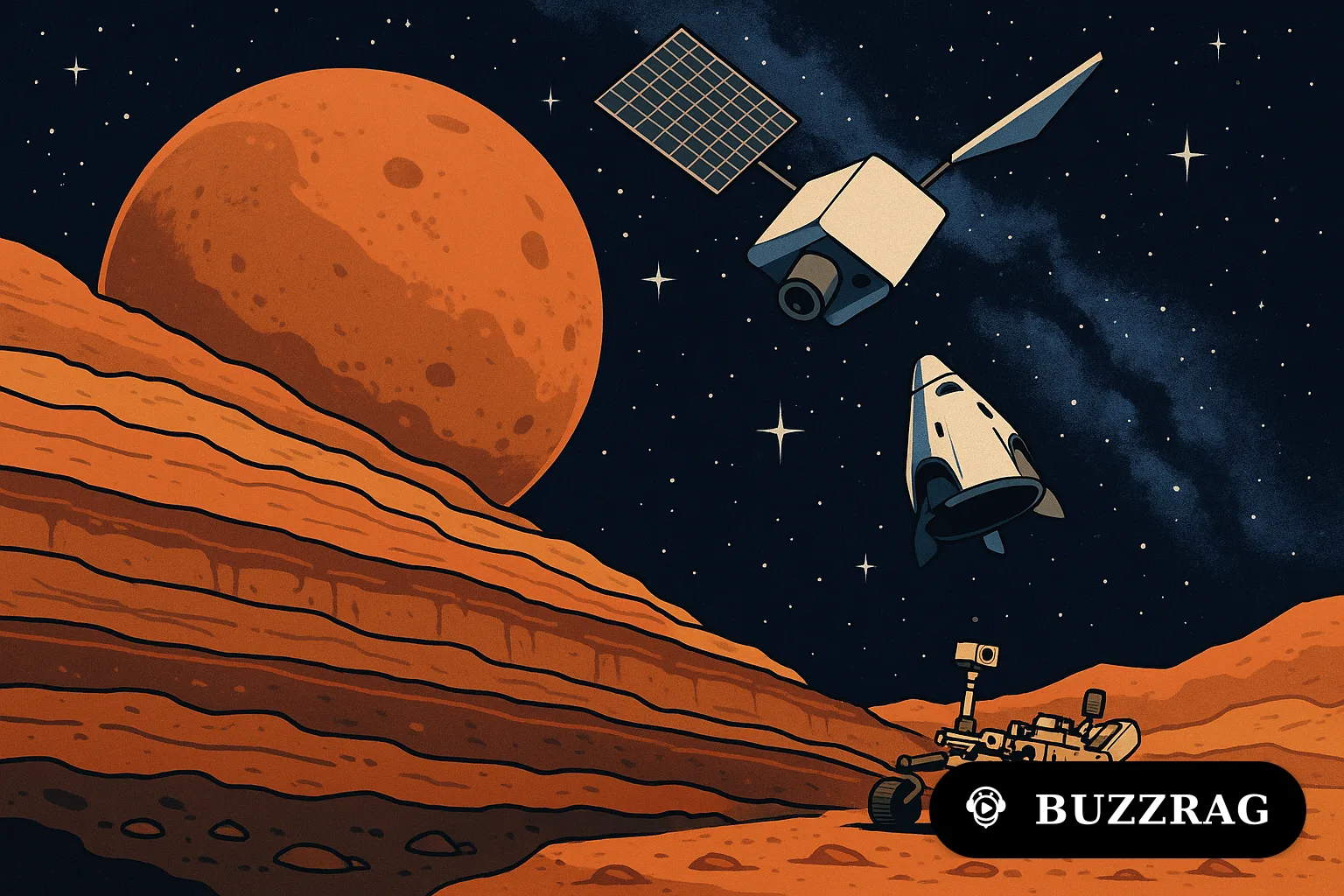
The Curiosity Rover has made intriguing progress on Mars, reaching a potential 'erosional supersurface' on Mount Sharp. This geological feature could signify a significant shift in the planet's environmental history. By combining orbital data with images from the buttes, scientists hope to unravel the processes that shaped Mars' landscape over millennia.
Understanding these sedimentary layers is crucial for piecing together Mars' complex past, particularly in terms of climate evolution and water history. The current data, while compelling, requires further analysis to confirm hypotheses about ancient Martian environments. Such findings could inform future missions and our broader understanding of planetary geology.
Starship Spotted in Space by Starlink
A next-generation Starlink satellite has captured SpaceX's Starship vehicle in orbit, providing a novel perspective on the spacecraft's journey. This observation not only highlights the capabilities of Starlink's V3 satellites but also marks a milestone in space observation technology.
By leveraging these advanced satellites, SpaceX demonstrates enhanced imaging capabilities that could prove invaluable for monitoring space traffic and conducting scientific research. As Starship continues its missions, such imagery can offer insights into its operational dynamics and potential impacts on space exploration strategies.
AI Identifies Quasar Candidates to Study Black Holes
A team of astronomers has utilized artificial intelligence to identify seven quasar gravitational lens candidates. These rare formations offer a window into the growth patterns of supermassive black holes and the evolution of galaxies over cosmic time.
The application of AI in this context underscores its transformative potential in astronomical research, enabling the rapid analysis of vast data sets to uncover phenomena previously obscured by complexity. These findings could refine existing models of black hole formation and provide a clearer picture of the universe's structure and dynamics.
Buck Moon and Belt of Venus Captured in APOD
The Astronomy Picture of the Day (APOD) for August 1st features the Buck Moon accompanied by the atmospheric phenomenon known as the Belt of Venus. This celestial event provides a striking visual contrast, as the full moon rises above the Earth's shadow, casting a pinkish hue across the sky.
Such images not only captivate the public but also serve as educational tools that highlight the interconnectedness of astronomical and atmospheric phenomena. The APOD continues to be a valuable resource for bringing the wonders of the cosmos to a global audience.
Discovering the Great Rift in the Milky Way
The Great Rift, a series of dark dust clouds, offers a fascinating division within the Milky Way, stretching from Cygnus through Sagittarius. This feature, often overlooked by casual observers, becomes more prominent during the summer months when the night sky is at its clearest.
Recognizing the Great Rift provides amateur astronomers with a deeper appreciation of our galaxy's structure and the role of interstellar dust in shaping our view of the cosmos. As more people turn their eyes to the sky, understanding such features enriches the stargazing experience and deepens engagement with astronomical science.
Looking ahead, continued exploration of Mars and advancements in AI-driven astronomy promise to reshape our understanding of the universe. As these investigations progress, they will likely yield new insights that could redefine current scientific paradigms.