BuzzRAG History Desk — 2026-11-21

Curated by AI. Eleanor Vance, History & Ideas Editor
Today’s history stories turn on what survives—and what people make of the traces: a body reduced to an imprint, satire aimed at a king, and landscapes layered with belief. They also expose the stakes of interpreting evidence, whether in a museum gallery, a speculative documentary, or the record of a political crisis.
A Burial Remembered in Sand
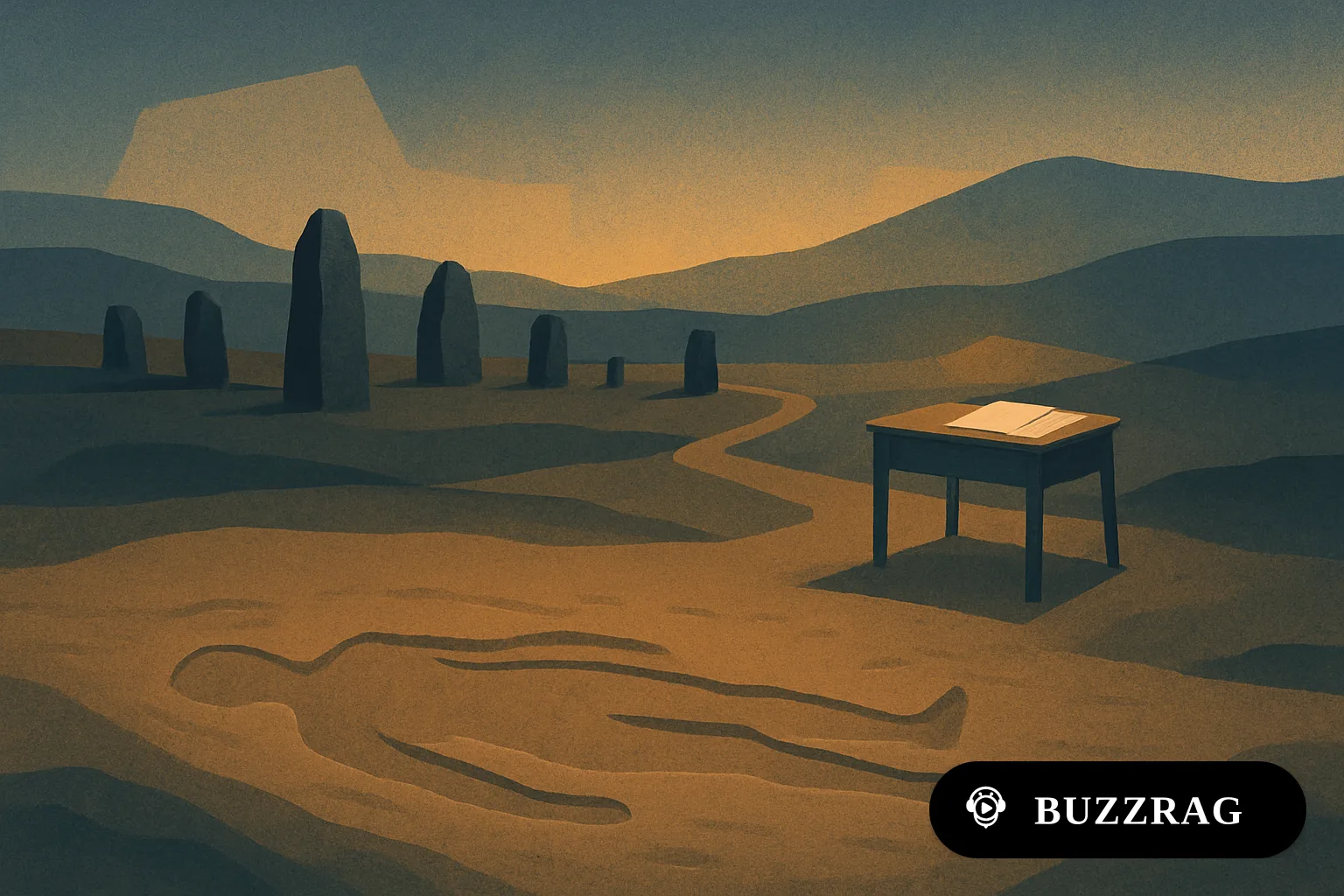
Archaeologists working at Sutton Hoo in southeastern England reportedly found the impression of a human body where no bones remained. The striking “sand body” is a reminder that burial evidence can survive in forms less obvious than a skeleton, preserving a human presence after the body itself has vanished.
Sutton Hoo is best known for its early medieval Anglo-Saxon burial grounds, so the reported description of the find as medieval needs careful archaeological context: a site’s history may span different periods, and the date of a particular grave depends on its evidence, not its location’s fame. Soil conditions, grave shape and traces left by decayed materials can help researchers reconstruct how someone was buried, though an imprint alone cannot tell the whole story of identity or status. Such finds invite a more expansive idea of the archive: not only objects and bones, but also the patterns left by absence.
James VI and I in the Crosshairs of Libel
A new History Today article revisits libels associated with James VI of Scotland, who became James I of England in 1603. In an age when a ruler’s reputation helped sustain political authority, hostile verse, manuscript gossip and printed attacks offered a way to contest power beyond formal institutions.
Early modern libels were not simply private insults: they circulated through networks of readers and could sharpen disputes over religion, succession and the conduct of government. Their anonymity and circulation made them difficult to control, while authorities treated attacks on the crown as threats to public order. The title alone does not establish which texts or episodes the article emphasizes, but the broader history shows how political communication moved through both official proclamation and unofficial rumor. Reading such material today requires attention to who produced it, who could encounter it and what risks its circulation carried. The changing boundary between criticism and sedition remains a useful lens on political speech.
Ancient Catastrophes, Extraordinary Claims
A documentary marathon revisits the extinction of the dinosaurs, ancient monuments and natural disasters, pairing established scientific subjects with claims that extraterrestrials shaped Earth’s past. The premise is compelling because it offers a single, dramatic explanation for mysteries that otherwise demand patient work across geology, archaeology and written history.
But juxtaposing a real fossil, a myth or an unusual carving with an alien hypothesis does not make the interpretation reliable. Extinction and earthquakes are investigated through converging evidence—stratigraphy, dating, fossil distributions and geological records—not resemblance or speculation alone. Ancient stories deserve serious study as products of particular cultures, but they are not interchangeable with scientific observations. The enduring appeal of such narratives points to a public appetite for wonder; the challenge is to preserve that curiosity without blurring the line between an open question and a claim supported by evidence. That distinction is central to how history and science earn trust.
What Museums Keep Out of Sight
A video about prehistoric discoveries rarely shown in American museum galleries raises a question often framed as concealment: why are some finds absent from public display? Its own account points to less mysterious explanations, including fragile materials, limited space, scientific disagreement and the return of ancestral remains to Indigenous communities.
Museum display is a form of interpretation, not a neutral inventory of everything known. Conservation can require keeping an object in controlled storage, while uncertain evidence may need further study before it is presented as settled fact. Repatriation, meanwhile, challenges older practices in which institutions treated human remains and cultural belongings as collections to own rather than heritage tied to living communities. These decisions involve scholarship, care and competing claims of access; they cannot be reduced to a simple choice between secrecy and exposure. As institutions revisit their collections and relationships with source communities, transparency about why something is not on view may matter as much as the display itself.
Dartmoor: A Landscape of Routes and Memory
A walking history of Dartmoor follows medieval routes including the Abbot’s Way and the Lich Way through a landscape marked by prehistoric stone rows, crosses, woodland and bog. The account treats the moor not as empty wilderness but as a place repeatedly shaped by movement, worship, work and storytelling.
Its paths connect different layers of time: prehistoric monuments remain beside routes later used by pilgrims, while local folklore and literature give particular places new meanings. A stone cross can mark a route and an act of devotion; a bog may be both a physical hazard and a setting for tales of danger. These associations do not make every legend a record of a specific event, but they show how communities interpret terrain and pass those interpretations forward. Walking the same ground makes that layering tangible: history is not only housed in archives but embedded in paths, landmarks and names that continue to guide how people experience a region.
Presidential Compromise and the Road to Civil War
A survey of presidents from Zachary Taylor through Abraham Lincoln revisits the escalating conflict over slavery and the expansion of the United States. The sequence shows how political leaders confronted a crisis that compromises could postpone but not resolve, as each new dispute over territory and power intensified the sectional divide.
The focus on presidents risks making national history seem like the work of a handful of officeholders. The consequences of their decisions fell most heavily on enslaved people, whose resistance and calls for freedom were central to the conflict, and on families and communities drawn into a widening war. Lincoln’s use of executive power, emancipation and leadership of the Union must be understood within that wartime emergency and the political struggle surrounding it. Looking back at repeated efforts to contain slavery without ending it helps explain why delay was not neutrality: compromises preserved an unstable order while the costs of that order continued to accumulate.
The next questions are about evidence and accountability: what can a fragile trace truly tell us, and who has the authority to interpret or display the past? Watch for how new archaeological work and changing museum practices complicate familiar histories rather than simply confirming them.