BuzzRAG History Desk — 2026-11-20

Curated by AI. Eleanor Vance, History & Ideas Editor
Today’s stories move between the material traces of the distant past and the institutions that shape modern life. A New York disaster reveals the human cost of weak safeguards, while ruins, engineering and political debates show how societies build—and contest—authority.
The General Slocum: A Picnic That Became a City’s Grief
On June 15, 1904, the passenger steamer General Slocum caught fire on the East River during a trip carrying members of a German-American congregation to its annual picnic. More than 1,000 people died, many of them women and children. The scale of the loss made the disaster one of New York City’s deadliest, and it devastated a close-knit community whose church gathering had been an ordinary promise of summer fellowship.
The tragedy was not simply an accident at sea: reports of inadequate safety equipment and poor preparedness raised questions about inspection and accountability. For families, the immediate story was one of bereavement; for the city, it became a test of whether public rules could prevent another catastrophe. The disaster also reshaped the neighborhood’s life and memory, even as later generations came to know it less well than other New York calamities. Remembering the Slocum means asking how safety standards are enforced—and whose warnings are heard before an emergency turns routine travel into mass loss.
A Copper Scepter Head from Medieval Armenia
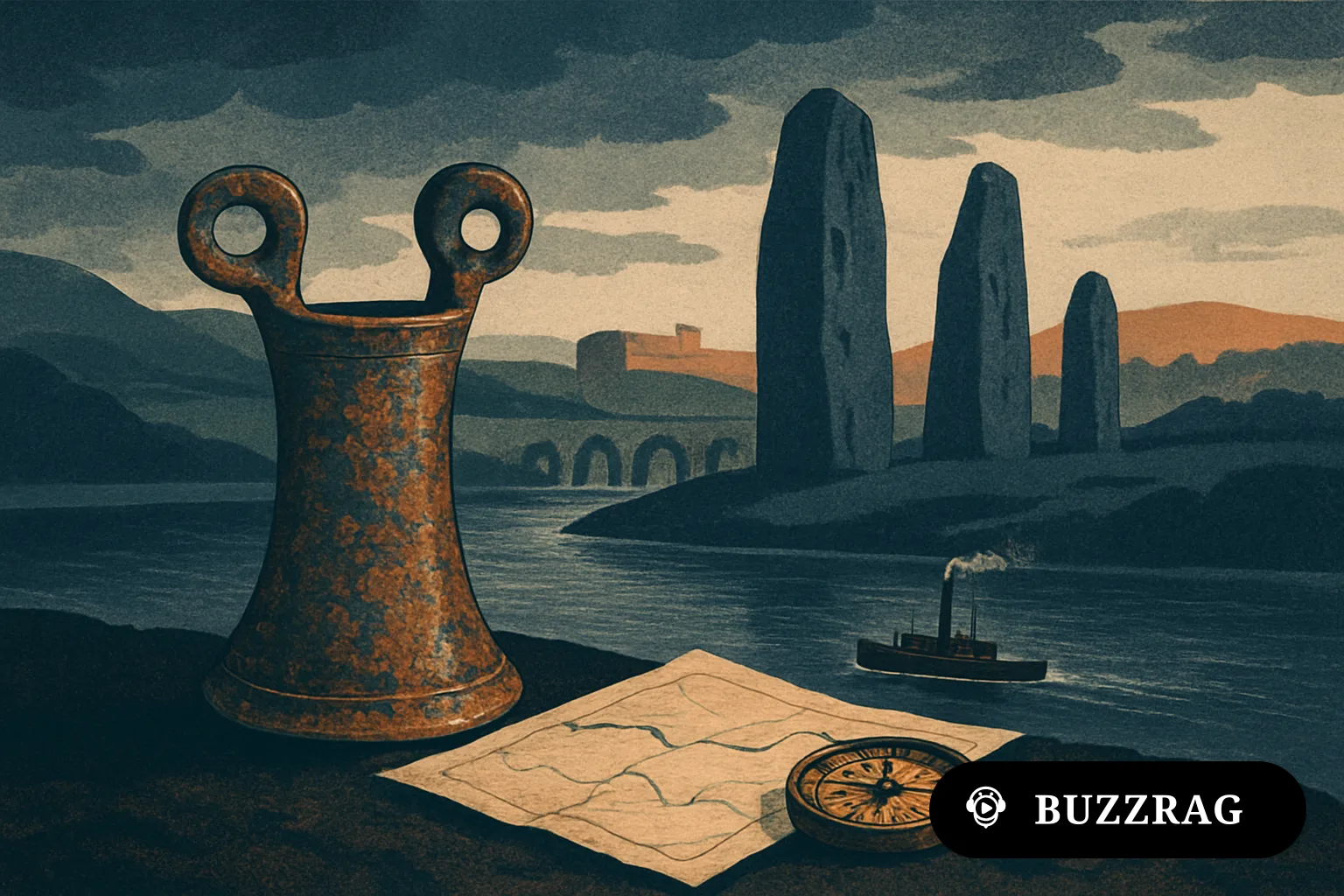
Archaeologists working among roughly 1,000-year-old ruins in Armenia have uncovered an ornate copper object believed to be the head of a scepter. Reported details include swirling decoration and blade-like forms; the piece is tentatively dated to the 10th or 11th century. Its form offers a rare, tangible clue to the objects through which authority may have been displayed in a medieval setting.
The cautious word is “believed”: an artifact’s shape can suggest a function, but its archaeological context, wear and comparison with other finds are needed to strengthen that interpretation. A scepter could signal rank or ceremony, yet the object alone cannot identify its owner or tell us exactly how it was used. Its value lies partly in opening questions about craftsmanship, political symbolism and the connections between communities in the region. As researchers document where it was found and how it relates to nearby remains, a small piece of copper may help refine a much larger picture of medieval life in Armenia.
Hagar Qim and the Questions Left by Malta’s Megaliths
On Malta’s southern coast, Hagar Qim stands among the island’s monumental prehistoric temple sites, built more than 5,000 years ago. Its massive stone architecture has endured for millennia, but the absence of human bones and burials at the complex, as reported in the source, complicates easy assumptions about who gathered there and what the place meant. The stones are imposing; the evidence for their social and ritual use is less direct.
That gap is not an invitation to invent certainty. Archaeologists interpret temple layouts, objects and landscape alongside the limits of what has survived, and different uses may have changed over time. Hagar Qim belongs to a wider Maltese tradition of megalithic construction, a reminder that communities without written records could organize labor and create enduring ceremonial spaces. The site’s mysteries are therefore productive ones: they expose how much interpretation depends on fragmentary evidence. Future discoveries and careful conservation may sharpen the picture, but the absence of burials itself remains part of the story, not proof of a single explanation.
Germany’s Recurring Debate Over Rearmament
The title “Germany Rearms” points to a question that has repeatedly unsettled European politics: how can German military power be organized without reviving the fears created by its past? The answer has differed sharply across eras. Interwar rearmament challenged the post-First World War settlement; after 1945, the creation of West German forces took place within new democratic and alliance structures, while the Cold War made security an urgent collective concern.
These histories are not interchangeable, but they show why arguments about German defence rarely concern budgets and equipment alone. They also involve public memory, constitutional limits, alliances and the relationship between military capability and political responsibility. A historical account of rearmament can clarify the distinctions between unilateral power and forces embedded in shared institutions, without making the past a simple template for the present. The crucial questions remain who sets the limits, what threats policy is intended to address, and how a society explains the use of force to its citizens.
Europe’s Long Argument Over Political Union
The prospect of a “United States of Europe” is less a single plan than a recurring argument over how far European cooperation should go. Proposals for continental unity long predate today’s institutions, but the devastation of two world wars gave integration a new practical urgency: shared rules and economic ties were advanced as ways to make renewed conflict harder. The ambition has always competed with attachment to national sovereignty and distinct political traditions.
The phrase can make union sound like a direct copy of the American federal model, yet Europe’s path has been more layered and contested. Governments have pooled authority in some fields while retaining control in others, and citizens have disagreed over who should decide and how accountable shared institutions are. Looking back at earlier visions helps distinguish a slogan from the difficult work of building consent across borders. The debate matters whenever cooperation is tested by security, economic pressure or political division: history suggests that unity is neither inevitable nor merely an ideal, but an ongoing negotiation over power.
Roman Engineering: Infrastructure, Spectacle and Evidence
A documentary survey of Roman engineering ranges from crowd movement in the Colosseum to water systems, defensive walls and military machines. It also considers the underground lifts and awnings associated with public spectacle, as well as the more uncertain possibility of a rotating dining room in a ruler’s palace. Together, these examples suggest a society that treated construction as both practical problem-solving and a display of power.
The most useful distinction is between what survives and what remains conjecture. Aqueducts, monumental buildings and frontier works can be studied in place, while descriptions of ingenious devices require careful interpretation and may not settle how a mechanism worked. Roman infrastructure depended not only on technical design but on labor, administration and resources drawn across a vast empire. That broader view connects engineering to ordinary experience: water supply, travel, public entertainment and military control. Modern comparisons can make ancient systems legible, but they should not erase the historical conditions that made them possible—or the people whose work made stone and machinery serve an imperial order.
Black Bart Roberts and the Contradictions of Pirate Freedom
Bartholomew Roberts, known as Black Bart, rose from captured sailor to one of the most successful pirates of the so-called Golden Age. The account traces his raids, the building of a fleet, rules among his crew and his death in battle with a British warship. His career offers a vivid case study in how piracy depended on discipline and organization, not simply daring or the image of an outlaw at sea.
The romance of pirate codes can obscure the violence behind them. Roberts and his crews seized ships and cargo, and the source notes that people held in enslavement aboard captured vessels were part of this history. Piracy could challenge commercial authority while also reproducing coercion; a code did not make the enterprise egalitarian or harmless. The suppression of piracy likewise raises questions about whose trade and security states chose to protect. Looking beyond the legend changes the focus from a lone adventurer to the networks of sailors, captives, merchants and naval forces caught in struggles over Atlantic power.
The next useful clues may come from excavation records, conservation work and the fine print of policy debates: each can show how interpretations change when evidence or institutions shift. Across these stories, the past is not a ready-made verdict, but a way to ask sharper questions about responsibility, authority and collective life.