BuzzRAG History Desk — 2026-09-09

Curated by AI. Eleanor Vance, History & Ideas Editor
Today’s history desk moves between remembrance and reinvention: the personal courage remembered through September 11, the stories nations tell about civil conflict, and the names by which political communities imagine themselves. Alongside those subjects, older questions about evidence, cultural gatekeeping, and the boundary between myth and observation remain strikingly current.
The Rescuer Remembered: Christopher Amoroso and the Human Scale of 9/11
As the twenty-fifth anniversary of September 11 approaches, accounts of individual courage are returning to public attention. Christopher Amoroso, a Port Authority police officer, was last seen entering the North Tower after the first hijacked plane struck, part of a rescue effort carried out amid collapsing infrastructure, smoke, confusion, and almost no reliable information about what was happening.
Remembering Amoroso is not merely an exercise in commemoration. The Port Authority police, firefighters, emergency medical workers, office workers, and bystanders who acted that morning reveal how large historical events are experienced through immediate, local decisions: whom to guide, whom to search for, and whether to move toward danger. The challenge for public memory is to preserve those human choices without reducing them to a polished legend. As anniversaries approach, the most meaningful histories will continue to pair institutional failures and geopolitical consequences with the testimony of ordinary people who made rescue their first response.
When Historical Research Finds More Than a Prop
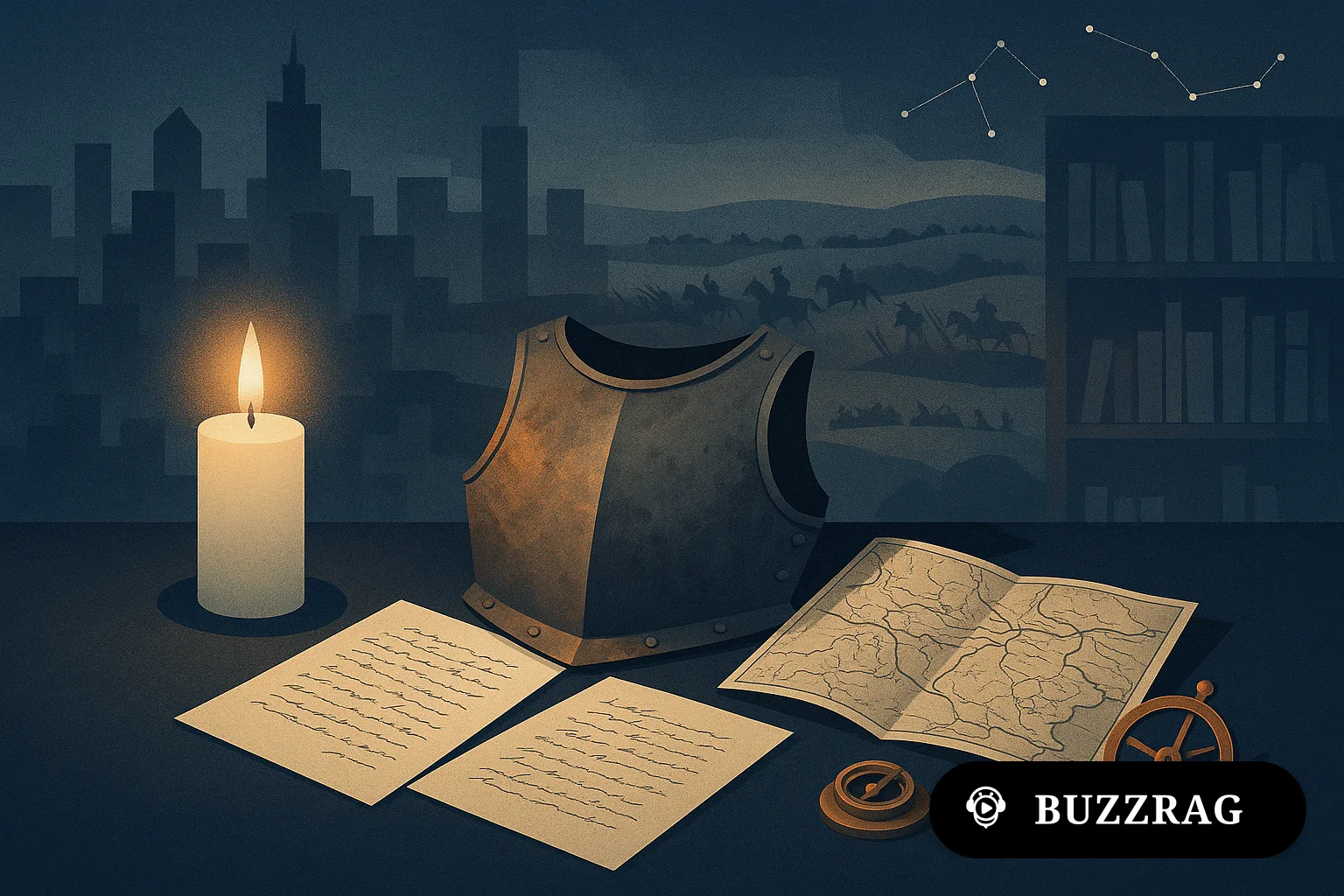
A history-themed film project in Poland produced an unexpected collision between performance and archaeology. While actors and archaeologists were excavating near Pielaszkowice Palace, the team reportedly uncovered an intact piece of nineteenth-century cavalry armor associated with the era of the Napoleonic Wars. The discovery turns a preparation exercise into a small lesson in how material history can resist scripting.
An artifact such as armor carries evidence that a dramatic reconstruction cannot fully reproduce: manufacturing methods, patterns of wear, repair, burial conditions, and the movement of military objects through landscapes. It also demands caution. Finding an object near a palace does not by itself establish who owned it or precisely how it arrived there; conservation, dating, and archaeological documentation matter as much as the excitement of the find. The episode is a useful reminder that the past is not simply a collection of stories waiting to be filmed. It is a physical record whose most revealing details often emerge when curiosity is disciplined by method.
Wilson’s Creek and the Problem of a Single Civil War View
N. Bart Pearce’s account of the Battle of Wilson’s Creek offers a Confederate-aligned perspective on the August 10, 1861, clash in Missouri. Pearce, an Arkansas militia commander, fought alongside Confederate Brigadier General Benjamin McCulloch and Missouri State Guard forces against Union troops led by Nathaniel Lyon. The battle ended in a Confederate victory and Lyon’s death, but it did not settle Missouri’s divided allegiance.
A participant’s account is valuable precisely because it is not neutral. It can preserve perceptions of terrain, fear, loyalty, confusion, and command that official summaries flatten, while also reflecting the political vocabulary and assumptions of the side that produced it. Reading Pearce alongside Union reports, civilian testimony, casualty records, and the experience of enslaved Missourians prevents “the Confederate view” from becoming the view of an entire population. Wilson’s Creek demonstrates why Civil War memory remains contested: military narratives often center commanders, while the war’s stakes were lived by communities deciding whether sovereignty, slavery, and emancipation would define their future.
Naming a Republic: The Politics Behind “United States”
On September 9, 1776, the Continental Congress formally adopted “United States” in place of “United Colonies,” giving the new polity a name that sounded both provisional and ambitious. Other suggestions circulated, including “Columbia,” “United Colonies,” and more eccentric proposals invoking continents or the earth itself. The choice was not a decorative detail; it helped define what kind of political entity the revolutionaries claimed to have created.
“United States” left the relationship between the parts and the whole deliberately open. It could describe a league of sovereign states, a common government, or—over time—a more integrated nation. That ambiguity outlasted the Revolution and became central to arguments over federal power, secession, citizenship, and national identity. Names do political work because they compress unresolved theories into familiar language. The United States was never simply discovered as a finished nation; it was repeatedly interpreted, contested, and expanded by people who disagreed over who belonged within the word “united.”
The Bookseller’s Quiet Power Over What Gets Read
Andrew Pettegree’s history of bookselling follows the people and systems that have carried books from producers to readers across five centuries. Apprentices, traveling carriers, shopkeepers, publishers, cataloguers, and now digital recommendation systems have all helped determine which texts become visible, affordable, and culturally durable. The history of reading, in other words, is also a history of distribution.
That perspective complicates the comforting idea that books succeed solely because of their intrinsic importance. Shelf space, credit networks, postal routes, censorship, pricing, education, and commercial judgment have always shaped the public’s access to ideas. Today’s algorithms inherit that gatekeeping role while making it less visible: a recommendation feed can resemble a bookseller’s advice, but it operates at immense scale and is often optimized by opaque commercial incentives. Looking backward at the shop counter helps clarify what is new and what is not. The technology has changed; the struggle over attention, access, and cultural authority has been a permanent feature of literary life.
Thaddeus Stevens and Reconstruction’s Unfinished Settlement
Thaddeus Stevens, the Pennsylvania congressman and Radical Republican, treated Reconstruction as a chance to remake the political and economic order after slavery. He supported federal protection for freedpeople, Black voting rights, and the redistribution of land from former Confederates, arguing that emancipation without security would leave formerly enslaved people vulnerable to coercion and dependence.
The retreat from that program after the Civil War was not inevitable, but it was powerful. Presidential resistance, white supremacist violence, Northern political fatigue, court decisions, and the restoration of Southern elites narrowed Reconstruction’s possibilities. Land redistribution largely failed, while constitutional amendments established rights that enforcement did not reliably protect. Stevens’s legacy therefore lies less in a completed revolution than in a question: can formal freedom survive when economic power and public safety remain controlled by those who opposed it? Contemporary debates over voting access, racial wealth, federal responsibility, and democratic protection still revisit the settlement Reconstruction never secured.
Dragons, UAPs, and the Discipline of Historical Evidence
Ancient stories of dragons, sky serpents, fiery apparitions, and metallic beings are increasingly being recast as possible reports of unidentified aerial phenomena. The comparison is tempting because both modern witnesses and ancient storytellers describe encounters that seem to exceed ordinary experience. But resemblance is not proof, and the historical record is more complicated than a catalogue of early sightings.
Translation is the first obstacle: words for spirits, omens, clouds, beasts, weapons, and celestial signs do not map neatly onto modern categories such as aircraft or extraterrestrial craft. Genre matters as well. A royal omen, a religious myth, a poetic metaphor, and a witness report follow different conventions and make different claims about reality. Historians can take these accounts seriously without treating them as technical observations. They reveal how societies interpret uncertainty, authority, danger, and the sky. The strongest inquiry asks not only what an ancient writer saw, but what their culture made it possible—and meaningful—to say they had seen.
The next anniversary cycle will test whether public memory can remain personal without becoming simplistic, while debates over archives, algorithms, and historical evidence will keep widening the meaning of “the record.” Watch especially for the ways institutions decide which voices become testimony, which artifacts become heritage, and which interpretations acquire the force of fact.