BuzzRAG Growth Desk — 2026-09-09

Curated by AI. James Emeka, Personal Development Editor
Today’s growth conversation is less about squeezing more from yourself and more about seeing clearly: which commitments still serve you, which stresses need proper support, and where popular wellness claims outrun the evidence. The lineup also moves from the psychology of everyday decisions to emerging research on mental health and sobering reminders about physical risk.
When Past Investment Starts Making the Decision
The sunk-cost fallacy keeps people committed to a failing plan because they have already spent time, money, effort, or emotion on it. The latest episode uses that familiar trap as a starting point, pairing it with a related question: why do people struggle to prepare for emergencies even when the consequences are obvious?
The practical correction is simple but not always easy: evaluate the next decision using future costs and benefits, not unrecoverable investments. For emergency planning, the obstacle is often psychological rather than informational. People discount low-probability risks, prefer the comfort of the present, and avoid imagining disruptive scenarios. A short checklist, an emergency fund target, backup contacts, or a household plan can turn vague anxiety into a manageable task. The useful lesson is not to eliminate uncertainty, but to make preparation small enough to happen before urgency takes over.
Why Familiar Good Things Fade From View
Habituation is the mind’s tendency to respond less intensely to stimuli that remain stable and familiar. That mechanism helps us avoid being overwhelmed by constant input, but it can also make relationships, privileges, surroundings, and ordinary sources of pleasure feel invisible until they disappear.
The answer is not forced gratitude or a permanent hunt for novelty. Deliberate attention can interrupt the fade: vary routines, notice specific details, spend occasional time away from a valued person or place, and record what is working before a crisis makes it obvious. These practices are modest, and they should not be sold as cures for dissatisfaction or loss. Their value is that they restore information the brain has begun filtering out. The broader implication is useful for personal development: appreciation is partly an attentional skill, not merely a feeling that arrives on its own.
Misophonia May Be More Than Extreme Irritation
New research discussed by Dr. Hansen supports the idea that misophonia may have a distinct neural signature rather than being simply an exaggerated dislike of certain sounds. People with the condition can experience intense emotional and physiological reactions to triggers such as chewing, breathing, or tapping, even when they understand that the sound is harmless.
A neural signature is an important research finding, not a complete diagnostic test or a guarantee of a single treatment. The field still needs larger, replicated studies that clarify causes, overlap with other conditions, and which interventions help most. That distinction matters because sufferers are often dismissed as rude, oversensitive, or difficult, while shame can make daily environments and relationships harder to navigate. Clinicians and families should take the distress seriously without turning one study into a definitive explanation. If reactions interfere with work, sleep, or relationships, professional assessment is more useful than internet-made exposure challenges or simplistic advice to “just ignore it.”
The Complicated Search for Relief in Midlife Anxiety
Benzodiazepines and kratom occupy very different places in medicine and regulation, but they can enter the same personal story: someone wants rapid relief from anxiety, insomnia, or emotional distress. The item raises a necessary question about what happens when symptom suppression becomes the whole treatment plan rather than one part of understanding the problem.
Benzodiazepines can carry risks including sedation, dependence, withdrawal, impaired coordination, and dangerous interactions with other substances. Kratom is not a risk-free alternative; its products vary, evidence for treating anxiety is limited, and adverse effects and dependence have been reported. None of that means people should abruptly stop a prescribed medication or manage withdrawal alone. A safer framework is collaborative care: review substances and prescriptions with a qualified clinician, assess underlying anxiety, trauma, depression, sleep, or medical contributors, and consider evidence-based psychological and behavioral treatments. Relief matters, but so does avoiding a new problem while pursuing it.
Making Overwhelm Smaller and More Specific
Feeling overwhelmed is not always a scheduling problem. It can come from absorbing an endless stream of news, responsibilities, other people’s distress, and imagined future demands until the mind treats everything as equally urgent. In that state, another productivity system may add friction instead of reducing it.
A more grounded response is to shrink the field of attention. Separate immediate obligations from concerns that can be revisited later; choose one next action; define what “enough” looks like; and create deliberate limits around information intake and availability. This is not an argument for indifference or withdrawal from legitimate responsibilities. It is a recognition that attention and emotional energy are finite resources. Persistent overwhelm, hopelessness, panic, or major changes in sleep and functioning deserve mental-health support rather than a better to-do list. The goal is not to carry the whole world more efficiently, but to identify what is genuinely yours to carry today.
What Structured Climbing Research Can—and Can’t—Show
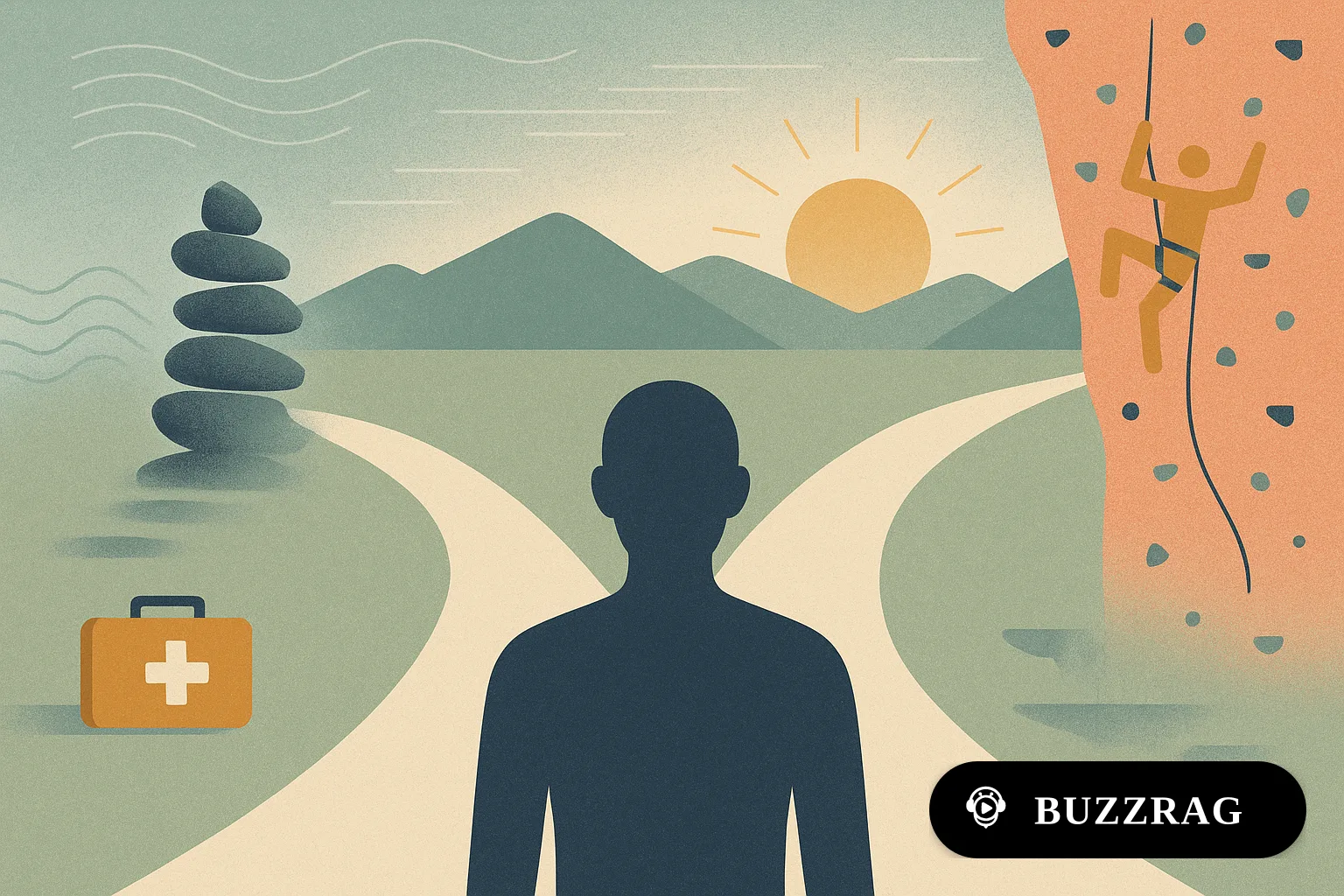
New research on structured bouldering therapy reports meaningful reductions in anxiety and depression, adding to growing interest in exercise as part of mental-health care. Climbing combines physical exertion, problem-solving, graded challenge, and social contact, all of which could help interrupt rumination and create a clear sense of progress.
The important qualifier is structure. A study of supervised or deliberately designed climbing sessions does not prove that casual climbing works for everyone, nor does it replace established treatment for depression or anxiety. Results need to be interpreted alongside sample size, comparison groups, follow-up duration, and whether benefits persist. Exercise can be a valuable complement, but access, injury risk, cost, fear of heights, and physical limitations matter. People interested in trying it should begin at an appropriate level with competent instruction and treat worsening mood or safety concerns as reasons to seek professional help, not as evidence that they simply failed at the activity.
A Sobering Reminder That Outdoor Progress Needs Risk Management
Access to Maroon Peak has been closed after a second climber died in less than a week, according to the report. The deaths and rescue operation underscore how quickly a demanding objective can shift from a personal challenge to a serious emergency, particularly in steep, exposed, and changing mountain terrain.
The immediate priority is respect for the deceased, their families, rescuers, and local officials managing the closure. For everyone else, the lesson is not to turn tragedy into motivational content. Mountain readiness involves honest assessment of skill, conditions, route-finding, equipment, partners, turnaround times, communication, and the ability to retreat before a plan becomes unsafe. Experience and confidence reduce some risks but do not cancel objective hazards such as rockfall, weather, altitude, or a consequential fall. Closures should be treated as safety information, not an inconvenience to work around. Outdoor ambition is healthiest when preparation includes the discipline to change plans.
The thread connecting today’s stories is calibrated judgment: notice what the mind filters out, question what evidence actually supports, and make safety part of the plan rather than an afterthought. Next, watch for stronger replication of mental-health exercise research, clearer clinical guidance for misophonia, and practical approaches that reduce distress without promising instant fixes.