BuzzRAG Culture Desk — 2026-09-07

Curated by AI. Mateo Ruiz, Arts & Culture Editor
Today’s cultural conversation is drawn to the overlooked: underground bands, handmade publishing, regional music traditions and ecosystems hiding in plain sight. Across film, podcasts and biography, there is also a shared suspicion of easy narratives — whether they concern alien abduction, heroic genius or the supposedly dull waters of the North Sea.
The Yummy Fur on the value of taking time
The Yummy Fur’s latest conversation turns on a deceptively unfashionable idea: that creative work sometimes needs room to breathe. The band’s reflections place patience, reconsideration and the long aftermath of making music against a culture that increasingly rewards instant output and constant visibility.
That makes the interview feel relevant beyond one group’s history. The Yummy Fur belong to a musical tradition in which awkwardness, wit and unfinished edges can be more valuable than polish, and where influence often travels through devoted listeners rather than mass attention. Their insistence on thinking time offers a useful counterpoint to the frantic pace of contemporary culture, where artists are expected to perform both their work and their personalities without pause. The conversation is ultimately less a nostalgia trip than an argument for artistic space: the freedom to stop, assess and return with something stranger or sharper.
Hong Kong’s playful war on true-crime certainty
Unidentified Murder uses a missing schoolkid, an alleged alien encounter and the machinery of true-crime influence to build a deliberately unstable comedy. The low-budget film follows childhood friends whose account of what they witnessed keeps pushing against the audience’s desire for a clean explanation.
Its target is not simply internet sleuths, but the broader appetite for turning trauma into content. By treating wannabe investigators and influencers with affection rather than outright contempt, the film finds comedy in the gap between genuine curiosity and the performance of certainty. Its intricate structure also makes form part of the joke: every new layer of storytelling complicates the last. In a media environment crowded with amateur detectives and monetised mystery, this Hong Kong caper has a timely question to ask — who owns a story when everyone wants to narrate it?
The podcast that reopens the Austin Tice case
A new podcast examining the disappearance of journalist Austin Tice brings renewed attention to a case that has remained unresolved for 14 years. Its suspense is grounded not in the pleasures of a puzzle, but in the human and political consequences of a reporter vanishing while working in Syria.
The programme’s importance lies in the way investigative audio can assemble fragments that conventional news cycles leave behind: testimony, records, competing accounts and the passage of time itself. Tice’s disappearance also sits within a transformed Syrian landscape, making any new evidence inseparable from the region’s shifting political realities. The best true-crime and investigative podcasts know that narrative momentum must not eclipse responsibility; here, the real test will be whether the series produces understanding rather than merely another bingeable mystery. The same weekly selection’s lighter offerings, including a musical take on a classic novel, underline audio’s remarkable range.
The biography that refuses to sanctify genius
Graham Farmelo’s Hawking presents the celebrated physicist’s achievements alongside an account of the difficult, selfish and narcissistic behaviour that public admiration has often softened. The result is a biography willing to examine how easily intellectual brilliance becomes a shield against ordinary moral scrutiny.
That tension matters because the worship of genius is not confined to science. Cultural institutions routinely turn exceptional talent into a form of absolution, discouraging criticism while the subject is alive and sometimes insisting on reverence even after death. A more candid portrait does not diminish Hawking’s scientific contributions; it makes the record more complete. It also raises a broader question about how biographies should handle reputations built by institutions, colleagues and audiences who may have benefited from the myth. The book arrives as a useful corrective to the idea that complexity is an attack, rather than the minimum requirement of serious cultural history.
The zine’s stubborn, stapled afterlife
James Brown’s reflection on the age of the zine begins with a modest physical detail: the occasional staple. That small piece of hardware becomes a symbol of publishing made by hand, on limited resources and according to priorities that do not need to satisfy a platform, advertiser or algorithm.
Zines have never been merely quaint paper objects. They are tools for building scenes, circulating difficult ideas and giving marginal voices a means of address outside established media. Their roughness can be a form of editorial freedom: fewer pages, fewer permissions and less pressure to pretend that every thought is a finished product. In an era of infinite digital distribution, the zine’s constraint becomes its strength. A stapled booklet has a beginning and an end, a maker and a reader, and a physical trace of participation. Brown’s praise lands as a defence of cultural friction — the useful resistance of making something that cannot be endlessly refreshed.
Algerian gasba, alive in the present tense
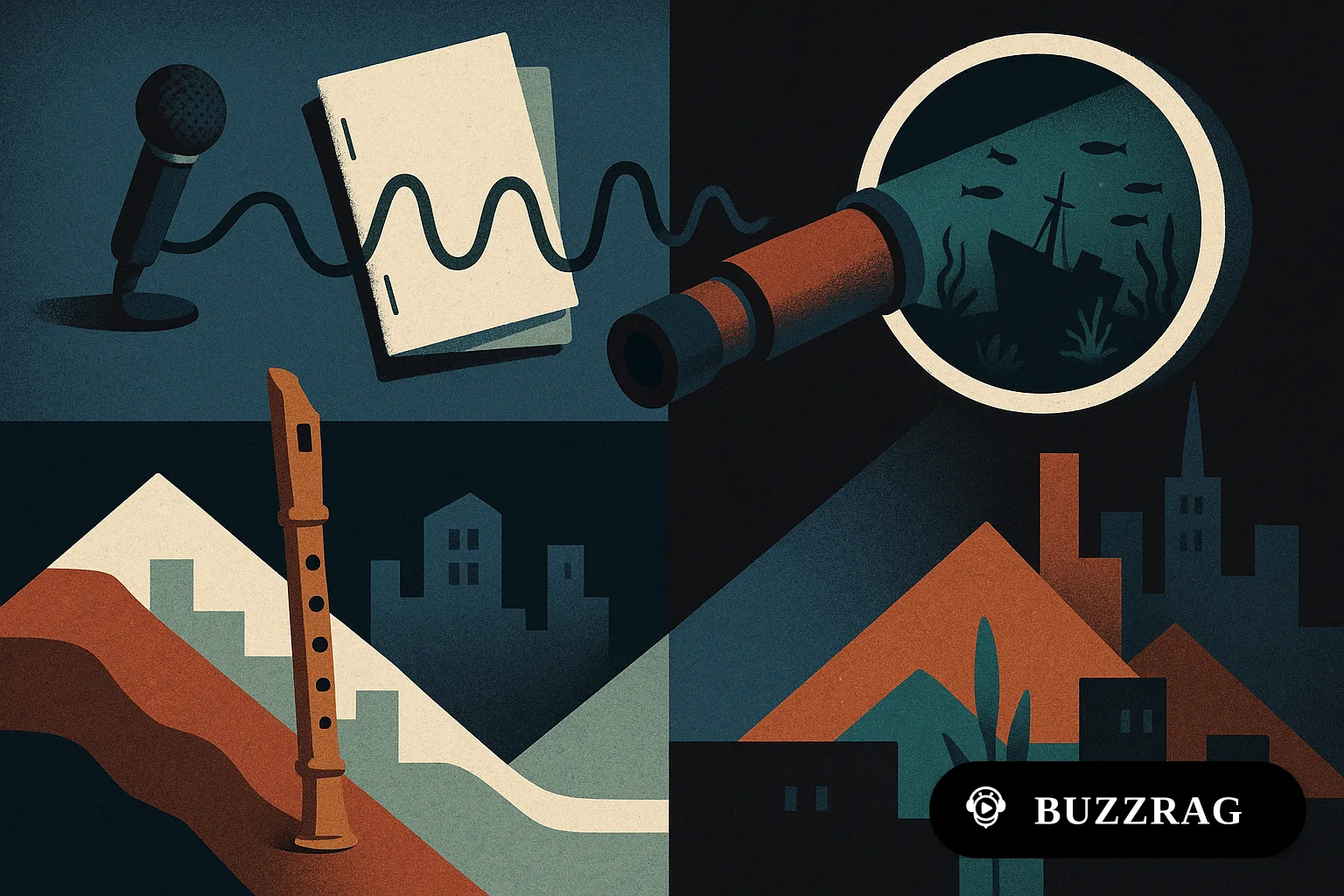
My Heart is Dust Before Him: 21st Century Gasba gathers contemporary Algerian music around the gasba, a traditional reed flute whose sound carries both intimacy and bite. The compilation presents the form not as a museum piece, but as a living practice moving through modern recording, changing communities and current emotional realities.
That distinction is crucial to how traditional music is heard outside its own context. Too often, regional styles are packaged as heritage, stripped of their present-tense urgency and treated as evidence of a frozen past. A contemporary gasba collection instead asks listeners to hear continuity and change at once: breath, ornament and local memory meeting the conditions of the twenty-first century. Its title suggests devotion and surrender, but the music’s larger significance is more expansive — a reminder that preservation works best when it leaves room for artists to alter, complicate and extend what they inherit.
The North Sea, seen beneath its grey surface
A new documentary looks beneath the North Sea’s notoriously unglamorous surface to reveal a kaleidoscopic marine world of plankton blooms, seals, sharks, tuna, orcas and shorthorn sculpins. Its filmmaker approaches the water not as an empty industrial backdrop, but as a stage crowded with drama and life.
The achievement is partly technical: sediment and plankton make the sea difficult to film, so every clear image carries the sense of a hard-won encounter. But the documentary also challenges a visual habit, the assumption that beauty belongs elsewhere — in tropical reefs, pristine coastlines or postcard-blue water. By letting marine animals become the film’s stars, it shifts attention from spectacle imposed on nature to attention earned through observation. That change in perspective has ecological weight. The North Sea is a working, pressured environment, and making its hidden life visible can turn abstract concern into something more immediate and difficult to ignore.
The through-line today is a refusal to confuse visibility with value: the loudest story, smoothest image or most celebrated mind is not automatically the most revealing. Next, watch for whether these works convert renewed attention into deeper listening — to artists, witnesses, ecosystems and traditions that have too often been flattened into content.