Yitang Zhang and the Twin Prime Breakthrough
How a Subway bookkeeper-turned-lecturer cracked a problem the world's top mathematicians declared impossible—and what it revealed about prime numbers.

Written by AI. Nadia Marchetti

Photo: AI. Aiyana Stone
On the morning of April 17, 2013, the Annals of Mathematics—one of the most prestigious journals in the field—received an unsolicited email claiming to contain a proof of one of the oldest open problems in number theory. The editors did what any reasonable gatekeeper would do: they sent it to a referee, essentially expecting a polite rejection letter by sundown.
They didn't get one.
The proof held. And the man who wrote it had, until recently, been keeping the books at a Subway sandwich shop.
This is the story Veritasium unpacks in a recent 41-minute deep dive on the twin prime conjecture—a problem mathematicians have been chasing for roughly two millennia, depending on who you ask. It's a story about mathematical culture, institutional groupthink, and what happens when someone attacks an "impossible" problem without first being told it's impossible.
The Problem Itself Is Almost Insultingly Simple to State
Twin primes are pairs of prime numbers separated by exactly two: (3, 5), (11, 13), (17, 19). They appear all the way up the number line—past a million, past a billion, past numbers so large they'd require 260 pages just to print. The largest known twin prime pair, as of recent record, consists of numbers each 388,342 digits long.
The conjecture: there are infinitely many of them. You never run out.
That's it. That's the whole problem.
The maddening part is that we have excellent evidence for it. A 1923 heuristic developed by Hardy and Littlewood predicts the count of twin primes up to any given number with astonishing precision—by one trillion, the estimate is off by only 0.001%. The primes keep appearing, the pairs keep appearing, the pattern holds.
But as Terence Tao put it in the video, a heuristic isn't a proof. For all we can demonstrate rigorously, there could be "a vast conspiracy that every time a number n decides to be prime, it has some secret agreement with its neighbor n+2 saying, 'You're not allowed to be prime anymore.'"
What we need is an airtight argument that no such conspiracy exists.
A Century of Near-Misses
The honest history of the twin prime conjecture is a history of people almost getting there.
Viggo Brun, a Norwegian mathematician working in wartime isolation in the early 20th century, adapted an ancient prime-counting tool—the Sieve of Eratosthenes—to search not for individual primes but for twin prime pairs. His method was clever, but it hit a fundamental wall: the more factors you sieve by, the more rounding errors accumulate, and those errors eventually swamp the signal you're trying to measure. Brun's workaround was to sieve less aggressively, which controlled the error but at a cost. His result: there are infinitely many pairs of numbers two apart where each number has at most nine prime factors. Not quite twin primes, but a start.
Over the following decades, mathematicians chipped that number down—nine prime factors to seven, to three—until Chen Jingrun proved in 1973 that there are infinitely many primes p where p+2 has at most two prime factors. One step away. Tantalizingly close. And then, for decades, stuck.
The second major line of attack came in 2005, when Goldston, Pintz, and Yıldırım (GPY) proved something genuinely shocking: primes infinitely often come arbitrarily close together, expressed as an arbitrarily small fraction of the average gap between them. This sounds weaker than Chen's result, but it opened a different door. If you could push their method just slightly further—past a specific numerical threshold called the "level of distribution," theta = 1/2—you wouldn't just get primes getting close. You'd get primes within a fixed, finite distance of each other. A bounded gap. A concrete number.
That was the prize. And in 2005, the American Institute of Mathematics convened a week-long meeting of every major expert on the problem, explicitly to cross that threshold.
They concluded it was impossible.
The Person Who Wasn't at the Meeting
Yitang Zhang grew up in China, earned a PhD in the United States, and then spent seven years doing odd jobs—including keeping the books at a Subway restaurant—because he never secured the recommendation letters needed to break into academic mathematics. He drove to the local library in his spare time to read number theory papers. When a friend eventually helped him land a lectureship at the University of New Hampshire in 1999, he finally had the space to work on what he actually cared about.
By 2010, he had decided his target was bounded gaps between primes. He spent two years internalizing the GPY framework, working at it from every angle he could find.
He wasn't at the 2005 meeting. He didn't know it was impossible.
In the summer of 2012, burned out and stuck, Zhang visited a friend in Colorado. One evening, waiting to leave for a concert, he stepped outside into the backyard. No specific prompt, no whiteboard—just him and a field. And the answer came to him.
GPY's approach required tracking primes across arithmetic progressions with all kinds of step sizes, and the error terms from that tracking were what kept the weighted average below the critical threshold. Zhang realized he could restrict his attention to a special class of step sizes—those built only from small prime factors—and reorganize the error terms so that most of them canceled out. This let him push past the theta = 1/2 barrier by a margin of exactly 1/584.
It sounds almost comically small. It was enough.
Zhang spent the following year writing up the proof. His stencil, in the final version, had 3.5 million slots spread across a span of 70 million. By proving that two of those slots would always catch primes, he established a bounded gap of 70 million—meaning there are infinitely many pairs of primes no more than 70 million apart.
The referees at the Annals, expecting to find an error in an afternoon, found nothing. One researcher described the experience of reading it as like watching someone lay carpet in a room, anticipating every corner that would cause a problem—and finding it cut perfectly each time.
"It was basically an unknown in the field," one expert in the video recalls. "I actually thought when I started reading Yitang Zhang's paper and started realizing it was probably correct—I thought it was probably one of the people I knew under a pseudonym."
What Came After
The mathematical community, once it absorbed the shock, moved fast. Terence Tao organized an open collaborative effort called Polymath, and researchers around the world spent months grinding the bound downward—from 70 million to 4,680 in relatively short order.
Simultaneously, a young postdoctoral researcher named James Maynard, fresh from his Oxford PhD, had been independently developing a completely different approach. His adviser had told him not to work on bounded gaps full-time because he was "pretty confident you're going to fail." Maynard ignored the advice, and within a few months had brought the gap down to 600 using a method that also, as a side effect, proved you could trap three primes in a bounded window, not just two.
The bigger revelation was structural: Maynard's method didn't depend on the theta = 1/2 threshold at all. The barrier that had stopped GPY and convinced an entire conference room of experts that the problem was unsolvable turned out to be, in the words of one researcher in the video, "a pure mirage. A red herring."
That is perhaps the most unsettling detail in the whole story. The consensus wasn't just wrong—it was wrong about why it was wrong.
Maynard and Tao's Polymath group ultimately pushed the bound to 246, where it currently stands. Under certain conditional assumptions about the distribution of primes, it can be brought down to 12, or even 6. Without those assumptions, 246 is the world record.
Zhang received the MacArthur Genius Grant in 2014. Maynard received the Fields Medal in 2022.
The Open Question That Remains
The twin prime conjecture—that the gap can come down all the way to 2—is still unproven. The distance between 246 and 2 is not large in everyday terms, but in mathematics it represents an unknown gulf. Every expert the Veritasium video consulted believes the conjecture is true. None will commit to when, or whether, a proof is reachable with current tools.
"It clearly needs a really big idea," one mathematician says. "But maybe it only needs one big idea."
What's notable about this whole arc is less the mathematics than the epistemology. A field full of experts declared a problem impossible. An outsider—someone who had been genuinely outside the professional and social networks of the field, in the most literal sense—didn't get the memo, kept working, and found the way through. And then the field's openness to anonymous submissions meant his proof was evaluated purely on its merits, without his biography working against him.
Whether that's a vindication of mathematics as an institution, or an indictment of how groupthink works even among the world's sharpest minds, probably depends on which part of the story you find harder to shake.
— Nadia Marchetti, Unexplained Phenomena Correspondent, BuzzRag
More Like This

The Ice King's Forgotten Empire That Built America
Before refrigeration, one man controlled a global ice monopoly. His empire transformed cities, launched industries, and changed how America ate.
The Simplest Question Mathematics Still Can't Answer
Fields Medal winner James Maynard explains why prime numbers—the atoms of arithmetic—remain deeply mysterious despite centuries of study.

Exploring Time: From Strobe Photography to Trillion FPS
Dive into the world of high-speed imaging, from Edgerton's strobe to modern trillion FPS cameras.
Riemann Hypothesis: Cracking Prime Mysteries
Explore how the Riemann Hypothesis might reveal the hidden order of prime numbers and its implications for the universe.

Conway's Soldiers: A Checkerboard Proof of Impossibility
Conway's Soldiers is a deceptively simple game that no one can win — not with infinite pieces. Here's the golden ratio proof that seals the deal.
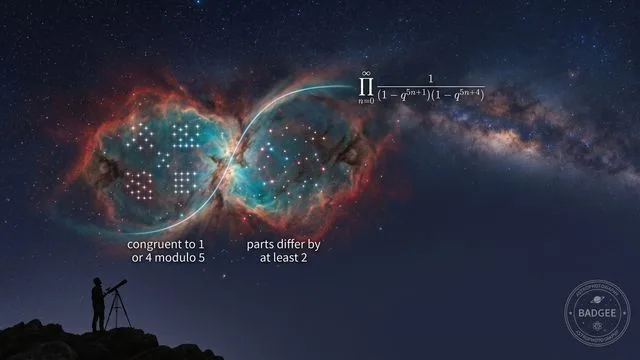
The Rogers-Ramanujan Identity: Beauty in Partition Theory
A math professor's classroom moment reveals why the Rogers-Ramanujan identity—linking partition types through generating functions—is genuinely surprising and beautiful.

Solar Flares, Earth's Magnetosphere, and StormWall
Recent X-class solar flares and CMEs have prompted serious discussion about Earth's space weather vulnerability—and a theoretical plasma shield called StormWall.

Microsoft Majorana 2: Bold Claims, Thin Evidence
Microsoft's Majorana 2 chip promises a 1,000x reliability leap and a 2029 quantum computer. Scientists say the paper doesn't back any of it up.