William Shatner’s Metal Debut Tests Genre’s Borders
William Shatner’s six-song metal debut mixed spoken-word covers, originals and veteran collaborators, raising questions about age, genre and authenticity.

Written by AI. Zoe Kim
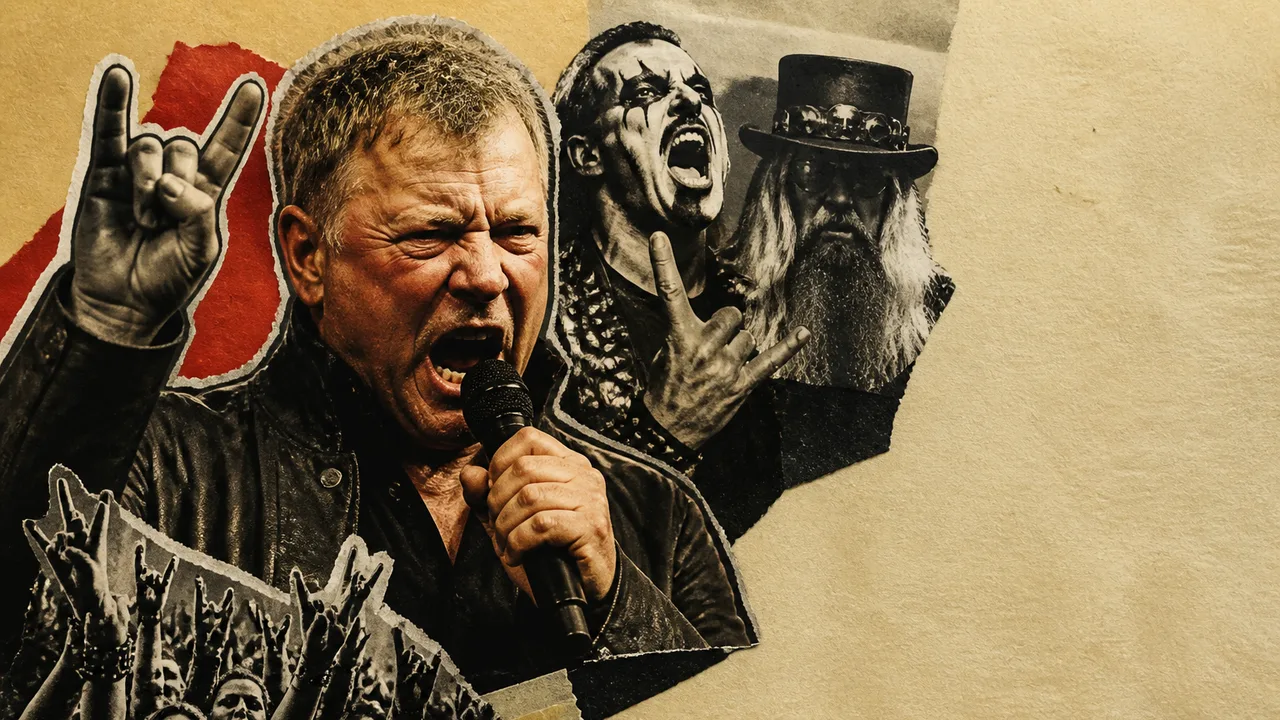
William Shatner made his heavy metal live debut at age 95 on September 19, playing six songs with The *uckers at Chicago’s Park West.
The warm-up show, staged before a scheduled Riot Fest appearance the following day, paired three enormous covers with three originals from Shatner’s forthcoming Cleopatra Records album, What the F Is Heavy Metal? The covers were Ozzy Osbourne’s “Crazy Train,” Motörhead’s “Ace of Spades” and Metallica’s “Enter Sandman.” That is essentially the heavy metal starter pack, except your substitute teacher is Captain Kirk and he has brought distortion pedals.
Yet the performance presents a more interesting question than whether celebrity metal is funny. Shatner delivered the lyrics as spoken drama while an experienced band handled the instrumental force, according to Consequence’s account of the show. That division of labor makes the project unusually easy to dismiss as kitsch. It also gives the project a coherent musical proposition: a speaking voice can occupy the dramatic center of metal without imitating a conventional metal singer.
The available accounts establish what happened at Park West, but they do not supply a full assessment of the sound in the room, the audience response or the later Riot Fest performance. Any grand declaration that Shatner has reinvented metal should remain in its flight case for now.
Three Covers, Three Arguments
The Park West set alternated between familiar songs and new material. “Crazy Train” led into “do not go gentle into that good night”; “Ace of Spades” preceded “will we care when the sky turns black”; “Enter Sandman” was followed by “damn old age.” Every cover received an original as its answer.
That sequencing creates a useful comparison inside the performance itself. The covers ask whether Shatner’s dramatic reading can survive contact with songs whose vocal contours listeners already know. The originals ask whether the same delivery can support a world built for him. A conventional tribute set usually rewards resemblance, vocal power or some fresh arrangement of the source material. Shatner offers character interpretation instead. His pauses, emphasis and actorly command become the variables.
That approach will frustrate listeners who treat singing ability and fluency in metal’s traditions as the entrance exam. Shatner has acknowledged that he does not know much about heavy metal. In an interview with Michael Moynihan quoted by Stereogum, he laughed in disbelief while describing his plan for “30 minutes of heavy metal” with a band.
The strongest skeptical reading follows directly from those facts. A globally famous actor with limited knowledge of the form can stand in front of accomplished musicians, speak through canonical songs and receive attention that emerging metal bands may never see. The project’s name, The *uckers, and its album title arrive preloaded with a wink. Its Riot Fest rider reportedly requested fire-breathers, a DeLorean, adoptable puppies, eight pallets of Faygo and a GWAR introduction. The joke has wardrobe, transportation and snacks.
Still, lack of imitation can be an artistic choice even when novelty opens the door. Consequence described Shatner’s performance as a dramatic reading over a band ripping through the instrumentals. On that description, the distance between his voice and the original singers is the arrangement. “Enter Sandman” becomes a text recited by an actor while the riff supplies the physical threat. Whether that combination works across an album remains unanswered, but the design is legible.
Shatner Has Been Genre-Hopping for Years
Metal follows a run of Shatner projects spanning spoken word, blues, country, Christmas music and children’s music, as Rolling Stone summarized. His announcement captured the method with maximum Shatner density: “I have explored space. I have explored time. Now … I explore distortion.”
That history changes how the debut reads. Structurally, metal is another stop in a career built around placing a recognizable speaking presence inside different musical settings. The current project raises the volume and moves that experiment onto a festival stage. Its continuity comes from Shatner’s voice; its change comes from the social and sonic machinery around him, including a live band, canonical metal songs and a bill where genre credibility carries weight.
His new originals also give the format a subject suited to his age. Shatner described “damn old age” through a list of irritations: losing hair, restricting food, catching colds and feeling tired. At 95, he can approach rage as lived material rather than borrowed attitude. The title “do not go gentle into that good night” pushes the same theme toward defiance, while “will we care when the sky turns black” expands it into something more apocalyptic.
Metal has always offered useful architecture for dread, anger and bodily extremity. Shatner’s age changes the source of those emotions. A younger performer might use death as image or fantasy; his song titles frame mortality and physical decline as immediate subjects. That interpretation comes from the titles and his comments, not from a complete recording, so the album may complicate it when released.
Collaboration Supplies Another Form of Credibility
The musicians around Shatner complicate the tourist narrative. The live group includes musical director and guitarist Marcus Nand, Vixen guitarist Britt Lightning and bassist Phil Soussan, who previously played with Osbourne. NME reports that the forthcoming album is also set to feature Brian May, Tony Iommi, Rob Halford, Disturbed bassist John Moyer and former Slayer drummer Dave Lombardo.
Those names offer a different model of genre legitimacy. One model prizes apprenticeship: learn the history, develop the technique, participate in the scene. Shatner’s own admission leaves him exposed under that test. The collaborative model asks whether practitioners can build something persuasive around an outsider’s strengths. His guest list gives the album access to extraordinary metal and rock fluency, although participation alone cannot establish quality or prove that every collaborator endorses the whole concept.
The distinction helps listeners judge the project without choosing between automatic reverence and automatic cringe. Listen for how much the arrangements respond to Shatner’s cadence. If the band simply reproduces famous instrumentals while he recites above them, the novelty charge gains force. If riffs, dynamics and pauses reorganize themselves around his speech, the record may function as a hybrid of monologue and metal rather than celebrity karaoke with premium amplification.
The album had no announced release date in the September 20 reporting, so that test remains open. NME also reported that Shatner appeared to reveal a Coachella 2027 booking, but the festival had not confirmed him for its lineup. A longer live future could show whether The *uckers have developed a repeatable performance language or assembled one spectacular weekend of chaos.
Shatner’s Park West debut cannot settle who belongs in metal, and one six-song warm-up should not carry the weight of an entire genre’s attitude toward age. It does expose two competing instincts: protect a musical culture through earned fluency, or let collaboration stretch the culture around an unfamiliar voice. At 95, Shatner walked into that argument speaking every word.
More Like This

The Psychology Behind Avoidant Lovers, Explained
Alain de Botton's viral School of Life video on avoidant attachment is everywhere on TikTok. Here's what it gets right — and what it leaves out.
Geddy Lee on Relearning Rush for the Road
Geddy Lee talks to Rick Beato about relearning Rush songs, tone, the space bass, and the emotional weight of making Vapor Trails without Neil Peart nearby.