Why Commercial Jets Burn Kerosene and Not Gasoline
Jet engines run on a refined cousin of lamp oil. Here's how flash points, vapor lock and freezing altitudes settled that choice, and where the story gets murkier.

Written by AI. Amelia Nwofor
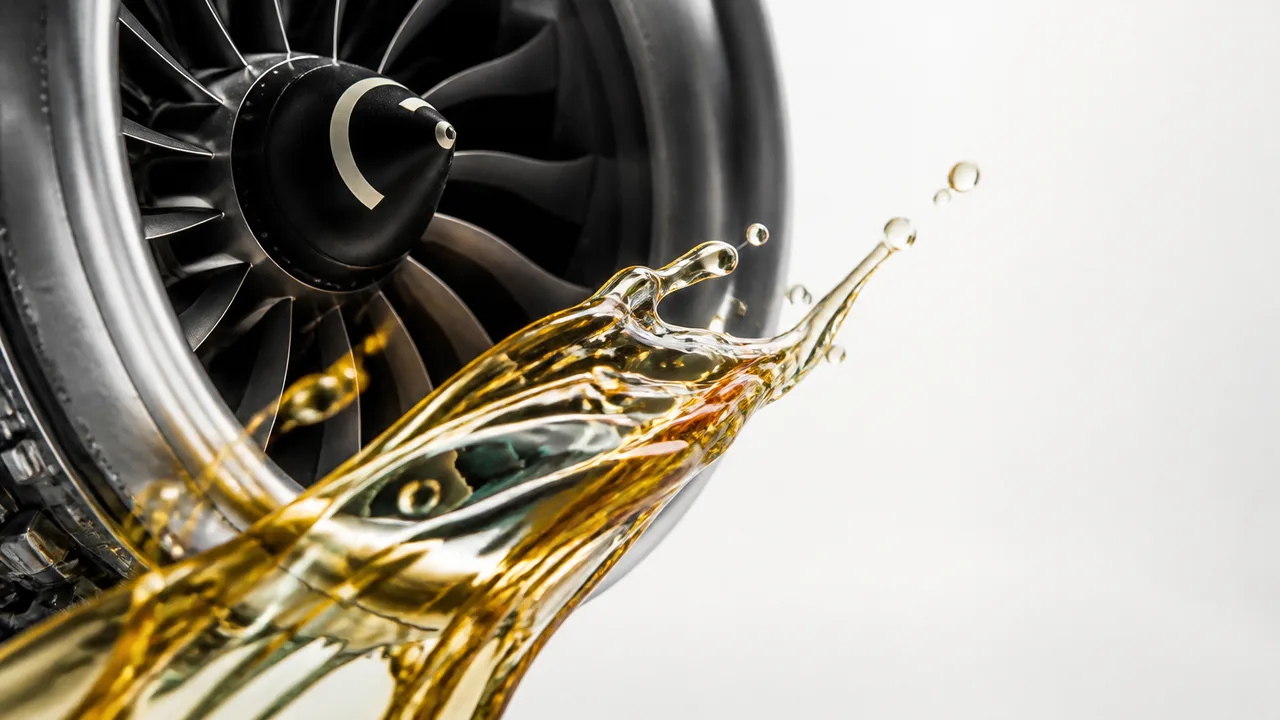
Photo: AI. Pippa Whitfield
The fuel in a Boeing 777's tanks is chemically close to the kerosene that lit 19th-century kitchen lamps, and no commercial jet flies on gasoline. That choice is one of the most important, and often overlooked, design decisions in aviation. The reasons behind it are compelling, more complicated than you'd think, and that is where things get interesting.
Why Jet Fuel Works Where Gasoline Would Fail
The argument rests on three properties of kerosene, each of which helps explain why gasoline would create problems at altitude.
First, volatility. At cruising altitude, air pressure drops to less than a quarter of its sea-level value. Because gasoline is more volatile, it can begin evaporating inside fuel lines, creating vapor bubbles that interrupt the flow of fuel. The result is known as vapor lock. Think of it like trying to drink through a straw partly filled with foam: the liquid no longer flows smoothly, and in severe cases, the flow can stop altogether.
Second, flash point. Gasoline vapor can ignite at temperatures around minus 43 degrees Celsius, while kerosene has a much higher flash point, generally between 38 and 72 degrees Celsius. As It Still Runs explains, that difference comes in part from kerosene's heavier hydrocarbon chains, which make it less volatile and harder to ignite.
That distinction matters when an aircraft is carrying an enormous volume of fuel. A Boeing 777 can hold well over 100,000 liters, depending on the model. Using a fuel that produces flammable vapor as readily as gasoline would significantly increase the risk posed by heat, sparks, or other ignition sources. Kerosene's higher flash point gives aviation fuel an important safety advantage.
Third, cold behavior. Outside air temperature at cruise regularly reaches minus 40 to minus 60 degrees Celsius, and fuel that turns waxy clogs the lines. Jet fuel is formulated with additives so it stays liquid down to roughly minus 47 degrees Celsius. Monroe Aerospace makes the related point that kerosene's freezing properties are naturally better suited to altitude than gasoline's, before any refining tricks are applied.
Kerosene was not chosen for aviation by accident. Its combination of volatility, flash point, and cold-weather performance makes it far better suited to flight than gasoline.
An answer on Aviation Stack Exchange adds an important distinction: Jet A and Jet A-1 are not simply the same kerosene once used in household lamps. Aviation fuel has to perform in conditions that ordinary kerosene rarely encounters, including temperatures near minus 40 degrees Celsius at cruising altitude. To meet those demands, jet fuel is further refined to reduce contaminants such as sulfur and water and is blended with additives designed to improve cold-weather performance and protect the fuel system from corrosion.
Kerosene itself is only one fraction of crude oil, separated during fractional distillation as hydrocarbons condense at different temperatures. That refined kerosene fraction then becomes the foundation for the specialized fuels used in modern commercial aviation.
The Fourth Property that is Actually a Fifth Job
Jet fuel does more than provide energy. Before it reaches the combustion chamber, it is often routed through parts of the engine where it absorbs heat from components operating at extremely high temperatures. In that role, the fuel helps cool the engine while also serving as a lubricant before it is finally burned for propulsion.
That cooling role creates a tradeoff. Fuel that absorbs heat becomes warmer, and warmer fuel evaporates more readily, increasing the amount of flammable vapor that can collect inside a fuel tank. That risk is not theoretical. After TWA Flight 800 broke apart off Long Island in 1996, the NTSB concluded that flammable vapors in the nearly empty center fuel tank were likely ignited by an electrical fault. The investigation ultimately helped drive major changes in how commercial aircraft manage fuel-tank flammability, including inerting systems that reduce oxygen levels by introducing nitrogen-enriched air.
Kerosene's relatively high flash point makes the liquid itself difficult to ignite under normal conditions. The vapor space above that fuel, especially after the fuel has been heated during a long flight, presents a different and potentially more dangerous problem.
Where the Story Gets Messier
The comparison between gasoline and kerosene becomes less useful when it is reduced to which fuel is simply "more powerful." Energy content can be measured by weight or by volume, and the answer changes depending on which metric is used. Without consistent figures, claims that one fuel burns hotter or delivers more energy can obscure the engineering question that actually matters.
For commercial aviation, fuel choice is driven less by peak energy output than by how the fuel behaves in real operating conditions. Volatility, flash point, freezing characteristics, storage safety, and compatibility with turbine engines all matter more than a single combustion number.
That distinction is critical because aviation gasoline and jet fuel are designed for fundamentally different engine systems. Elan Fuels notes that the two fuels are not interchangeable and that using the wrong one can cause significant engine damage.
The real advantage of kerosene, then, is not that it simply produces more power. It is that its physical and chemical properties make it better suited to the temperatures, pressures, safety demands, and engine designs of modern jet aircraft.
Two important complications add more nuance.
First, gasoline never disappeared from aviation. Many smaller piston-engine aircraft still run on avgas, a specialized form of gasoline, and do so reliably. Kerosene became the standard for commercial jets because it is particularly well suited to turbine engines operating for long periods at high altitude. The distinction is important: gasoline is not inherently unsuitable for flight. Rather, turbine engines and their operating conditions favor the properties of kerosene.
Second, kerosene's safety advantages do not eliminate risk. Modern aircraft use multiple layers of engineering to manage fuel safely, including fuel-tank inerting systems designed to reduce the chance that flammable vapors can ignite. Those systems exist because a fuel that is relatively stable under ordinary conditions can behave differently when heated, pressurized, circulated through an aircraft, and carried for hours at altitude.
The broader point is that aviation safety does not depend on kerosene alone. It comes from combining the right fuel with engine design, fuel-management systems, and multiple layers of protection around it.
Can Aviation Move Beyond Kerosene?
All of this depends on one larger assumption: that aviation can continue relying on petroleum-based fuel. Kerosene works because its physical properties have been refined around the demands of modern aircraft, and sustainable aviation fuels are being developed to reproduce those same characteristics from very different sources, including used cooking oil and synthetic hydrocarbons.
That requirement is demanding. Any replacement has to behave much like Jet A, matching key properties such as volatility, freezing point, and flash point, because aircraft fuel systems were engineered around those parameters.
So the bigger question is no longer whether kerosene was the right choice. For the aircraft built around it, it was. The question is whether aviation can move beyond it without giving up the characteristics that made it so useful in the first place.
For more than a century, aviation has optimized its machines around kerosene. The next challenge may be the reverse: creating a new fuel capable of fitting into an industry built around the old one.
More Like This

Webb Detects Methane on Interstellar Comet 3I/ATLAS
Webb's MIRI instrument detected methane on interstellar comet 3I/ATLAS after perihelion—a timing that hints at buried volatile layers from another planetary system.

Exploring the Enigma of Negative Time in Quantum Physics
Dive into the perplexing world of negative time in quantum physics with insights from Prof. Aephraim Steinberg.

Kirchhoff's Circuit Laws: A Student's Rules That Held Up for 180 Years
In 1845 a 21-year-old student wrote two circuit rules. Twenty years later, Maxwell's equations revealed they were conservation laws all along.

Why Physics Has No Preferred Direction of Time
Physics equations work equally well forwards or backwards in time. So why does time feel so irreversibly one-directional? The answer is stranger than you'd expect.

Unveiling the Intricate Engineering of Runways
Explore the hidden complexities of runway design and how these choices impact safety and military operations.

The Messy, Brilliant History of Divergence and Curl
How Hamilton's quaternion obsession, Maxwell's electromagnetism, and a self-taught telegraph operator gave us the vector calculus we use today.

How Newton Calculated Pi With Calculus
Newton didn't set out to calculate pi—he built a universal method for finding areas under curves. Pi was just what came out when he tested it on a circle.