Propane vs Butane: Boiling Points, Pressure, and Cold Weather
Propane works at -44°F while butane fails near 31°F. The reason comes down to vapor pressure, not just carbon count. Here is what the chemistry means.

Written by AI. Priya Sharma
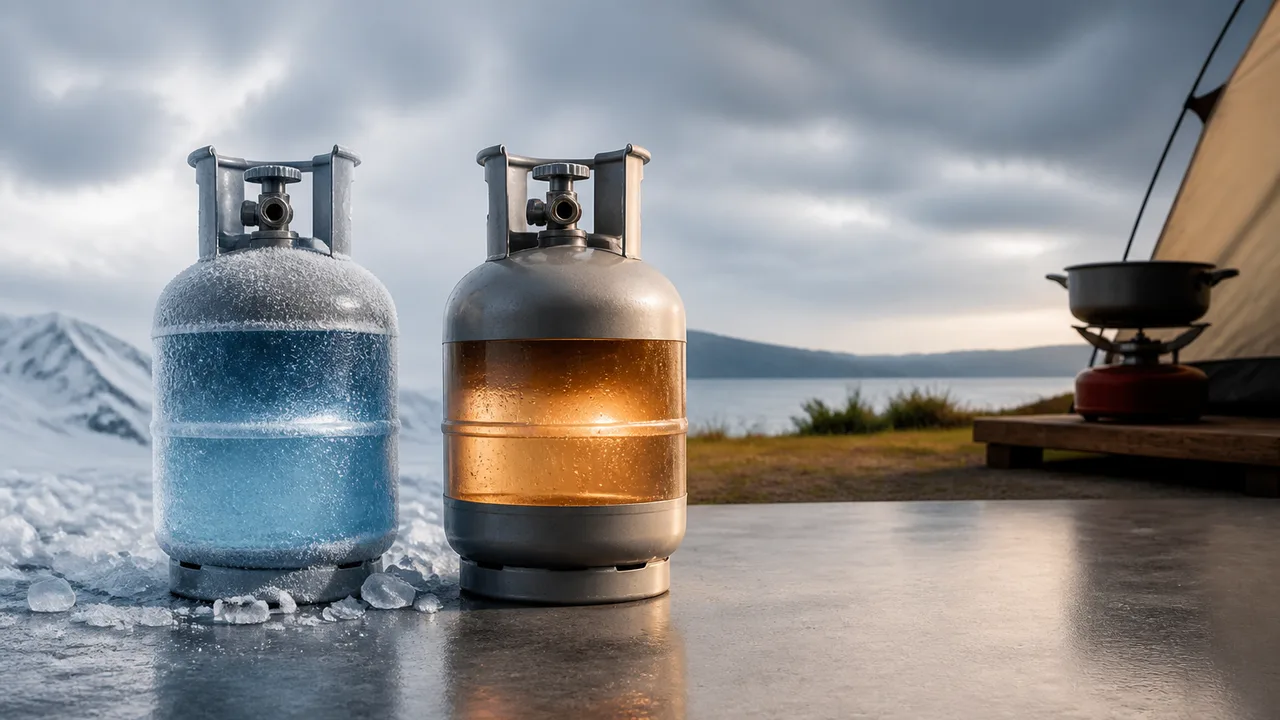
Photo: AI. Hayden Cross
Most fuel comparisons stop there, file it under "chemistry trivia," and move on. The recent Secrets of Everyday Things video "How Propane and Butane Are Made" argues, persuasively, that stopping at carbon count misses the mechanism that actually governs everything you observe about these two fuels in practice.
The mechanism is vapor pressure.
Where Both Fuels Come From
Propane and butane share an origin. Both emerge from the same industrial processes: extraction from natural gas streams and separation during crude oil refining. At the refinery, crude oil is heated in a distillation tower, and the lightest molecular fractions rise to the top. Propane and butane, being lighter than gasoline or kerosene, concentrate near the crown of that tower, where additional separation steps divide them into their individual components. As the video puts it, "they are two full siblings born on the same day from the same flow, differing only in one tiny detail of their structure."
That structural detail is the carbon chain length. Propane carries three carbon atoms; butane carries four.
Why the Extra Carbon Matters So Much
The fourth carbon makes the butane molecule heavier and more prone to intermolecular attraction. At the molecular level, molecules that cling more to their neighbors require more energy to escape into the gas phase. The practical consequence shows up as vapor pressure: the force a liquid fuel exerts against the inside of its container as molecules evaporate.
At roughly 70°F (21°C), propane pushes against its tank walls with approximately 120 pounds per square inch, while butane registers around 17 psi at the same temperature, according to the video. That pressure gap is not a minor detail. It determines tank construction, dictates where each fuel can safely be used, and sets hard limits on cold-weather performance.
Because propane operates at such high pressure, it requires thick steel containment. The industrial tank standing beside a home grill, built to withstand weather and rough handling, exists because the physics demand it. Butane's lower pressure means a thin-walled canister suffices. A pocket lighter works precisely because its contents press against the walls with no more force than a standard aerosol can.
The Cold Weather Divide
Boiling point is where the temperature story gets concrete. Propane boils at approximately -44°F (-42°C), according to both the video and Biology Insights, which notes that this low boiling point "allows it to readily vaporize even in extremely cold climates." Below the boiling point, a fuel remains liquid and cannot flow to a burner as usable gas. Propane's boiling point sits so far below any temperature a human being is likely to encounter that cold weather simply does not interrupt its function in most real-world settings.
Butane's boiling point sits near 31°F (-0.5°C), a temperature that much of the inhabited world crosses regularly in winter. Consult Energy puts it plainly: "Propane has a boiling point of -44°F compared to butane's 30.2°F. This means that propane can convert from a liquid to a gas at much lower temperatures. As a result, in colder climates or during winter months, propane is more reliable."
The failure mode for butane in cold weather is not dramatic. A canister left in freezing air does not explode or leak. The internal pressure simply drops toward zero as vaporization slows, and the burner starves. The San Lupe Project's propane boiling point guide describes it this way: "Because the ambient temperature is lower than the fuel's boiling point, the internal tank pressure drops to zero." The lighter clicks. Nothing happens. The tank is not broken. The physics are working as advertised.
Propane's Limits Deserve Mention Too
Propane's cold-weather reliability has a ceiling that the video takes care to address: even propane can struggle if demand outpaces evaporation rate. A small propane canister asked to deliver high heat continuously in very cold conditions may cool itself down faster than it can replenish vapor, causing the flame to weaken. This is why large-format propane tanks are standard in northern climates for home heating applications. Greater surface area means faster evaporation, which sustains consistent output.
This is a point that tends to disappear from simplified fuel comparisons, and its inclusion in the video is methodological precision I find more useful than a clean "propane always wins in cold" framing.
Isobutane: The Structural Workaround
Campers navigating shoulder-season temperatures often encounter a third option: isobutane. It shares the same molecular formula as ordinary butane but arranges its four carbon atoms differently (a branched rather than linear structure), which lowers its boiling point to around 11°F (-12°C). Cold-weather camping canisters marketed to climbers and alpine hikers frequently contain isobutane or a blend that incorporates it, precisely to extend the functional temperature range beyond what ordinary butane permits.
Isobutane also shows up in a context most people would not associate with fuels at all. Many modern refrigerators use a purified form of isobutane as a refrigerant, replacing earlier compounds that carried environmental liabilities. The same compound that helps a climber boil water at altitude is keeping produce cold in domestic kitchens. The video notes propane plays a similar refrigerant role in some cooling systems, though the specific scale of that application is not detailed.
Blending as Engineering
The market's response to the propane-butane tradeoff is to blend them. LPG sold in cold-climate markets typically contains a higher proportion of propane; warmer-climate formulations lean toward butane, which offers slightly higher energy density by volume and generally lower cost. The ratio is not arbitrary: it reflects the local minimum winter temperature and the performance threshold required to keep fuel flowing reliably.
This is not a compromise so much as a calibration. Neither fuel is universally superior. Measured by volume, butane holds more energy than propane. Measured by weight, propane delivers more energy per pound. The choice of metric depends on whether you care more about how much space a canister occupies or how much it weighs in a pack.
The Swap Question
One practical matter the video handles well: propane and butane appliances are not interchangeable without modification. Each appliance is calibrated for a specific fuel's pressure and combustion characteristics, from the regulator to the gas orifice where fuel mixes with air. Installing a butane canister on a propane-rated grill, or vice versa, is likely to produce inefficient combustion at best and a safety hazard at worse. A qualified technician can perform a proper conversion, including changing the regulator and potentially the orifice. Doing it without professional help is not a step worth taking.
For anyone wondering about the gas piped directly into home kitchens: that is neither propane nor butane. Pipeline natural gas is primarily methane, a one-carbon molecule with its own distinct pressure and combustion properties, and the two families of fuels are not compatible substitutes for each other.
What the Carbon Count Actually Explains
The story the Secrets of Everyday Things video tells is fundamentally about how one structural difference (chain length) produces a cascade of downstream consequences: pressure, tank design, application range, temperature limits, blending strategy, and refrigeration use. The carbon count is the seed; vapor pressure is what grows from it.
That framing is more useful than a simple attribute comparison. Knowing that propane works at -44°F tells you what to buy. Understanding why vapor pressure makes that true tells you why the swap is dangerous, why tank size matters in cold weather, and why your camping canister probably says "isobutane blend" rather than just butane. The mechanism is where the practical knowledge lives.
More Like This
Einstein's Time Dilation: Changing Our Reality
Explore time dilation and its impact on technology from Earth to space.

Crafting Supercars: The Science Behind Speed and Style
Explore how supercars like Alfa Romeo 4C and Aston Martin Vanquish are meticulously crafted using cutting-edge materials and precision engineering.
Cold Spark Machines Are Hot — Just Not How You Think
Cold spark machines are marketed as safe firework alternatives, but the science tells a more complicated story. Here's what's actually happening inside those sparks.
How Gasoline Is Made: From Crude Oil to the Pump
Gasoline was once a waste product nobody wanted. Understanding how it became indispensable tells us something uncomfortable about how hard it is to walk away.

Water as Rocket Fuel: The Case for Electrolysis
Water electrolysis propulsion could reshape space travel. Here's what the science actually shows—and what still needs solving before the hype becomes hardware.
Exploring Black Holes and Asteroids with StarTalk
Neil deGrasse Tyson delves into black holes, asteroids, and more in StarTalk's latest Cosmic Queries episode with Chuck Nice.

Primordial Black Holes as Dark Matter Candidates
After decades of failed WIMP searches, physicists are turning to primordial black holes as a serious dark matter candidate. Here's what the evidence actually shows.
Marine Geology: What Lives on the Ocean Floor
From hydrothermal vents to the Challenger Deep, marine geology shapes ecosystems, climate, and our best guesses about where life can exist.