Why AI-Generated Restaurant Menus All Taste the Same
Restaurant owners are discovering that AI-generated menus share a sameness problem. Here's what that reveals about the limits of generative AI in creative work.

Written by AI. Jai Trivedi
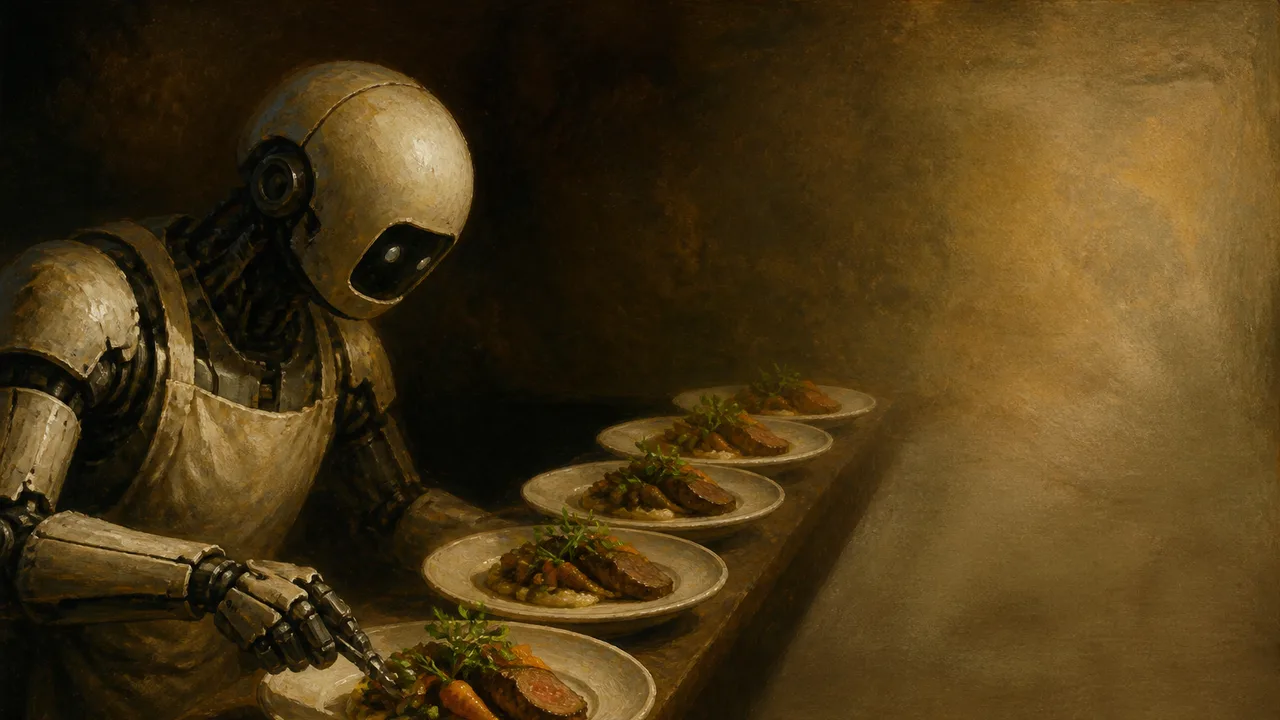
Restaurant owners sold on generative AI as a cheap, fast route to fresher menus are running into a wall: customers can tell.
According to TechCrunch, the culprit has a name: the "sameness problem." AI-drafted menu items, whether copy or accompanying food photography, share a kind of uncanny uniformity that diners are picking up on, even without being able to articulate why. The truffle-forward small plates. The "globally inspired" grain bowls. The smash burgers described as "elevated." Once you clock it, you can't untrack it.
The explanation for this isn't mysterious. Large language models learn by compressing patterns from existing text. Ask one to write a menu, and it will synthesize what menus, broadly, look like. The output is statistically representative of menus as a category. That's precisely the problem: a menu that reads like the average of all menus reads like no menu in particular.
Creativity in food, or in any craft domain, runs on deviation from expectation. A dish earns a description because something specific happened: a chef tried a technique they learned in Oaxaca, or swapped an ingredient because a supplier fell through, or chased a flavor memory from childhood. That specificity has no path into a model trained on Yelp copy and food blog SEO filler.
The Photo Problem Is Worse
If the copy issue is subtle, the image issue is visceral. Blogger Shubham Jain documented his reaction to AI-generated food photography in an August post at shubhamjain.co that went around Hacker News last week. The headline: "Your AI Generated Menu Triggered My Trypophobia."
Trypophobia is a fear or aversion response to clusters of small holes or bumps. Jain's piece identified something that a lot of people feel but haven't named: AI food images pile on texture in ways that read as "abundant" or "artisanal" to the model, but land as deeply wrong to human eyes. Sesame seeds distributed with unsettling evenness. Crumbs that look tiled. Sauce pooling in patterns that suggest computation rather than gravity.
This is a known artifact of how diffusion models handle surfaces. They overload them with repetitive micro-detail because that detail pattern scores well as a proxy for "high quality food photography" in training data. The model is optimizing for the aesthetic signal, not the dish. The result looks like food a very confident algorithm made.
For restaurant operators, this matters commercially. A menu photo's job is to make someone want to eat the thing. AI images that trigger low-grade unease are doing the opposite.
The Efficiency Trap
The reason restaurants chased this technology is rational. Menu refreshes cost money. Good food photography costs more. Copywriters who understand flavor and can write something that isn't "a symphony of bold flavors" cost time to find and brief. AI offered all of that at a fraction of the price and at a turnaround speed that fit the pace of a busy kitchen.
For operational tasks, that calculation holds. AI scheduling, inventory forecasting, and demand modeling are areas where pattern-matching on historical data is exactly the right tool. A system that predicts Friday-night cover counts or flags when avocado prices are about to spike is solving a problem where "average of past data" is the answer you want.
Menu creativity runs the opposite direction. The competitive advantage of a restaurant's identity sits in what makes it distinct from every other restaurant. Feeding that problem to a model trained on the entire internet's worth of restaurant copy produces something that competes with your restaurant's identity rather than expressing it.
Sam Altman acknowledged in late August, per The Next Web, that AI developers have fumbled at communicating what the technology actually does well. The restaurant menu case illustrates the downstream cost of that fumble: operators deployed a tool in a context it was poorly suited for, because the messaging around AI collapsed the distinction between "can generate text" and "can generate good text for your specific situation."
What Operators Are Learning
The practical correction isn't complicated, though it requires admitting something the sales pitch obscured: AI output needs a human filter that understands the specific restaurant, not just food in general.
A chef who uses an AI draft as a starting provocation, then rewrites it against their actual ingredients and cooking style, can move faster without losing voice. That's a real workflow gain. A restaurant that publishes the draft as-is, because the draft sounded fine and editing takes time, ends up with a menu that reads like the ghost of every other menu.
The photo problem has a similar two-step fix: use AI generation for speed, then run images past someone whose job is to notice when sesame seeds look algorithmic. That sounds obvious in retrospect. It wasn't obvious when the tool was being sold as a full replacement for the photography budget.
The deeper issue, one the TechCrunch piece points at without fully naming, is that the sameness problem is self-reinforcing. As more restaurants use AI-generated copy and images without editing, those outputs feed back into training data for future models. The average of all menus drifts toward the average of all AI-generated menus, which is a tighter and tighter loop of the same descriptors, the same plating aesthetics, the same flavor language. "Bold" and "elevated" and "globally inspired" aren't going anywhere.
The Broader Pattern
Restaurant menus are a compact, legible version of a problem showing up across AI deployments in creative fields: marketing copy, social media content, blog posts, product descriptions. The output is defensible. It clears a basic bar. It does not make anyone feel anything.
For some use cases, clearing a basic bar is enough. For use cases where the goal is differentiation, it's actively counterproductive. A brand that sounds like every other brand is not a brand.
The AI industry has, as Altman admitted, underinvested in helping users understand which category their problem falls into. The tech press has contributed to the blur by covering AI capabilities in aggregate rather than by domain and task. A model that writes solid contract summaries and a model that writes a menu that makes you want to eat there are not demonstrating the same capability, and treating them as equivalent has cost operators real money and real customer trust.
The sameness problem in restaurant menus is small-scale. The pattern underneath it, deploying a tool that maximizes for average before understanding whether average is the goal, scales to anywhere that originality is the product.
Restaurants are just the place where you can smell the difference.
More Like This
How a Mechanical Watch Stores Energy, Explained
Chronova Engineering's Mike machines watch barrels from scratch, revealing how mechanical watches store and release energy through coiled springs and clever design.

Hotel AI Visibility: Why Google Rank No Longer Guarantees Discovery
Hotels that rank well on Google are disappearing from AI chatbot results. Here's what's driving that gap and what properties need to rethink about their content.
Ten Tools to Fix Claude Code's Terrible Design Aesthetic
Claude Code generates the same purple gradients and Inter font on every site. Here are ten plugins and skills that might actually fix its design problem.

FBI Probes Sale of 153 Million Driver's Licenses on Dark Web
The FBI is investigating a breach where 153M+ U.S. and Canadian driver's licenses appeared on a Russian cybercrime forum. Here's what we know so far.
Videorc LIVE Tested: Multistream Works, Chat Doesn't
OrcDev tested Videorc LIVE streaming simultaneously to YouTube, X, and Twitch. The broadcast worked. The comment aggregation didn't. Here's what that gap means.
AI Wearables Are Becoming Health Coaches. Now What?
From Oura rings to Tonal's smart gym, AI is turning fitness trackers into personal coaches. But is all that data making us healthier or just more anxious?

Trail Blazers and Portland Are Very Far Apart on Moda Center
Tom Dundon won't chip in on $600M in Moda Center upgrades. Portland won't write a blank check. Here's what's actually at stake for both sides.
FIFA's TikTok Deal Is Rewriting Sports Media Rights
FIFA's TikTok partnership for the 2026 World Cup pulled 465 million streams. The real story is what that means for every rights deal negotiated after this.