AI Wearables Are Becoming Health Coaches. Now What?
From Oura rings to Tonal's smart gym, AI is turning fitness trackers into personal coaches. But is all that data making us healthier or just more anxious?

Written by AI. Jai Trivedi
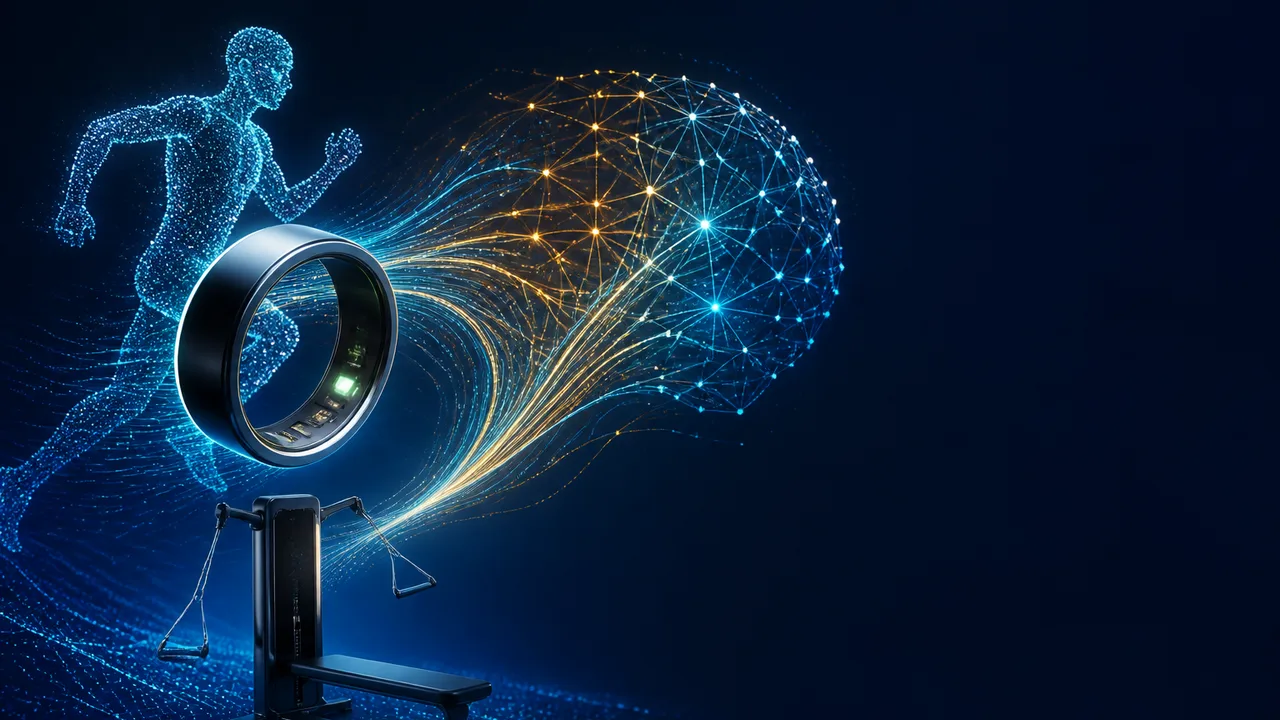
Photo: AI. Dante Nwosu
Nearly half of American adults now own at least one wearable fitness device, up 33 percentage points from a decade ago, according to Fortune's recent breakdown of the connected fitness market. The global consumer wellness market sits at $2 trillion. The global smart fitness segment alone is projected to grow past $60 billion over the next decade.
Those numbers are wild. But the more interesting story is what the devices are actually doing now.
From Step Counter to Coach
The original pitch for wearables was simple: count your steps, maybe your calories, sleep eight hours, don't die. Fitbit made that pitch in the late 2000s and it worked. Millions of people clipped a tiny sensor to their waistband and called it a health plan.
AI broke that model open. Companies like Oura and Tonal are no longer selling data collection. They're selling interpretation, prediction, and prescription. The Oura Ring, now in its fifth generation, monitors sleep, physical activity, heart rate variability, and other biometric signals, then uses AI to tell you things like: you're getting sick, and you'll feel it in three days. A model trained on what Oura says is 42 billion hours of user data found the pattern first.
Tonal takes a different angle. Its AI-powered home gym captures force data 50 times per second, tracking how you pull a cable, how your output curves across a set, where you're fading. When you're about to fail a rep, the system lightens the load automatically so you can finish the set. Fortune's Allie Garfinkle got a demo, and the pitch from Tonal was straightforward: it's your AI spotter.
Both companies made the same structural pivot at some point. Hardware opens the door; software and subscriptions are where the money actually lives. Oura added a subscription model in 2021, and the company reported over $1 billion in revenue in 2025, with roughly 20% coming from subscriptions. A potential IPO at a valuation above $16 billion has been floated for 2026, per the Fortune video. Tonal pairs its equipment with coaching software and conversational AI through its Tonal Intelligent Assistant, layering subscription revenue onto hardware sales.
The Data Moat Argument
Here's where the business logic gets interesting, because it's also where the existential threat lives.
If ChatGPT can analyze your sleep data, your heart rate variability, your workout logs, and give you a personalized recovery plan for free, why does anyone need a $500 ring and a $50/month subscription? Garfinkle asked Tonal's team exactly that question. Their answer was the data moat: general-purpose LLMs haven't trained on eight-plus years of strength training data from hundreds of thousands of users. Tonal claims its members have collectively lifted more than 235 billion pounds, building what it calls the world's largest strength training dataset.
Oura's CEO Tom Hail made the same case: "The data is actually the scarce resource here. Our data set: 42 billion hours of data across a huge population. That data asset is what fuels the intelligence. The intelligence is the thing that you can't recreate unless you have the data."
This is a credible argument, at least for now. Specialized training data does matter, and neither OpenAI nor Anthropic has the biometric depth these companies have built. But the moat shrinks every time a user uploads their Apple Health export to Claude and gets a surprisingly good answer back. Fast Company noted that fitness apps are increasingly positioning themselves as AI wellness systems, which is exactly what Tonal and Oura are doing. The question is whether that positioning survives as foundation models get better at generalization.
Tonal's team acknowledged the tension directly: "We certainly have observed people taking medical information and uploading it to ChatGPT or Claude and asking questions. We thought: oh, we can do this, but we can do this with the data."
The Influencer Layer
Fortune's piece also pulls back on something the industry doesn't love talking about: the creator economy's role in driving adoption. Fitness influencer Shervin Shake, who goes by Shervin Shares on YouTube, showed Garfinkle his wearables drawer. Roughly 30 devices. He was wearing four on camera. He has done paid branded content for both Tonal and Oura and earns affiliate commissions on Oura ring sales.
Shake was also the most honest person in the piece: "Do you really need to be wearing five, six devices? No." And: "So many people think if I buy XYZ, this gadget, this fitness tech is going to make me fit. Buying anything is not going to change your behavior."
That's a fitness influencer with a drawer full of sponsored devices telling you the devices aren't the point. The cognitive dissonance is a feature of how this market works. Creators generate awareness and drive purchase intent; the companies pay for that reach; the users accumulate hardware and subscriptions and, sometimes, results.
The Verge has been asking what role simple fitness bands even play anymore in an era where every platform wants to be your AI health coach. The answer isn't obvious. A basic band can still close your rings and nudge you off the couch. But the conversation has moved to whether passive nudges are enough, or whether you need a system that watches your force curves and predicts your illness before you sneeze.
When Optimization Becomes the Problem
The Fortune video raises a question the industry doesn't have a clean answer to: what happens when the data becomes the anxiety?
Garfinkle described hitting a wall after years of overoptimizing. Oura is currently facing a lawsuit alleging that its sleep tracking data is misleading. (The company told Fortune it stands behind its accuracy claims and is focused on helping members understand how to use the data.) Digital Trends covered an AI fitness coach that reads muscle mechanics in real time to prevent injury, which is compelling tech, but it also illustrates how much cognitive real estate this stuff is starting to occupy.
Tonal's team framed their goal as delivering personal trainer value "without the cognitive load that would require you to even think about data." That's a real insight: the best version of this technology disappears. You just get better. The worst version is a dashboard you check before deciding whether you're allowed to feel good today.
Shake put it plainly: "If we use the data to influence how we feel, then we forget how we feel. And I think how we feel is the biggest metric for how that day is going to go."
That's the tension the $2 trillion wellness economy hasn't resolved. The companies building these systems believe personalized AI health coaching at scale could bend the curve on national healthcare costs, and that's not a small claim. But the path from "your ring says your readiness score is 73" to "you are actually healthier" runs through behavior change, not dashboards. Whether AI coaches close that gap, or just give people a more sophisticated way to overthink their rest days, is the question this industry is still answering.
More Like This
How a Mechanical Watch Stores Energy, Explained
Chronova Engineering's Mike machines watch barrels from scratch, revealing how mechanical watches store and release energy through coiled springs and clever design.

AI as a Life OS: Promise and Privacy Stakes
Daniel Miessler argues AI tools should manage your entire life, not just your code. The idea is compelling — and the privacy questions are serious.
FBI Probes Sale of 153 Million Driver's Licenses on Dark Web
The FBI is investigating a breach where 153M+ U.S. and Canadian driver's licenses appeared on a Russian cybercrime forum. Here's what we know so far.
Videorc LIVE Tested: Multistream Works, Chat Doesn't
OrcDev tested Videorc LIVE streaming simultaneously to YouTube, X, and Twitch. The broadcast worked. The comment aggregation didn't. Here's what that gap means.

AI Assistants Are Changing How We Stay Curious
AI tools promise smarter thinking, but are they quietly training us out of the discomfort that makes curiosity possible? A look at what the research and the industry actually say.

Microsoft's Copilot Data Reveals What People Actually Use AI For
Microsoft's Copilot usage report shows people want health advice from AI, not just coding help. The data raises questions about enterprise costs and privacy.

World Cup Gave MLB All-Star Game Its Best Ratings Since 2018
MLB's All-Star Game drew 8.79M viewers on Fox—up 22%—with the World Cup acting as an unlikely lead-in. What does that actually mean for sports broadcast strategy?
England Ends Norway's World Cup Run, Haaland Silenced
England beat Norway 2-1 in extra time to reach the 2026 World Cup semifinals. Bellingham scored the winner. Here's what the money story actually looks like.