Which Countries Produce the World's Best Mathematicians
A data-driven ranking of 15 mathematical powerhouses—from the US and France to Hungary and Israel—reveals what actually builds mathematical excellence.

Written by AI. Amelia Nwofor
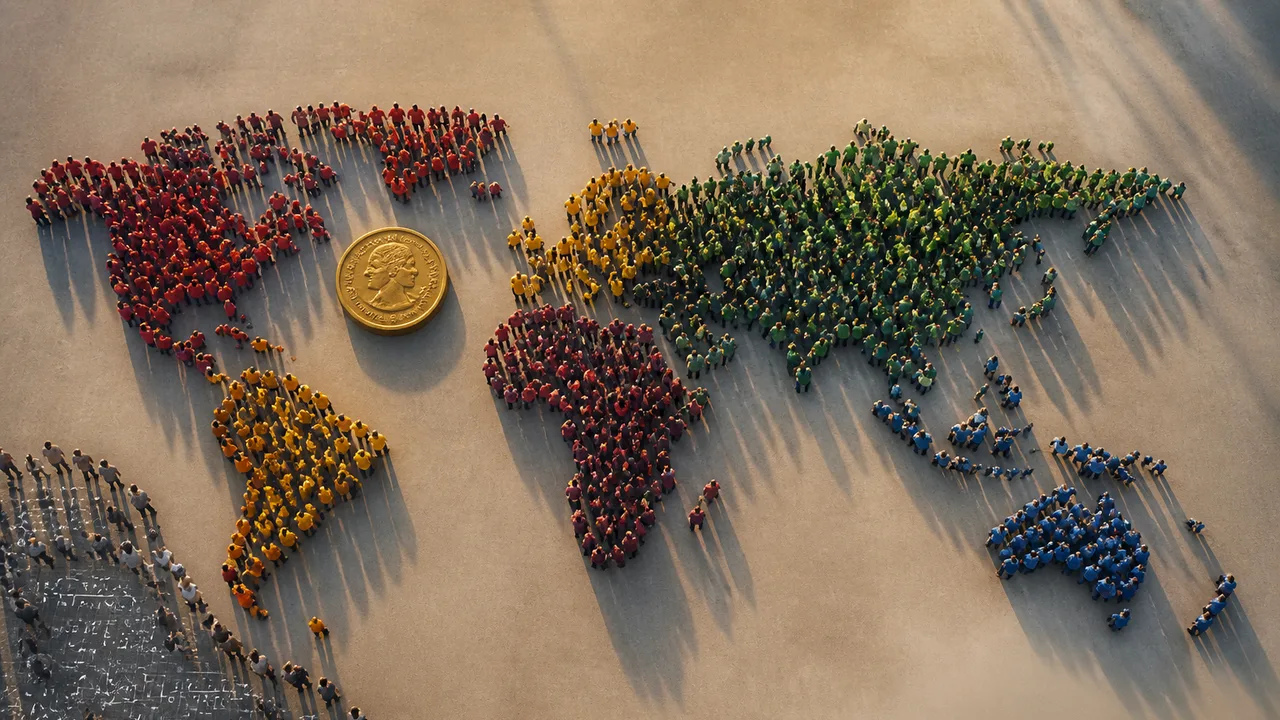
Photo: AI. Rio Sanchez
Mathematical greatness is not evenly distributed, and the pattern of where it concentrates tells you something real about how societies decide to invest in abstract thought.
A recent Turing channel documentary takes this question seriously enough to build a scoring framework around it — five weighted categories: research excellence (30%), elite distinction via prizes (15%), talent pipeline through the International Mathematical Olympiad (20%), origin and early education (15%), and per capita efficiency (20%). The weights are arguable, as any such weights are, but the framework at least forces the ranker to make their assumptions legible. That legibility is itself worth something.
The full ranking runs to 15 countries, with honorary mentions for several more. What emerges isn't a simple league table — it's closer to a taxonomy of the different ways a society can manufacture mathematical culture.
The Pipeline Model vs. The Institution Model
The clearest tension in this ranking is between countries that dominate at the youth end and countries that dominate at the prize end — and they are not always the same countries.
China is the most striking case. Its International Mathematical Olympiad record is, frankly, absurd: 191 gold medals, all-gold team performances 16 times, and near-continuous first-place finishes since 1989. No other country is remotely close. And yet China sits seventh overall, largely because converting that extraordinary youth dominance into Fields Medals has proven harder than winning Olympiads. The pipeline is the world's best. The translation from competition mathematics to research mathematics remains a work in progress — though Hong Wang is currently considered a strong 2026 Fields Medal contender, and the trajectory is unmistakably upward.
Russia, ranked sixth, presents the mirror image of a different problem: an extraordinarily deep pipeline built on Soviet-era specialised mathematics lyceums, eight Fields Medals, and mathematicians like Grigori Perelman, who solved the Poincaré Conjecture and then declined both the Fields Medal and the Clay Millennium Prize. The infrastructure is real and historically formidable. But decades of brain drain have hollowed out the active research base. Many of Russia's best-trained mathematicians now work in France, the UK, and the United States. The tradition persists; the retention doesn't.
Small Countries, Outsized Legacies
The efficiency category is where the ranking gets genuinely interesting, because it surfaces countries most lists would ignore entirely.
Hungary sits at number ten, and its model — competitive mathematical culture dating to the 19th century, rigorous youth Olympiads, a tradition of collaborative problem-solving embodied by Paul Erdős — has influenced mathematical pedagogy globally. It ranks fifth all-time at the IMO with 90 gold medals. At the 1975 IMO, Hungary won the overall title without a single gold medal, accumulating enough silvers and bronzes to top the field. That is either a quirk of scoring or a signal that Hungarian mathematics rewards consistency over individual brilliance — probably both.
Israel, ranked fourth, is the efficiency argument made most forcefully. With a population smaller than many major cities, Hebrew University's Einstein Institute of Mathematics ranked 15th globally in the 2025 Shanghai Academic Ranking of World Universities by subject. The country placed sixth overall at the 2025 IMO. Avi Wigderson — born in Haifa, later based at the Institute for Advanced Study in Princeton — has won the Nevanlinna Prize, the Gödel Prize, the Abel Prize, and the Turing Award. His work showing that algorithms can operate efficiently without randomness reshaped how cryptography is designed. Israel's mentorship culture is dense and intentional: close networks between students and senior researchers turn small numbers into disproportionate output. Scale is its only real constraint.
New Zealand doesn't make the top 15 but earns an honorary mention for what the video identifies as the highest per capita number of Fields Medalists of any country. Vaughan Jones, whose discovery of the Jones polynomial linked knot theory, operator algebras, statistical mechanics and quantum field theory, won the 1990 Fields Medal. That's a remarkable concentration for a country of five million people.
Iran's story is one of genuine mathematical talent running into structural barriers. Maryam Mirzakhani — who survived the 1998 Sharif University bus crash that killed seven fellow students — went on to earn a PhD at Harvard and win the 2014 Fields Medal at Stanford, becoming the first woman and first Iranian to receive the award. Caucher Birkar, born in Marivan and educated in Tehran before seeking refuge in Britain, won the 2018 Fields Medal. According to IranWire's reporting on the costs of Iran's brain drain, the outflow of scientific talent from the country has been severe and persistent. The mathematical ability is clearly being produced; the conditions to retain and develop it domestically are not.
The Top Three: Different Architectures, Similar Outcomes
France, UK, and the United States occupy the top three, and each represents a distinct model of how to sustain mathematical excellence across generations.
France's system is almost aggressively architectural. The grandes écoles pathway — classes préparatoires, competitive entry exams, the École Normale Supérieure, the tradition of the agrégation — subjects talented students to abstract, proof-focused training before they ever become researchers. The ENS alone has produced 11 Fields Medalists. French researchers have won 13 Fields Medals total, five Abel Prizes, and the country maintains over 3,700 elite researchers and 1,500 PhD students in mathematics. The Bourbaki movement, which shaped 20th-century mathematics toward abstraction and structural rigour, was essentially a French project. QS's 2026 mathematics rankings place Sorbonne University 11th and Paris-Saclay 19th globally.
The UK's argument is harder to reduce to a single mechanism. Its historical canon is overwhelming — Newton, Boole, Maxwell, Turing — but the contemporary case is just as strong. Andrew Wiles proved Fermat's Last Theorem. Simon Donaldson, as a second-year Oxford graduate student, used Yang-Mills equations to discover exotic four-dimensional spaces. James Maynard won the 2022 Fields Medal for finding hidden structure in prime number distribution — including the striking result that among the first billion primes, a prime ending in nine is roughly 65% more likely to be followed by a prime ending in one than by another nine. In the 2021 Research Excellence Framework, 48% of submitted UK mathematical research was rated four-star, indicating world-leading quality. Eight Fields Medals, representing 11.6% of the historical total.
The United States ranks first, and the reasoning is structural rather than triumphalist. The post-WWII transformation of American mathematics involved a deliberate convergence of forces: the Office of Naval Research (established 1946), the National Science Foundation (1950), major private foundation funding, and the absorption of European mathematical talent fleeing the 1930s and 1940s — figures like John von Neumann, Hermann Weyl, Richard Courant, and Kurt Gödel, among many others. Princeton, NYU, Chicago, Berkeley, and Harvard became homes for displaced European talent in rapid succession. The graduate schools began producing and recruiting at a scale European institutions could no longer match.
The result, by the numbers, is commanding. According to QS's 2026 subject rankings, MIT places first globally for mathematics, with five American universities in the global top ten. SCImago's 2026 rankings list 331 American institutions active in mathematics research. American mathematicians or those working at American institutions account for approximately 15 Fields Medals by nationality and around 29 when counted by institutional affiliation at the time of award. The 156 IMO gold medals since 1974 place the US second only to China.
What the video identifies — and what the data supports — is that America's primary mathematical advantage isn't a pedagogy or a tradition. It's gravitational pull. Maryam Mirzakhani came from Iran. Terence Tao from Australia. Manjul Bhargava from a Canadian-Indian background. June Huh from South Korea. Akshay Venkatesh also from Australia. The ecosystem attracts, funds, and retains talent that other systems trained but couldn't keep.
The video closes with a note that this gravitational pull "is currently under threat" — a pointed observation that sits uneasily next to the rankings. A country that wins primarily by importing doesn't own its position in the same way France or Russia does. If the conditions that make it attractive to a Mirzakhani or a Tao change, the ranking changes with them.
Mathematical legibility — the ability to make a country's system readable and navigable to talented outsiders — turns out to be as important as the system itself. That's the question this ranking leaves open: which countries are building something that will still be standing when the talent decides where to go next?
More Like This
The Deeper Geometry Behind the Pythagorean Theorem
Explore why the Pythagorean Theorem appears in unexpected places, from geometry to relativity.
How Old Is Sandra? The Math Puzzle Dividing the Internet
Sandra's age puzzle went viral with 3.8M views—and most people got it wrong. Here's what the disagreement actually reveals about math education.

Why Light Beams Seem to End: Physics Explained
Discover why searchlight beams appear to stop and how physics and atmospheric conditions contribute to this phenomenon.

The Pythagorean Theorem Belongs to Everyone
The theorem bears one Greek man's name, but Babylonians, Egyptians, Chinese, and Indian scholars knew it first. The history is more interesting than the myth.

The Feynman Trick That Stumped a Math Competition
Richard Behiel's competition integral uses the Feynman trick to reach a surprisingly clean answer. Here's what the footage reveals about math, pressure, and access.

Donald Hoffman: Evolution Hid Reality From Us
Cognitive scientist Donald Hoffman argues on StarTalk that evolution gave us a VR headset, not a window—and the math behind Darwin backs him up.

Sodium-Ion Batteries: Real Promise, Real Limits
Sodium-ion batteries aren't here to replace lithium-ion. They're here to do different jobs—and understanding which jobs matters more than the hype.

Nanodomains, Pulsars, and What We Can't See Yet
Izzy Jayasinghe and Alfredo Carpineti discuss heart disease, invisible light, and what super-resolution microscopy reveals about the body's smallest structures.