What Monster's Lizzie Borden Season Reveals About TV
Netflix's Lizzie Borden season exposes the strain of stretching disputed history into eight hours, using invented links and borrowed killers for scale.
Written by AI. Devon Quincy
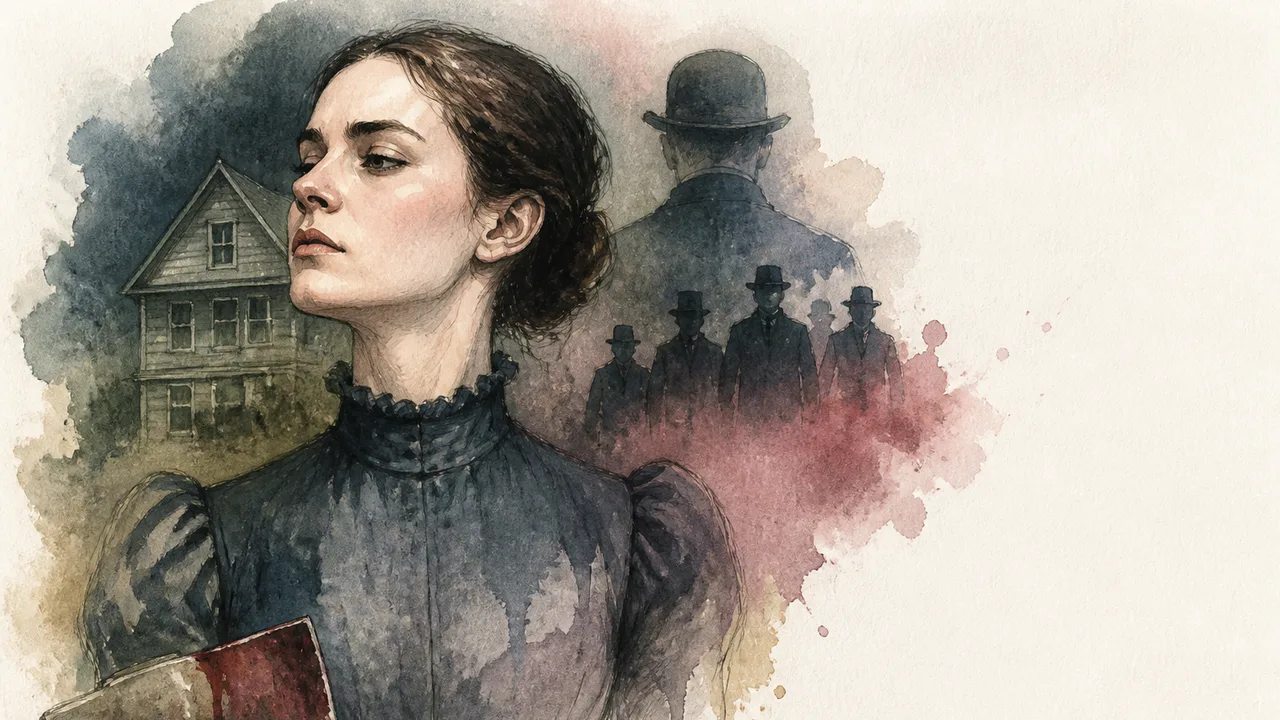
Netflix’s Monster: The Lizzie Borden Story spends eight episodes turning an unresolved 1892 murder case into a lineage of female rage.
Lizzie Borden, played by Ella Beatty, sits at the center. The season also recruits Elizabeth Báthory through flashbacks and gives Aileen Wuornos, played by Sarah Paulson, a substantial detour beginning in Episode 4. By the finale, the series has positioned its Lizzie as a feminist benefactor whose notoriety can be redirected toward women’s suffrage.
That architecture raises a useful question about streaming true crime: What happens when a famous name can sell a season but the available history cannot comfortably fill one?
For Monster, the answer appears to be expansion. A disputed crime becomes a psychological certainty. Missing biographical detail becomes melodrama. Other notorious women become thematic relatives, even when their circumstances resist the family portrait.
A Subject Chosen Before the Story Was Solved
Co-creator Ian Brennan has offered an unusually revealing account of how the season began. In an interview with The Hollywood Reporter, he said the creative team had been trying to “crack” a season about Luigi Mangione, who was accused in the 2024 killing of UnitedHealthcare CEO Brian Thompson. Brennan called that story too new and esoteric. Ryan Murphy then suggested Borden, a subject he had long wanted to tackle, and the project moved forward.
Brennan also said he and Murphy hope to make 10 Monster seasons. They keep several possible subjects in a “hopper,” abandon many, and ask viewers to spend seven, eight, nine or 10 hours inside the selected person’s head. Once a subject works, he said, the writing moves quickly because the facts supply the destination and the writers can curate episodes around them.
Borden complicates that description. Her father Andrew and stepmother Abby were killed in Fall River, Massachusetts, in 1892. Lizzie went on trial and was acquitted. The crime entered American folklore through a playground rhyme, while dramatizations such as the 2018 film Lizzie, starring Chloë Sevigny and Kristen Stewart, supplied later generations with new interpretations.
The rhyme preserved an accusation rather than a verdict. That makes Borden excellent cultural property: recognition arrives preloaded, while uncertainty leaves room for invention. It also creates an ethical and dramatic problem. An eight-hour character study needs motives, relationships and interiority that the surviving record may not provide.
Charlie Hunnam, who plays Andrew, told The Hollywood Reporter that he found “almost nothing” to draw on in researching the man. The scarcity allowed the production to create the Andrew who would have the greatest impact on Lizzie’s story. Hunnam said Murphy and Brennan believed Lizzie was probably responsible, while acknowledging that her acquittal meant the crime was never proved against her.
The show consequently treats one interpretation as its governing reality. It depicts Lizzie as the killer and builds Andrew and Abby into abusive antagonists whose cruelty helps explain her violence. Drama always selects among possibilities, but Monster sells proximity to real crime as part of its appeal. When documentation thins out, its confident psychology can look more authoritative than its foundations warrant.
Brennan’s own comments illustrate the risk. Asked whether Andrew cut the legs from bodies to fit them into caskets, he replied, “I think that is true, although I have to check.” He then described older histories as elliptical and said writers must take liberties to fill the gaps. The anecdote should therefore be treated as an unverified element of the production’s version, rather than biographical fact.
Three Killers Enter, One Theme Leaves
After establishing its answer to who killed Andrew and Abby, the season searches for larger significance. The Hollywood Reporter’s review describes Lizzie and the maid Maggie reading about Báthory, with Vicky Krieps appearing as the countess in flashbacks. Wuornos later visits the Borden house in the show’s telling and hallucinates encounters with Lizzie.
Consequence identifies that overnight stay as a fictional event created for the series. Its review also notes the enormous differences among the women: Báthory represents murderous power in the legend attached to her; Wuornos is framed as killing from powerlessness; Borden remains an acquitted suspect whose motives and responsibility are disputed.
The strongest defense of this structure is thematic rather than historical. The series wants to examine how women’s anger becomes spectacle, how notoriety can produce an imagined community, and how later audiences convert an accused murderer into an emblem of rebellion. Fiction can place figures in conversation without claiming they literally shared a political program.
The execution still asks resemblance to do too much work. Báthory, Borden and Wuornos are women associated with killing, but sex and notoriety provide a thin basis for common cause. Once the season turns that association into a feminist inheritance, it compresses radically different forms of power, evidence and victimization into a slogan with an axe in its hand.
This is where the production history clarifies the finished program. The creators selected a recognizable subject after abandoning a newer one. They committed to an eight-episode form despite limited information about central family members. The resulting season reaches outward for Báthory, Wuornos and suffrage history. Those facts do not prove that Netflix imposed a content quota or that the creators knowingly padded the series. No disclosed internal production record establishes either claim. They do support a narrower inference: the anthology’s fixed appetite for many hours encourages narrative enlargement when one case cannot supply enough documented character material.
What the Earlier Monsters Could Use
The Menendez season offers a comparison within the same franchise. As Consequence observes, that story also concerned a small number of victims, yet it could draw on public reaction and an extended trial narrative across nine episodes. Borden’s case has a vast cultural afterlife, but the available material presented here offers less access to the private lives the new season wants to dramatize.
The comparison has limits. The Menendez case occurred in a modern media environment, while the Borden murders happened in the 19th century. More recent records do not guarantee responsible drama, and archival abundance can create its own distortions. Still, the difference helps explain why The Lizzie Borden Story imports other killers instead of staying in Fall River.
Wuornos also arrives with a formidable screen precedent. Patty Jenkins’ 2003 film Monster developed the idea that Wuornos could be understood as both victim and murderer within a feature-length story. IndieWire argues that the Netflix anthology repeats that interpretation without adding much, while noting that secondary killers have appeared throughout the franchise. Jeffrey Dahmer’s season included John Wayne Gacy and Ed Gein; the Menendez season brought in O.J. Simpson; the Ed Gein season included Ilsa Koch.
The Borden season therefore intensifies an established habit. Supporting figures once widened the historical environment around the principal subject. Here, Báthory and Wuornos help manufacture a cross-century argument that the central case cannot independently sustain.
Reception has been mixed rather than uniformly hostile. A roundup published by ComingSoon cited praise for the season’s distinct tone, performances and the chemistry between Beatty and Krieps, alongside criticism of its direction and feminist-revenge argument. Its reported Rotten Tomatoes figures stood at 50 percent from critics and 27 percent from audiences at that point. Those changing aggregates measure approval, not the quality of any single argument, and the critic score was reportedly similar to the preceding Ed Gein season.
Viewers can reasonably enjoy the performances, heightened style or speculative romance while remaining alert to the seams. The useful distinction is between a series interpreting uncertainty and one disguising invention as recovered psychology. The Lizzie Borden Story keeps crossing that border because its format demands a complete person from an incomplete archive.
Borden survived in American culture because the case never settled into one meaning. Monster gives her several at once: murderer, victim, lover, celebrity and suffrage patron. Eight hours can hold all those identities. The surviving history cannot confirm most of them, so the season borrows two more killers and asks notoriety to supply the connective tissue.
More Like This
Unraveling the Mysteries: Toxic Lady and Farmhouse Murders
Explore the chilling mysteries of Gloria Ramirez and the Gruber family farmhouse murders, where answers remain elusive.
Bigfoot, Werewolves, and the Science of Strange Sightings
From Georgia dashcam footage to Brazilian backyards, cryptozoology meets real wildlife science—and the answers are often stranger than the legends.
Toni Collette's Miss Marple and the Prestige Audio Question
Toni Collette stars as Miss Marple in a new Christie podcast. But who really controls this adaptation—and whose nostalgia does it serve?
Enola Holmes 3 and the Sound of Franchise Fatigue
Enola Holmes 3 is competent, charming, and quietly exhausted. What the score and Millie Bobby Brown's voice reveal about a franchise losing its internal momentum.

When ABS Challenges Go Wrong: A Rules Breakdown
Umpire Carlos Torres denied two ABS challenges in one A's-Orioles game. Here's what the tape reveals about a protocol still working out its kinks.

Tom Bombadil's Power: Why You're Asking Wrong
Tom Bombadil is Tolkien's most debated enigma. A new In Deep Geek breakdown reframes the question of his power—and the reframe is more interesting than any answer.