Toni Collette's Miss Marple and the Prestige Audio Question
Toni Collette stars as Miss Marple in a new Christie podcast. But who really controls this adaptation—and whose nostalgia does it serve?

Written by AI. Fatima Al-Hassan
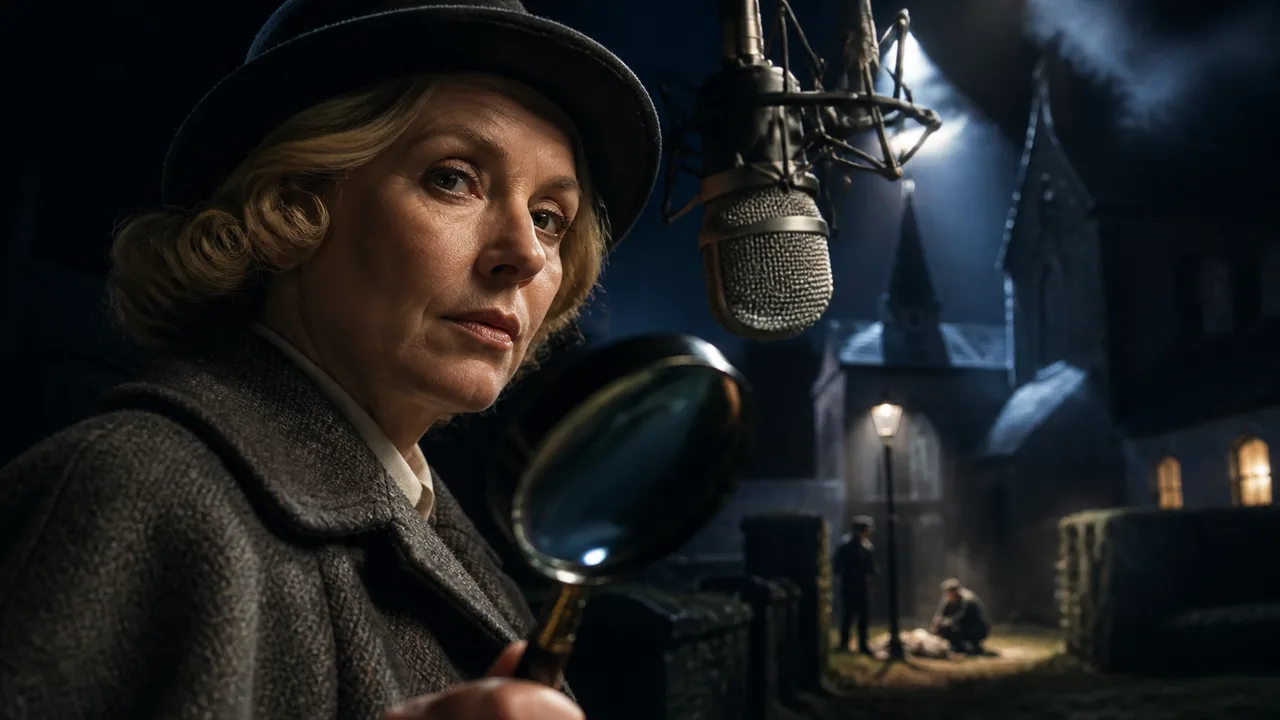
Start with the premise: you can't see anything. No drawing room, no body, no facial expression of the colonel's wife when she learns the vicar is dead. You have only voices — and, critically, only the voices that someone has decided you should hear, arranged in the order someone has chosen, with the pauses they've scripted. That is, it turns out, a very precise analog for how Miss Marple actually operates. She works from inference on incomplete data, constructing a truth from what people say and don't say, from tonal hesitation and the revealing overshare. In a medium that gives you nothing but sound, the listener is structurally positioned where Christie's detective lives. That's a genuinely interesting formal argument for why a podcast, not a streaming series, is the right frame for The Murder at the Vicarage — and it's also, if you pull on that thread, a more interesting argument than anything the promotional buzz about "breathing new life into classic literature" is doing.
The Guardian highlighted the adaptation in its best podcasts of the week, noting that Toni Collette heads "a list of familiar voices playing out the village murder-mystery." Collette's casting is, by any read, the production's central bet. She has a demonstrated range across tonal registers — sharp comedy and genuine menace often in the same scene — which matters for Miss Marple, a character whose power depends on being systematically underestimated. The vicarage, the village, the English coziness: it all functions as camouflage for a woman who sees through everyone and says nothing until she's ready. Collette casting against that expectation of gentle-elderly-lady performance is, at minimum, a statement of intent.
But here's where I want to slow down, because intent and context are different things, and the context of any Christie adaptation in 2026 runs directly through Agatha Christie Limited — the estate's commercial arm, which has managed and licensed her intellectual property with a tenacity that makes other literary estates look relaxed. The Christie estate has been involved in some notable friction over the decades: disputes over how Poirot could be depicted, sustained control over which elements of her biography could be dramatised and by whom, and a pattern of licensing decisions that reflect a very clear institutional view about what the Christie brand means and how it should travel. When the National Theatre's Rufus Norris faced pushback on how Christie's work was being handled in a contemporary adaptation, it wasn't an isolated argument about one production — it was a surface expression of how intensely this particular IP portfolio is governed.
None of that is inherently sinister. Estates exist to protect authors' work, and Christie's output — however one counts it across novels, short story collections, and plays, a question the bibliographic record genuinely contests — is commercially extraordinary. According to the official Agatha Christie site, the estate has been deliberate about audio as a format, and the existing ecosystem confirms there's a market they've been cultivating carefully. Feedspot's 2026 ranking of Agatha Christie podcasts and Millionpodcasts.com's list of the best 30 both show a well-populated audio landscape that predates this adaptation — dedicated Christie criticism podcasts, anthology drama series, reader discussion formats. The Shedunnit podcast, noted on the official Christie audio page, is hosted by Caroline Crampton and takes Christie seriously as a literary object rather than a heritage brand, which is its own kind of commentary on the range of engagements the work supports. Apple Podcasts describes All About Agatha as a biweekly exploration of Christie's life and fiction, treating her as, among other things, "a real-life Dame of the British Empire" — a framing that tells you something about how the Christie audio universe has already been assembled before this production arrived.
So the production enters a landscape that's already textured. The question I keep returning to is: what cultural work is this particular adaptation doing, and for whom?
St Mary Mead — Christie's fictional village where Miss Marple lives and where bodies have a habit of accumulating across multiple novels — is not incidentally English. It is comprehensively, architecturally English: the vicar, the village gossip, the class hierarchies legible in who uses the tradesmen's entrance and who does not, the assumption that murder is a disruption of a natural social order rather than a revelation of what was always lurking in it. That is the world being brought back into a 2026 audio format and positioned, implicitly, as prestige drama.
Prestige is a word worth holding. What signals "quality" in audio in 2026 tends to involve recognisable star casting (Collette), a literary source with established cultural authority (Christie), and a production mode that references rather than disrupts the form — here, the acknowledged nod to golden-age radio drama. The nostalgia isn't accidental; it's the pitch. And I'm not saying nostalgia is without value — there is real craft in the classic mystery form, real formal pleasure in the genre's logic, and Christie's plotting precision is a genuine literary achievement. But nostalgia for what, exactly, and experienced by whom?
This is where Christie's global reach complicates the picture in ways the prestige-audio framing doesn't acknowledge. Christie is one of the best-selling fiction authors in recorded publishing history — her work has found enormous readerships in India, Japan, Egypt, across the Gulf, in countries that have a relationship to the English class system she depicts that is, to put it mildly, not straightforwardly nostalgic. For readers and listeners who encountered Christie in translation, or who read her in English as a window into a world that was simultaneously imperial and cosy — the village that produced colonial administrators, the drawing room that organized a society of extraction — Miss Marple's village is not a comfort. It can be read as one. It can also be read as a document. The audio format's intimacy, the fact that the voices come directly into your ears with no visual mediation, might actually sharpen that ambivalence rather than smooth it over.
That's the version of this adaptation I'm most curious about: the one that knows what it's doing with the form, that has thought about why audio rather than screen, why this novel rather than another, why Collette's voice in particular — and that has something to say to the substantial global audience for whom "cosy English village" is not a default comfort zone but a more complicated proposition.
The Guardian's recommendation gets you through the door. Whether the production itself has thought through what's on the other side of it is a question the first episode will have to answer.
More Like This

Is Nature Good? Harari and Žižek Say No
Yuval Noah Harari and Slavoj Žižek agree: nature isn't inherently good. Their debate reveals why "natural" is almost always a political argument in disguise.
Chapel Head: Time Team Digs the Cambridgeshire Fens
Time Team's "Beacon on the Fens" investigates Chapel Head in Cambridgeshire, uncovering a medieval chapel, Saxon pottery, and layers of prehistoric occupation.

Alexander McCall Smith Launches Positive Distraction Podcast
Alexander McCall Smith brings short fiction and uplifting storytelling to podcasting with Positive Distraction — a deliberate antidote to the relentless news cycle.

Ricky Gervais' Alley Cats: Bittersweet or Just Broken?
Netflix's Alley Cats divides critics sharply. We examine what the sound and voice direction reveal about why the tonal experiment works—or doesn't.

Netflix's Bold February: A Visual Culture Dive
Explore February's Netflix lineup through a design lens, from heists to satire.
Enola Holmes 3 and the Sound of Franchise Fatigue
Enola Holmes 3 is competent, charming, and quietly exhausted. What the score and Millie Bobby Brown's voice reveal about a franchise losing its internal momentum.

A Stonehenge Precursor Found Under a Housing Estate
A 5,000-year-old solar structure found near Stonehenge raises sharp questions about prehistoric astronomy—and how Britain treats unprotected heritage sites.

Destiny 2 Ends: A Community Bungie Built and Switched Off
Bungie ends Destiny 2 content updates in June. Three creators reflect on careers, community, and what happens when a corporation owns your third place.