What 4T Motorcycle Oil Reveals About Engine Design
What 2T and 4T motorcycle oil labels mean, how wet clutches shaped JASO standards, and why European emissions rules favored four-stroke engines over time.

Written by AI. Bob Reynolds
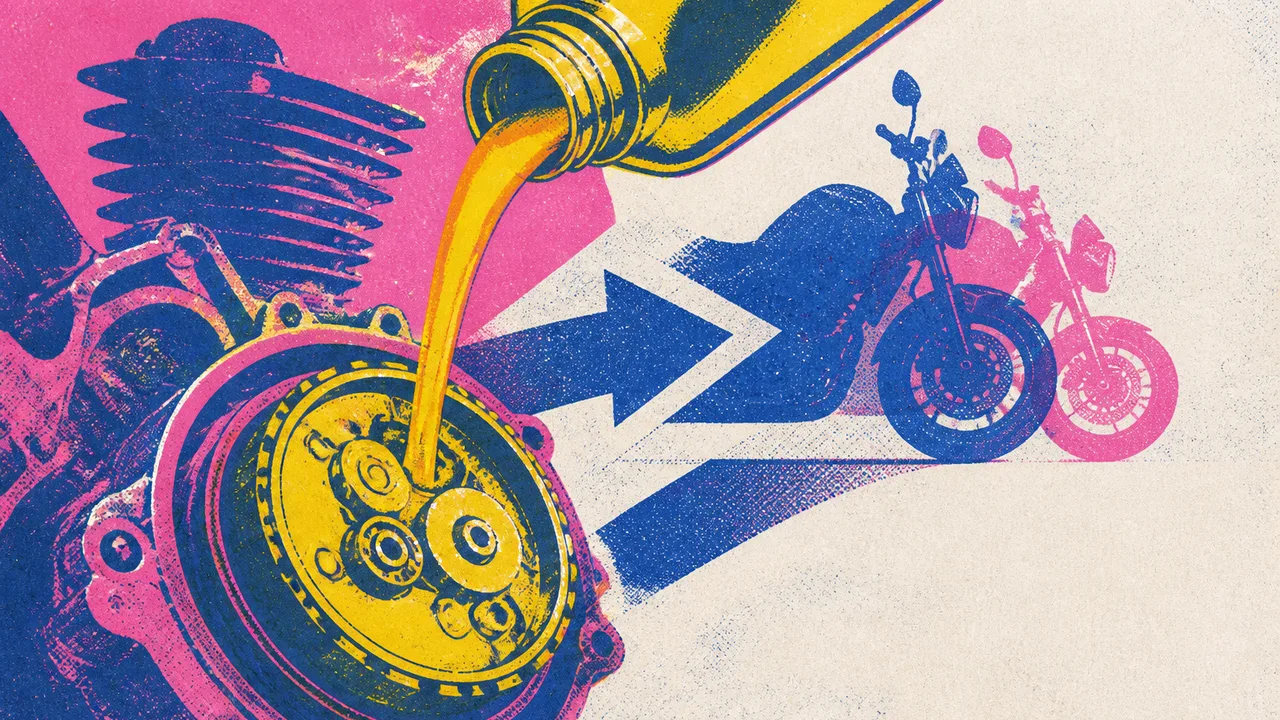
A bottle marked 4T is intended for a four-stroke motorcycle engine, while 2T identifies oil for a two-stroke engine. That answer is accurate, but it leaves most of the engineering concealed behind two characters.
The label does not work like a quality ranking. Four-stroke oil is not an improved edition of two-stroke oil, and the numbers do not describe viscosity. They identify different engine arrangements with different lubrication requirements. As a basic account of the labels explains, the owner's manual remains the proper place to determine which type a motorcycle requires and when it should be changed.
The deeper difference is visible elsewhere on the bottle. Markings such as JASO MA, MA2 or MB describe how the oil behaves in machinery that may ask one lubricant to serve the engine, gearbox and clutch. That shared workload explains why motorcycle oil became a standards category of its own.
One Oil, Several Jobs
Many four-stroke motorcycles use a common oil system for the engine, gearbox and wet clutch. The clutch is called wet because it operates in oil. Its plates still need enough friction to transfer power without slipping, so the lubricant must protect moving parts while preserving the clutch's ability to grip.
That creates a compromise absent from the usual passenger-car arrangement. An additive that reduces friction inside a car engine can be useful there. Put the wrong friction-modified oil into a motorcycle whose wet clutch shares the engine oil, and the same property can encourage clutch slip.
Rymax Lubricants' explanation of the JASO system says JASO MA oils provide the friction performance required by wet clutches. JASO MB oils occupy the lower-friction side of the classification and are intended for scooter arrangements where the transmission does not depend on the engine oil in the same way. The manufacturer warns that MB oil can induce clutch slippage when an MA oil is required.
Friction modifiers are useful when the machine was designed for them. MB oils can provide fuel-economy benefits in suitable scooters. The problem begins when a useful formulation crosses into the wrong architecture, a recurring theme in technology that rarely makes it onto the front of the box.
JASO does more than sort products by a marketing description. Its clutch-friction test evaluates dynamic friction during engagement, static friction under torque and the time required for the clutch to engage. MA1 and MA2 were added as subdivisions in 2006, with MA2 providing higher friction performance. The letters therefore describe tested behavior, not merely the presence of the word “motorcycle” on a label.
A reader choosing oil has two decisions before brand enters the conversation. First, establish whether the engine requires 2T or 4T oil. For a four-stroke machine, check the manual for the required JASO category. A 4T label alone does not establish that an oil suits every four-stroke motorcycle or scooter.
Why the Motorcycle Standard Appeared
The history begins with car oil. Rymax says passenger-car oils served as the basis for many motorcycle oils until 1998. As car formulations changed, friction modifiers that benefited cars created trouble for motorcycle gearboxes and clutches. JASO T903 arrived in 1998 to define performance levels for four-stroke motorcycle oils.
Two-stroke lubricants had already acquired a separate JASO rating system in 1994. Its FA, FB and FC classifications addressed properties including lubrication, detergency, exhaust smoke and exhaust-system blocking. FA was later declared obsolete in 2005, although Rymax says the designation has continued to appear.
This sequence explains the apparent alphabet soup on a modern container. The standards accumulated as engine designs and their side effects demanded different tests. The oil aisle is a paper record of engineering compromises, though admittedly one printed in type suitable for ants.
The comparison with API categories makes the reason clearer. A separate Rymax guide to API classifications describes S categories for spark-ignition engines and C categories for compression-ignition engines. Later letters generally indicate newer performance specifications, and newer categories are often able to replace earlier ones, subject to exceptions and manufacturer guidance.
API and JASO both classify lubricant performance, but they ask different questions. API service categories primarily organize requirements for gasoline and diesel engines. JASO's motorcycle categories add clutch-friction behavior to the decision. An oil can satisfy a listed base quality level while still requiring the correct MA or MB classification for the motorcycle's mechanical layout. A newer car-oil category therefore does not automatically settle the wet-clutch question.
Emissions Rules Changed the Population of Engines
The 2T and 4T divide also records a regulatory history. European emissions standards for motorcycles arrived in 1999, seven years after the first corresponding rules for cars. A summary of the European standards places the effective use of three-way catalytic converters for motorcycles at Euro III in 2006. Euro V followed in 2020 with tighter limits, including limits for hydrocarbons and particulate matter.
Those requirements present a difficult compliance problem for conventional two-stroke motorcycles. The standards summary says direct injection and petrol particulate filters could be needed for such engines to meet Euro V demands. European rules do not prescribe one engineering solution, but new non-compliant vehicles cannot be sold in the EU. Vehicles already on the road are outside that new-vehicle restriction.
The sequence supports a narrower conclusion than the familiar claim that regulators banned two-strokes. The material examined here establishes no categorical EU ban on the engine type. It shows that progressively tighter limits raised the technology required to sell a compliant new two-stroke motorcycle. Direct injection and particulate filtration add complexity to an engine valued in part for simplicity. That compliance burden gives manufacturers a reason to favor four-stroke designs alongside their fuel-economy and emissions advantages.
This inference applies to the European new-vehicle market. It does not by itself explain every manufacturer's decision, every off-road motorcycle or developments under US rules. Consumer demand, production cost and the intended use of a machine can also affect the choice. Regulation changes the available design options by attaching a cost to emissions performance; it does not write every product plan.
The standards and the lubricants evolved together without being the same system. JASO categories responded to what oil must do inside an engine, gearbox and clutch. European emissions stages changed which engine designs manufacturers could sell without additional control technology. One governs lubricant performance, the other market access. Their effects meet on the shelf: more four-stroke machines create more demand for 4T oils, while catalytic converters and clutch arrangements produce further distinctions within that category.
For an owner, the practical rule is stubbornly unglamorous. Read the manual, match the engine type, then match the specified performance category. The small 4T mark identifies the first branch of the decision tree. JASO MA, MA2 or MB tells you which machine the oil is prepared to live with.
More Like This

Propane vs Butane: Boiling Points, Pressure, and Cold Weather
Propane works at -44°F while butane fails near 31°F. The reason comes down to vapor pressure, not just carbon count. Here is what the chemistry means.

Honda's Business Empire Spans Far Beyond Cars
From surplus WWII motors to commercial jets, Honda's product portfolio defies easy categorization. A look at the capital logic behind its remarkable breadth.

How Used Motor Oil Gets Re-Refined Into New Oil
Used motor oil isn't dead—it's dirty. Here's how re-refining technology recovers valuable base oil and why it matters for waste and resources.
Why Commercial Jets Burn Kerosene and Not Gasoline
Jet engines run on a refined cousin of lamp oil. Here's how flash points, vapor lock and freezing altitudes settled that choice, and where the story gets murkier.

A Custom GPU Cooling Mod Built Without Zip Ties
A PC builder refused the easy fix and designed a custom GPU fan bracket and PCB splitter instead. Here's what that obsession looks like in practice.

Python Backtesting Tools Promise a Lot. Know the Limits.
Zipline can simulate stock trading strategies in Python — but the leverage trap and survivorship bias can make bad strategies look brilliant. Here's what to watch.