Intel Arc Pro B70: 32GB of VRAM at a Real Price
Intel's Arc Pro B70 offers 32GB of VRAM for $1,000 and free SR-IOV support. For homelabbers and AI tinkerers, it's a serious buy. Gamers should wait.

Written by AI. Bob Reynolds
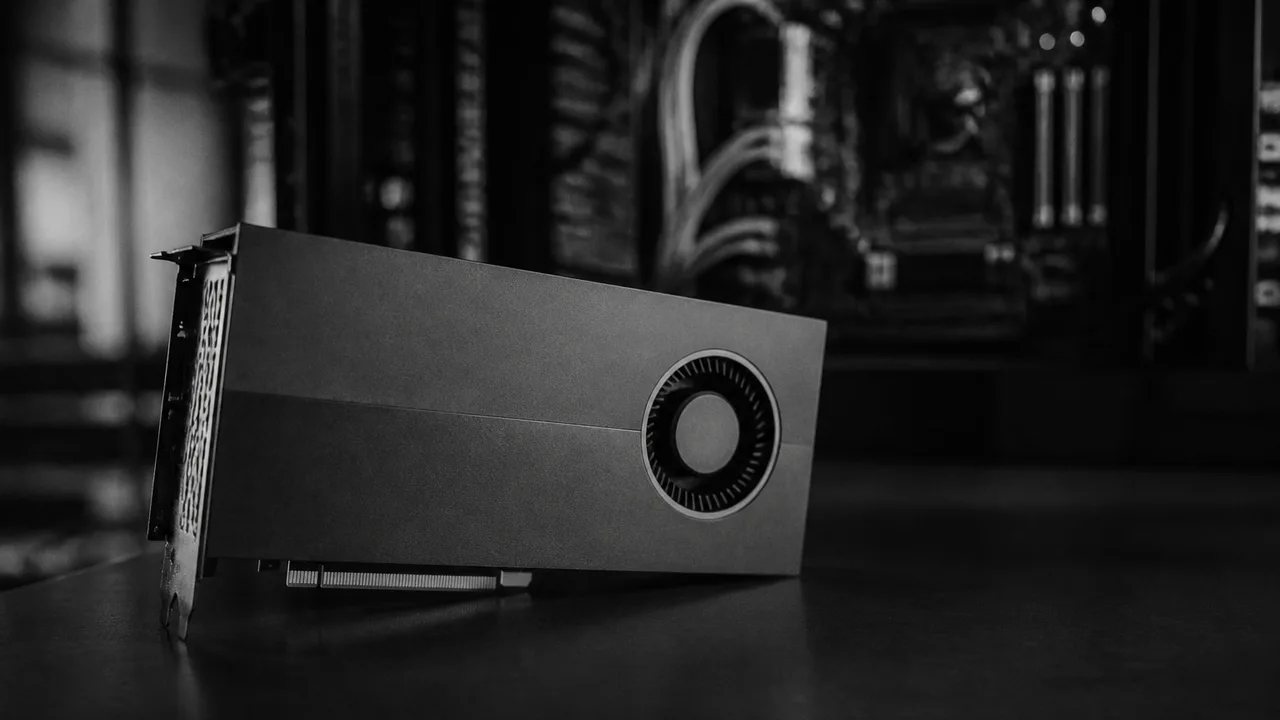
Photo: AI. Atticus Ferenczi
The number that stopped me when I first looked at these specs was $31.25. That's what Intel is charging per gigabyte of VRAM on the Arc Pro B70 — $1,000 for 32GB. The RTX 5090 runs $125 per gigabyte. The AMD Radeon AI Pro R9700 comes in at $43.75. Those aren't rounding errors. That's a structural pricing gap, and it's the reason this card exists as a serious option rather than a curiosity.
The B70 is Intel's workstation-class Battlemage GPU: 32GB of GDDR6, 600 GB/s memory bandwidth, 2.2 GHz base clock, 230W TDP, two slots, single eight-pin connector. It sits above the B60 (24GB, slower bandwidth, fewer XE cores) and well above the B50, which draws a remarkable 70 watts and costs roughly half as much. The lineup is coherent in a way Intel's GPU efforts haven't always been.
Raid Owl, a homelab and self-hosted AI content creator, put the B70 through its paces across three use cases: AI inference, virtualization via SR-IOV, and gaming. His framing is worth quoting directly: "Since Intel is new to the game in the GPU market, I think they need to do two of these three things to stay competitive — that's be cheaper than the competition, do something the competition doesn't, or just perform better." His conclusion is that the B70 clears two of those three bars cleanly.
What 32GB Actually Buys You
The core appeal here is local AI inference — running language models on your own hardware, without cloud API costs or data leaving your machine. For that use case, VRAM is the binding constraint. Most consumer cards top out at 16 or 24GB. The B70 at 32GB lets you load meaningfully larger models, or load multiple smaller ones simultaneously.
Raid Owl tested the card using LlamaBench with a SYCL backend across four models: Qwen 3 4B, Llama 3.1 8B, Mistral 7B, and Qwen 3 32B. On prefill — how fast the card processes your input prompt — the smaller models cleared 1,000 tokens per second, with the Qwen 3 4B hitting over 1,500. To put that in practical terms: at that speed, the card is processing a dense paragraph of text in well under a tenth of a second. The bottleneck in your workflow will be something else entirely.
The more relevant figure for most users is decode — how fast the model streams a response back to you. Raid Owl sets a personal benchmark of 20 to 30 tokens per second as the floor for usable real-time performance. In his testing, the Qwen 3 32B came in at 237 tokens per second on prefill, though its decode rate fell just under that 20-30 token threshold — "which means that it'll feel slower, but it'll be more accurate and helpful," as he puts it. For an 8B model, you're well above that floor, and the interaction feels immediate.
On concurrency — what happens when multiple users or applications hit the model simultaneously — Raid Owl's testing found performance scaled reasonably well up to around eight concurrent streams before plateauing. He also measured time-to-first-token, a latency metric that matters for interactive applications: in his test data, TTFT remained well under a second even at sixteen concurrent streams. He's quick to note that llama.cpp, the inference framework he used, isn't optimized for raw concurrency; the expectation is that vLLM, once it stabilizes on Intel hardware, will push those numbers higher.
The software caveat runs through all of this. Intel's GPU ecosystem — drivers, AI backends, compatibility with the broader model toolchain — is younger and less battle-tested than Nvidia's CUDA stack. SYCL works, but it isn't CUDA, and the gap matters when you're trying to run something that was optimized for Nvidia hardware. This is the single limitation I'd weight most heavily: not the hardware performance, which is competitive, but the friction of being off the dominant platform at a moment when the AI software stack is moving fast.
The SR-IOV Angle
The feature that makes the B70 genuinely interesting beyond raw specs is SR-IOV — Single Root I/O Virtualization. In plain terms, it lets you carve the physical GPU into virtual slices and assign each slice to a separate virtual machine or container. One GPU, multiple independent workloads, running simultaneously.
This exists in enterprise hardware. What's unusual here is that Intel ships it on consumer cards, for free, without an enterprise license or a hardware tier upgrade. Nvidia and AMD both fence this capability behind cost or hardware class. Intel doesn't. Raid Owl is pointed about the irony: "I'm super excited that Intel allows you to just do this with a consumer card natively for free, but on the other hand, I hate that we have to celebrate that this feature is actually available to the masses."
He's right to note both things at once. The feature is genuinely useful — he split the B70 into four 8GB virtual GPUs, sent one to a Windows VM for gaming and another to an Ubuntu VM for AI workloads, and reports both worked. It's also a mild indictment of the rest of the market that this counts as a differentiator.
The capability extends down the Battlemage lineup to the B50. For homelabbers building multi-VM environments on a budget, that's a meaningful data point. The Arc Pro B60 and multi-card configurations extend this logic further — though as we've examined elsewhere, stacking cards introduces its own complexity around software and workload distribution.
Gaming: Honest About the Limitations
Raid Owl doesn't pretend the B70 is a gaming card, and the review is better for it. He ran 3DMark and tested Cyberpunk 2077 at 1080p, high settings, with XeSS super resolution and ray tracing enabled, reporting 100 FPS. He preempts the obvious objection — that XeSS is a crutch — by noting, reasonably, that most people will use upscaling because it works and the frame rate boost is real.
The harder limitation is driver and compatibility maturity. Older games in particular can exhibit issues on Intel's GPU stack, and the ecosystem of per-game optimizations that Nvidia has built over two decades doesn't appear overnight. If gaming is your primary use case for a $1,000 GPU, the B70 is not the card to buy right now. That isn't a knock on the hardware; it's an honest read of where Intel's software is in its development cycle.
Who Should Buy This Today, and Who Should Wait
Here's my read: if you're running a homelab and you want native SR-IOV without paying enterprise prices, buy this card now. The feature works, the price is right, and nothing else on the consumer market offers it. Same goes if your primary workload is local AI inference on models in the 8B-to-32B range and you want the most VRAM per dollar available today. The VRAM-per-dollar math is unambiguous, and the inference performance in Raid Owl's testing is competitive for that tier.
If you're a developer who wants to run AI workloads but needs tight compatibility with a software stack built around CUDA — frameworks, tools, model fine-tuning pipelines — wait. Not forever, but wait until SYCL support in the tools you actually use is tested and stable. Six months of ecosystem development might meaningfully change that calculation.
If you're primarily a gamer, look elsewhere. The B70 can game, but you're paying a workstation card's price for gaming performance that carries real asterisks around compatibility, and you'd be better served by a card from a GPU vendor with a longer track record in that space.
Intel's hardware team delivered something real here. The software team has more ground to cover. Those two facts can coexist, and which one matters more depends entirely on what you're planning to run. My expectation is that Intel closes most of the software gap — the commercial incentive is obvious, and the SYCL foundation is functional — but not fast enough to matter if you need reliable, friction-free operation today. The B70 is a card for people who don't mind being slightly ahead of the support curve in exchange for a price that the competition simply isn't offering.
More Like This
Anthropic's Claude Routines Targets No-Code Automation Market
Claude Routines lets users automate workflows with natural language instead of drag-and-drop builders. Is this the end of traditional no-code platforms?

AgentZero's Sub-Agents: Self-Modifying AI Delegation
AgentZero demonstrates AI agents that create and manage specialized subordinates on demand. The system modifies itself—which raises practical questions.
AMD Instinct MI350P: 144GB HBM3E in a PCIe GPU
AMD's Instinct MI350P brings 144GB of HBM3E and 3.6TB/s bandwidth to standard PCIe servers. Here's what it means for the mid-market AI infrastructure gap.

Anthropic's Advisor Strategy: When Cheaper AI Models Work Better
Anthropic's new advisor strategy pairs expensive Opus with budget models, cutting costs by 12% while maintaining quality. But testing reveals surprises.

Not Every Problem Needs AI. Here's How to Tell.
Google engineers explain when to use generative AI, traditional machine learning, or just plain code. The answer matters more than you'd think.

Gigabyte MW94-RP0 Xeon 6 E-ATX Workstation Board Review
Wendell at Level1Techs tears down the Gigabyte MW94-RP0 Xeon 6 E-ATX board: six PCIe Gen 5 slots, DDR5-6400, and some real airflow warnings.
A Custom GPU Cooling Mod Built Without Zip Ties
A PC builder refused the easy fix and designed a custom GPU fan bracket and PCB splitter instead. Here's what that obsession looks like in practice.

Diffusion Gemma Runs Locally—and That Changes Privacy
Google's Diffusion Gemma runs on consumer GPUs at 700+ tokens/sec. For privacy, the real story isn't speed—it's that your prompts never leave your machine.