Gigabyte MW94-RP0 Xeon 6 E-ATX Workstation Board Review
Wendell at Level1Techs tears down the Gigabyte MW94-RP0 Xeon 6 E-ATX board: six PCIe Gen 5 slots, DDR5-6400, and some real airflow warnings.

Written by AI. Tyler Nakamura
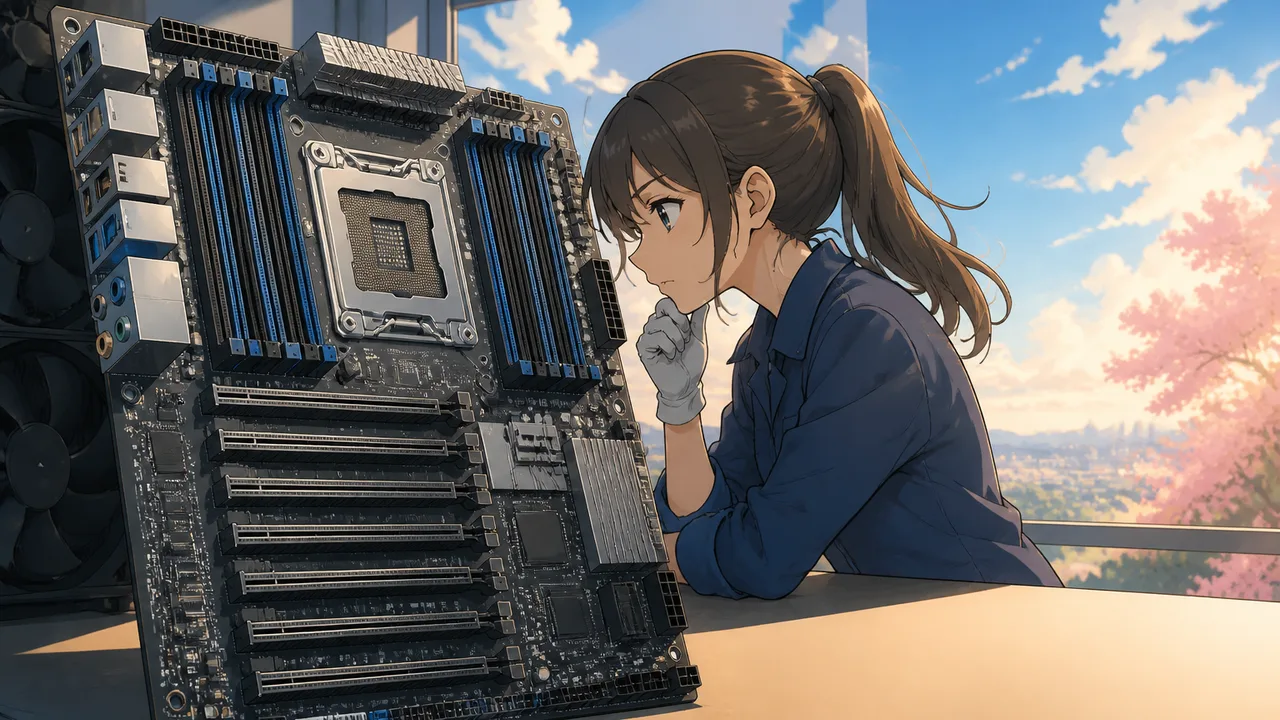
Photo: AI. Mei Fujimoto
An ancient VGA monitor sitting on your desk is apparently the universal signal for "server board incoming" over at Level1Techs. Wendell's latest deep-dive lands on the Gigabyte MW94-RP0 — an E-ATX Xeon 6 board that's gunning for the workstation-slash-server crossover market. It's a board with a clear pitch and some equally clear caveats, and the gap between those two things is exactly where the interesting questions live.
The pitch: PCIe Gen 5, wall-to-wall
The core argument for this board isn't subtle. Six PCIe Gen 5 slots plus two PCIe Gen 5 headers, all fed by up to 128 lanes from the CPU itself (chipset lanes handle a separate SlimSAS 8 connection via the W890). That's a serious amount of bandwidth headroom, and it's why Wendell frames the board the way he does right out of the gate:
"That's why you want this board. That's why you want this platform. It's so that you can host and connect a lot of PCIe Gen 5 peripherals."
Bifurcation goes all the way down to x2, which matters more than it sounds. A lot of Gen 5 storage — particularly enterprise E1/E3 form-factor drives built for density rather than raw speed — only needs two lanes. Being able to carve an x16 slot into eight two-lane connections means this board can actually serve high-density storage builds, not just GPU farms. And for GPU farms: the slot arrangement properly supports four double-wide cards at x16 each, which is a configuration that gets awkward fast on boards that don't think it through.
Five M.2 slots support up to the 22110 length, positioned around the board with cooling in mind. Seven total fan headers are controllable through the ASPEED 2500 BMC, which also handles out-of-band management — complete with that rear-panel VGA port that screams "this is actually a server board wearing workstation clothes." Dual Intel X710 10GbE NICs onboard. Front-panel USB-C. RS232 serial for legacy OOB needs. Onboard audio, because apparently someone at Gigabyte drew a Venn diagram between "workstation user" and "person who wants audio" and found meaningful overlap.
The ceiling: 350W TDP, no exceptions
Here's where the targeting gets precise. Intel launched Xeon 6 with overclockable "X" variants, and if you came to this board hoping to push those, you're going to be disappointed. The MW94-RP0 caps hard at 350W TDP — Wendell is clear that this is a ceiling, not a suggestion.
"This is not a motherboard you want for overclocking. It's 350W TDP is a hard cap."
You can install an X-series CPU. It'll just run within that power envelope. Which means if overclocking is the reason you're buying Xeon 6 in the first place, this isn't your board. If it's not — if you're here for connectivity, memory channels, and IO density — then the cap probably doesn't cost you much in practice.
Memory configuration follows the same non-overclocking logic. DDR5-6400 is officially supported at JEDEC spec, meaning looser timings but stable, native operation. Multi-rank DIMMs can run at DDR5-8000, which is genuinely fast and requires no tricks. What won't work: XMP profiles. Wendell tested Kingston's 6400-branded RDIMMs and found that they're actually XMP overclocks from a 4800 or 5600 base — the board simply won't run them at their advertised speed. JEDEC 6400 works. XMP 6400 doesn't. That's a distinction worth reading twice before ordering memory.
Across JEDEC DDR5 from SK Hynix, Samsung, and Kingston (with proper JEDEC profiles), Wendell reports clean results through 8, 16, 32, and 64GB DIMMs. No instability, no surprises.
Sub-NUMA clustering and where Xeon 6 actually wins
This is the part of the video that deserves more attention than it's going to get in most coverage. Xeon 6 supports sub-NUMA clustering — you can enable additional NUMA groups to reduce effective memory latency. It's an architecture-level feature that translates directly into real-world wins for specific workloads.
"The best, highest and best calling for the Intel platform if you don't need Intel-specific extensions for performance like AMX is relatively low memory and platform IO latency. This can be really good for storage. This can be really good for mixed storage and GPU workloads. This can be really good for AI workstations."
That framing matters a lot for how you evaluate the platform against AMD's alternatives. In raw core-for-core throughput, Xeon 6 holds its own against Zen 4 but trails Zen 5 Threadripper in a number of benchmarks — Wendell is direct about that. AMD's Zen 5 implementation of AVX-512 is notably ahead of Xeon 6's. But Intel's AMX extensions, memory bandwidth, and IO throughput for GPU-heavy workloads are where Xeon 6 closes or reverses that gap.
So the honest summary is: if your workload cares about raw compute throughput and AVX-512 performance, Zen 5 Threadripper is probably ahead. If your workload is GPU-attached, storage-intensive, or specifically tuned for AMX — or if you're running mixed workloads that benefit from low memory latency — Xeon 6 makes a more competitive case. Neither platform is wrong; they're optimized for different pressure points.
Sourcing the chip: a real constraint
One thread running through Wendell's coverage that's easy to miss: getting these CPUs is genuinely complicated right now. He sourced some test hardware from eBay, borrowed a chip from Gigabyte, and noted that "there's no such thing as it samples in this" — everything that's being manufactured is going straight to enterprise buyers who need it.
Per Intel's own specifications, the Xeon 6 658X is a 24-core chip. Wendell's recommendation lands squarely there: the 24-core tier is his sweet spot for buyers where memory bandwidth and IO matter more than raw core count — and it's also the configuration that's actually attainable in something resembling normal retail channels. At 24 cores, he argues Xeon 6 delivers more memory bandwidth and IO than the equivalent AMD 24-core platform, which is the specific advantage that makes the platform worth considering rather than defaulting to Threadripper.
Whether that delta justifies the platform cost and sourcing hassle is a calculation you'll need to run against your specific workload and budget. Prices fluctuate, eBay availability is unpredictable, and Wendell acknowledges that Intel's initial "more compute per dollar" positioning has gotten murkier as supply has tightened.
The airflow problem is not optional
Buried in the feature tour is a warning that deserves a bigger spotlight. This board runs like a server because it is a server board — and it needs server-style airflow to stay healthy.
"I promise you need to upgrade the airflow because you need a lot of front-to-back airflow."
The VRM cooling fans are small by design, sized for environments with serious front-to-back case airflow pushing air across the board. Drop this into a typical enthusiast tower without augmenting the fans and the VRMs will run hot. Wendell needed a second external fan at the back of his open test bench to keep things under control, which is a real-world signal about thermal demands.
His case recommendation: Silverstone, specifically something like the Ceda H2 or one of their rackmount options — but with higher-CFM fans than stock. The board's E-ATX footprint is also genuinely large, so case compatibility needs a careful check before you commit.
Cooler choice matters for a related reason: Arctic tower coolers are recommended over Noctua for this platform specifically because of how they handle airflow direction. The Noctua works, but its geometry fights the front-to-back airflow the board needs. The Arctic unit cooperates with it.
Software RAID and Linux: both fine, different ways
G RAID (which absorbed Intel RST) is the software RAID story here. Wendell's observation that Intel's NVMe RAID solution is reportedly the only one that doesn't require add-in hardware for VMware is interesting if you're in that ecosystem — though he frames it as the best he knows, not a definitive market survey. Linux MD RAID is the simpler answer for anyone running Linux, which Wendell does, and which he reports running cleanly on kernels from 6.7 through the 7.x series with solid IOMMU separation and PCIe ACS support.
One minor BIOS note: MCIO header lane configuration isn't fully exposed in current firmware. Wendell tried running an E810 NIC off an MCIO-to-PCIe adapter — it works, but getting the lane configuration right requires digging into UPI registers rather than a clean BIOS toggle. He expects a firmware update to surface that properly.
The MW94-RP0 occupies a real but specific niche: it's for builders who need dense PCIe Gen 5 connectivity, don't care about overclocking, and are willing to treat airflow as a first-class design requirement rather than an afterthought. That's not a huge audience, but it's a real one — and for that audience, the 24-core Xeon 6 platform's memory bandwidth and IO advantages over AMD at the same core count might be exactly the edge that justifies the platform complexity.
Whether that edge is worth the current sourcing friction is the question the spec sheet can't answer for you.
More Like This

AMD EPYC 8005 Sorano: A Genuine Generational Leap
AMD's EPYC 8005 Sorano upgrades SP6 with Zen 5 cores, 84-core density, and 96 PCIe Gen 5 lanes—but the ecosystem remains niche and memory costs sting.
Intel's Core Ultra 7 270K Plus: Budget CPU That Beats Pricier Chips
Intel's $299 Core Ultra 7 270K Plus outperforms AMD's twice-as-expensive 9950X in creative workflows. We break down the benchmarks and the conspiracy.
How One Engineer Created the AM5 Motherboard AMD Won't Build
A Level1Techs engineer bypassed AM5's PCIe lane limitations using a $1,200 Broadcom bridge to run four GPUs on consumer hardware—revealing what's possible.
This Tool Treats Your Home Lab Like Infrastructure Code
RackPeek documents home labs as YAML code in Git. Brandon Lee shows how this infrastructure-as-code approach beats static diagrams and spreadsheets.
9850X3D Processor: A Gamer's Dream or Overhyped?
Explore the 9850X3D's 7% performance boost. Is it worth upgrading? Dive into gaming benchmarks and CPU trends.

When Walmart Sells Last-Gen GPUs Cheaper Than Amazon
A PC build experiment reveals an uncomfortable truth about 2026 hardware markets: sometimes the discount bin beats the cutting edge.

FCC Ends Rule Requiring ISPs to List All Fees
The FCC just killed the rule forcing ISPs to itemize every fee on your bill. Here's what changed, who pushed for it, and what it means for your wallet.

Big Tech's $1.65 Trillion Off-Balance-Sheet AI Debt
Nikkei finds Alphabet, Microsoft, Amazon, Meta, and Oracle carry $1.65T in off-balance-sheet AI debt—more than their actual reported debt combined.