Weekly Wall Squats May Maintain Some Blood Pressure Gains
After four weeks of thrice-weekly wall squats, one weekly session preserved some blood-pressure gains for a month. The trial cannot establish a starting dose.

Written by AI. Kira Yoshida
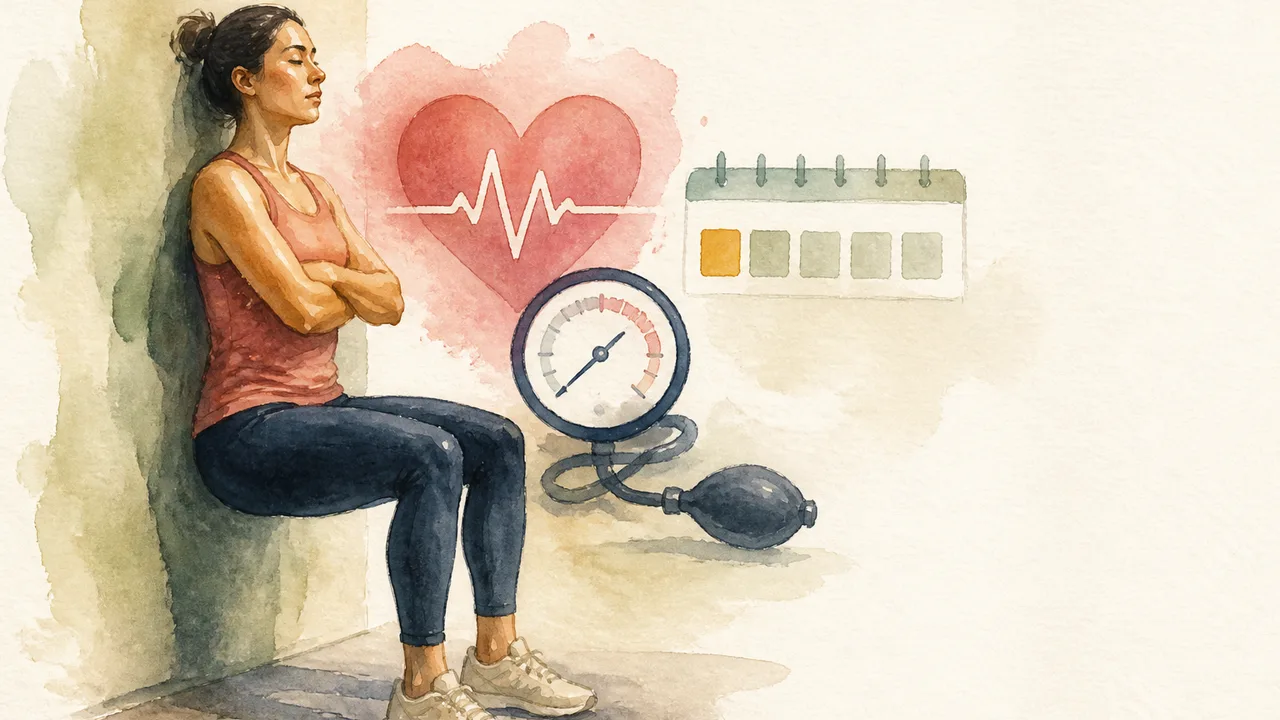
A 2026 wall-squat trial found that one session a week preserved some blood-pressure improvements for four weeks, after participants had already trained three times a week for a month. Anyone hoping to begin with one weekly session has a different question from the one the researchers tested.
The eight-week trial, published in BMJ Open Sport & Exercise Medicine, enrolled 100 adults with normal to high-normal systolic blood pressure who did not regularly do structured exercise. The exercise groups first did four weeks of home-based wall squats: four holds per session, with two minutes of seated rest between them, three sessions each week. For the next four weeks, they continued at three, two or one session a week, or stopped. A control group did not follow the program.
A wall squat is an isometric exercise: you hold a position rather than moving repeatedly through it. The appeal is easy to see. The equipment list starts and ends with a wall, and the session consists of four holds rather than a trip to a gym. But every person assigned to a reduced-frequency group first had the same three-sessions-a-week training period. The study asks what happened when people continued less often. It cannot tell a newcomer whether one weekly session would produce the initial improvement.
What the Blood-Pressure Numbers Did
After the first four weeks, the exercise groups had statistically significant reductions, compared with the control group, in systolic pressure, diastolic pressure and mean arterial pressure. Systolic is the top number on a blood-pressure reading; diastolic is the bottom number. Mean arterial pressure summarizes pressure across the cardiac cycle. By week eight, the once- and twice-weekly groups still had significant reductions in systolic and mean arterial pressure relative to control. None of the exercise groups had a statistically significant diastolic difference from control at that point.
So a weekly wall-squat session preserved a measurable difference in two of the three pressure measures during the maintenance phase. The diastolic result keeps the claim narrower than “lower blood pressure” might suggest. And the trial followed the reduced-frequency groups for only four weeks. A calendar with one squat session circled each week might be useful after a regular training spell; the study does not show what that calendar looks like six months later.
At eight weeks, the three-times-weekly group had the largest reported average systolic reduction from its own starting point, 13.73 mmHg. The twice-weekly group’s reduction was 6.95 mmHg, and the once-weekly group’s was 6.56 mmHg. The three-session group also retained improvements in other measured cardiovascular indicators, including total peripheral resistance and heart-rate variability. Those results give the more frequent schedule a stronger showing across the measurements reported here. They do not forecast any individual reader’s next cuff reading.
There are two comparisons tucked into those numbers. The reductions in millimeters of mercury compare each group with its own starting point. The findings described as statistically significant compare groups with the control group. Keeping those questions separate helps when a larger-looking average threatens to become a promise about what your body will do.
The group that stopped wall squats after week four had blood pressure that was no longer statistically distinguishable from control at week eight. Of the 100 participants, 80 were assigned to exercise and 20 served as controls. After four weeks of three weekly sessions, the exercise participants followed the three-, two-, one- or zero-session schedules for the next four weeks; the controls remained the comparison group. For someone whose routine has been squeezed, keeping one session might be a plausible short-term way to retain some measured gains. The trial did not test restarting after a longer break.
Why Wall Squats Were on the Research Agenda
Isometric exercise arrived at this trial with a research history. A review of isometric resistance training describes an earlier network analysis of 270 randomized trials that found isometric exercise especially effective for reducing resting blood pressure. That provides a reason to investigate the humble wall squat. The 270 trials did not all test this eight-week schedule, and their findings cannot supply the missing answer about beginning with one session a week.
The history is less tidy for diastolic pressure in people with hypertension. The review describes an earlier meta-analysis of five studies that found no statistically significant diastolic effect, while another, of 12 studies, found one. Those are the review authors’ summaries of the earlier analyses. The new trial’s week-eight diastolic result gives readers another reason to track which pressure measure changed. Because its participants did not have diagnosed hypertension, it cannot resolve the disagreement about that population.
The volunteers’ eligibility rules draw another boundary around the result. Their average age was 37.4 years, their starting systolic readings were in the normal to high-normal range of 120–140 mmHg, and they did not regularly do structured exercise. Participants had no injuries or illnesses, did not smoke and were neither taking nor previously taking blood-pressure medication. Someone managing diagnosed hypertension with medication, or looking for movement that accommodates an injury, was outside the group studied. These results do not establish the effect or safety of the schedule for those readers.
A Wall is Handy; a Whole Activity Plan Has More Room
The World Health Organization’s physical-activity guidance recommends 150 to 300 minutes of moderate aerobic activity a week for adults, or an equivalent amount of vigorous activity. It also recognizes muscle-strengthening benefits and counts movement during work, transport, household tasks and leisure. Walking, wheeling and cycling appear among its examples. That menu has room for different bodies and different days; the trial tested one static exercise and measured short-term cardiovascular outcomes.
WHO’s aerobic target cannot answer how often someone must repeat wall squats to retain a change in blood pressure. The squat trial, in turn, did not test whether its brief sessions deliver the wider health benefits sought by activity guidance. No arithmetic turns four holds against a wall into an evaluated substitute for the rest of a movement routine. A hold can still be one useful way to move, without having to audition for the role of Complete Fitness Plan.
The schedule offers a modest choice rather than a command: among people who had already trained regularly, one weekly session preserved some measured gains over the next month, while three weekly sessions had the largest reported systolic reduction and retained other measured changes. Starting from scratch or managing hypertension calls for questions this trial did not answer, including what plan fits the person and their care. A wall may be the most accessible piece of exercise equipment around. It does not have to carry every expectation we place on movement.
More Like This

Homeschooling Is a Family-System Decision, Movement Included
A family-systems look at homeschooling: evidence limits, curriculum marketing, services law, and the movement question most checklists forget to ask.

Can Better Physical Function Help Protect Your Hearing?
A study links better physical function with better hearing, but it does not prove exercise prevents hearing loss or rule out blood pressure as a factor.

Virtual Nature Shows Promise for Hospital Blood Pressure
A hospital study links virtual river scenery and classical music to rapid blood pressure drops, but key design details and lasting benefits remain unclear.

How Streaming Platforms Use Psychology to Hold Your Attention
Streaming platforms are built on behavioral science. Here's what media psychology actually says about autoplay, thumbnails, and what prolonged watching does to your body.

The Sardine Fast: Metabolic Reset or Wellness Trend?
Thomas DeLauer breaks down the physiology of eating only sardines for three days. Here's what the science actually supports—and where the gaps are.