How Streaming Platforms Use Psychology to Hold Your Attention
Streaming platforms are built on behavioral science. Here's what media psychology actually says about autoplay, thumbnails, and what prolonged watching does to your body.

Written by AI. Kira Yoshida
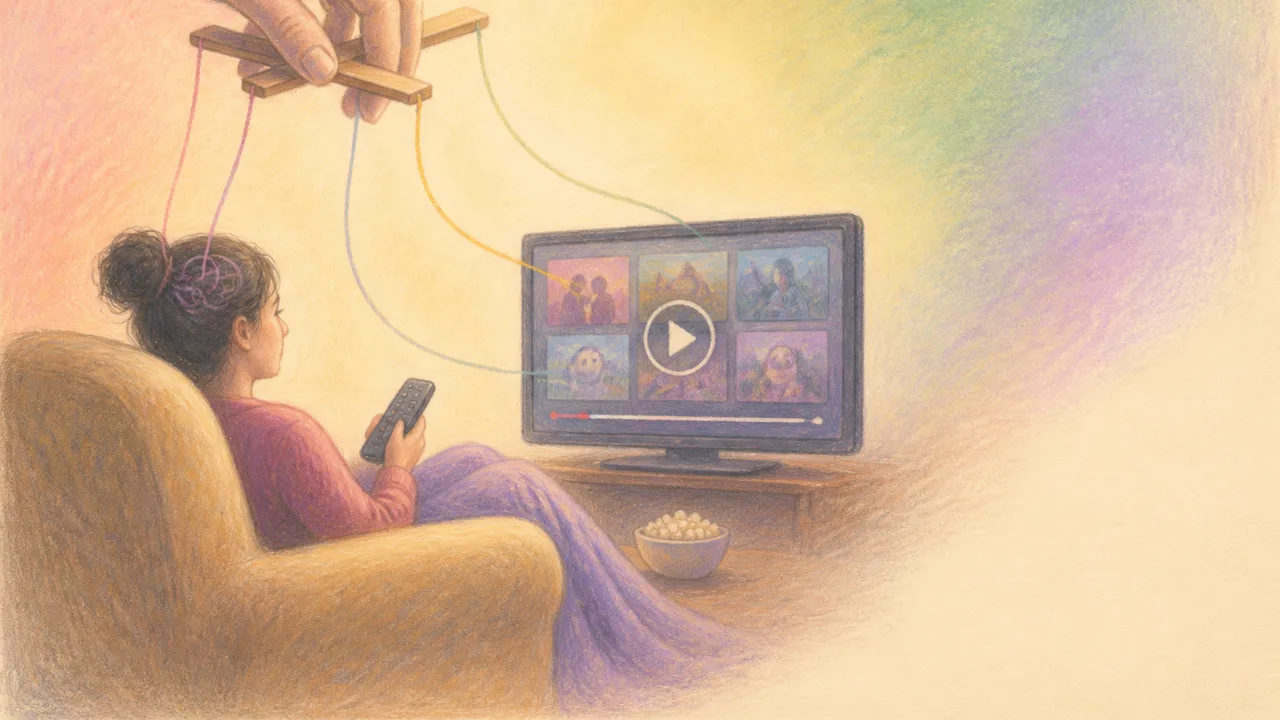
Here is a thing that has probably happened to you: you sat down to watch one episode of something, and somewhere around midnight you were five episodes deep, vaguely dehydrated, and not entirely sure how you got there.
That's not a character flaw. That's an engineering outcome.
Streaming platforms are not accidentally good at keeping you watching. According to Psychology Today, the most successful platforms have been built using media psychology in designs specifically intended to keep viewers immersed, loyal, and habituated. The word "habituated" is doing a lot of work in that sentence. Habit formation is a well-documented psychological process. What's newer is the degree to which entertainment infrastructure has been deliberately architected around it.
Understanding what's actually happening — not to be paranoid about it, but because it's genuinely interesting — means pulling apart a few distinct mechanisms.
The Recommendation Engine Is Not Trying to Please You
It is trying to predict you, which is a subtly different thing.
Personalized recommendations don't work by identifying what you want. They work by identifying what you're likely to start — and then optimizing for the probability of continuation. That distinction matters. A recommendation that gets you to click and stay for three hours is more valuable to the platform than a recommendation for something you'd genuinely love but finish in 90 minutes and then close the app.
The thumbnail is part of this system. The Independent reported that Netflix has used A/B testing on personalized thumbnails — showing different images to different users to determine which visual presentation is most likely to generate a click from that specific person, based on their viewing history. The image you see for a film is not necessarily the image someone else sees for the same film. It's the image the algorithm calculated would work best on you.
This is media psychology at a granular, individualized scale. And it works.
The Mechanics of Staying
Autoplay is the feature that gets the most cultural criticism, but it's worth understanding why it's effective rather than just noting that it is.
The phenomenon at play is something behavioral scientists call "status quo bias" — the human tendency to continue whatever we're already doing unless we're given a clear reason to stop. Autoplay exploits this by making continuation the default and stopping the effortful choice. By the time the next episode has loaded and the theme music is playing, you're already watching it. The decision window was small, and the platform filled it.
Choice Hacking's analysis of Netflix's design philosophy notes that Reed Hastings has cited "hours per subscriber per month" as Netflix's primary success metric — framing the platform's design goal clearly: not which shows you like, but how long you stay.
This is worth sitting with. "Hours per subscriber per month" is not a metric about satisfaction. It's a metric about time capture. Those are correlated but not the same thing, and the conflation is where things get philosophically interesting.
The Uses and Gratifications Wrinkle
Here's where the story gets more complicated, and where I think a lot of cultural criticism of streaming loses its grip.
Media psychology doesn't just study how platforms manipulate viewers. It also studies why viewers show up and what they're actually getting from the experience. The theoretical framework called Uses and Gratifications — which has been around since the 1970s — is built on the premise that audiences actively seek media to satisfy specific needs, rather than passively receiving whatever platforms deliver.
A PMC-published study on streaming and wellbeing applied this framework to a mindfulness-focused streaming service and found that users engaged with content specifically to increase or maintain their sense of wellbeing — and that frequent engagement did satisfy those needs. In other words: when people choose media that meets something they're actually looking for, it can work in their favor.
The tension here is real. Platforms are designed to capture time. Users are also, genuinely, meeting needs through that time. Both things are true simultaneously, and collapsing them in either direction — "it's all manipulation" or "you chose this freely" — misses the complexity.
What the research suggests is that the question isn't whether streaming serves psychological needs (it does), but whether the platform's goals and the viewer's needs stay aligned across an entire session — or whether platform design engineers a gap between them over time.
What This Is Actually Doing to Your Body
I cover movement science, so I can't write about extended sedentary behavior and just leave it there.
Research published in Physiological Reviews by the American Physiological Society associates prolonged sedentary behavior with reduced insulin sensitivity, elevated inflammatory markers, and decreased cardiovascular efficiency. These aren't dramatic overnight effects — they're cumulative, which is partly what makes them easy to ignore. Your body doesn't send you a notification.
I want to be careful here, because I'm not interested in moralizing about rest. Lying on the couch watching something absorbing is a legitimate human activity. Your body wants rest sometimes — that's not a weakness, that's physiology doing exactly what physiology does after a day of being a person in the world. But there's a difference between rest you chose and rest that was engineered to extend itself beyond what you'd have chosen with a neutral interface. The physiology doesn't distinguish between them. The design intent does.
The Innovation Pressure Underneath All of This
Psychology Today's piece on streaming in a wider media context references Disney CEO Bob Iger's frame for the competitive landscape: innovate, innovate, innovate, with content creators focusing on creativity and technical people focusing on distribution. What's interesting about that frame is what it leaves implicit — that the psychological layer, the layer that determines whether any of it actually sticks, is baked into both sides.
Consumer psychology expert Dr. Brent Coker, writing via experts-blog.com, points to the role of emotional investment and brand attachment in the rise of Disney+ specifically — the nostalgia infrastructure, the franchise continuity, the way Disney leverages existing emotional relationships with characters and worlds to lower the threshold for subscription decisions. That's a different psychological mechanism than Netflix's retention engineering, but it's psychology all the way down.
Streamshark's analysis of live streaming adds another layer: real-time interaction, the sense of shared experience, and the community dimension that distinguishes live content from on-demand. The psychology of "we're all watching this together right now" activates something that algorithmic recommendation doesn't — social presence, participation, belonging. Platforms are increasingly trying to manufacture that feeling even outside live contexts.
What You Can Actually Do With This
I'm not going to tell you to delete your streaming apps. That's not the piece I'm writing.
What I will say is that understanding the mechanics changes your relationship to them. Status quo bias is easier to interrupt when you know it's happening. The deliberate moment of "do I actually want to watch another episode?" — just the pause, just the choice point autoplay is designed to eliminate — is something you can reinsert. It takes about three seconds. The platform bet you wouldn't bother.
And for what it's worth: the research on Uses and Gratifications suggests that streaming can genuinely meet real needs when you're the one doing the choosing. Watching something because you sought it out feels different from watching something because the interface made stopping slightly harder than continuing. Bodies know the difference too — there's a specific quality to movement you chose, whether it's a walk or a stretch or just standing up to refill your water, that is categorically different from movement that happens because you finally ran out of show. One is yours. The other is the gap between episodes.
The platforms are very good at what they do. That's not a reason to be passive about it.
More Like This

Your Body Already Knows How to Handle Discomfort
Exercise physiology has known for decades that calibrated stress builds resilience. So why does the wellness industry keep selling you comfort instead?
Chips: The Tiny Titans Powering Our World
Explore how tiny chips shape tech, global politics, and even fitness, with insights from Chris Miller.
Morning Routines: Intention, Gratitude, and a Dash of Skepticism
Explore morning routines focusing on intention and gratitude, with a critical look at wellness industry promises.
YouTube's 50MB Thumbnail Update Signals Living Room Strategy
YouTube increased thumbnail size limits from 2MB to 50MB as TV viewing surpasses Netflix. What this platform shift means for creators and the streaming wars.

Your Distracted Mind Isn't Social Media's Fault
Philosopher Bence Nanay argues our attention crisis runs deeper than TikTok. The real culprit? The cognitive cost of a fragmented mind policing its own secrets.

Languishing Is Real — and Distinct from Depression
Languishing sits between thriving and depression. Here's what the science says about why you feel nothing — and how behavioral activation can help.
The Sardine Fast: Metabolic Reset or Wellness Trend?
Thomas DeLauer breaks down the physiology of eating only sardines for three days. Here's what the science actually supports—and where the gaps are.
Eckhart Tolle Says Know Less. Your Body Already Does.
Eckhart Tolle's case for 'not knowing' as spiritual awakening has real overlap with movement science—and a $139/year subscription attached to it.