Homeschooling Is a Family-System Decision, Movement Included
A family-systems look at homeschooling: evidence limits, curriculum marketing, services law, and the movement question most checklists forget to ask.

Written by AI. Kira Yoshida
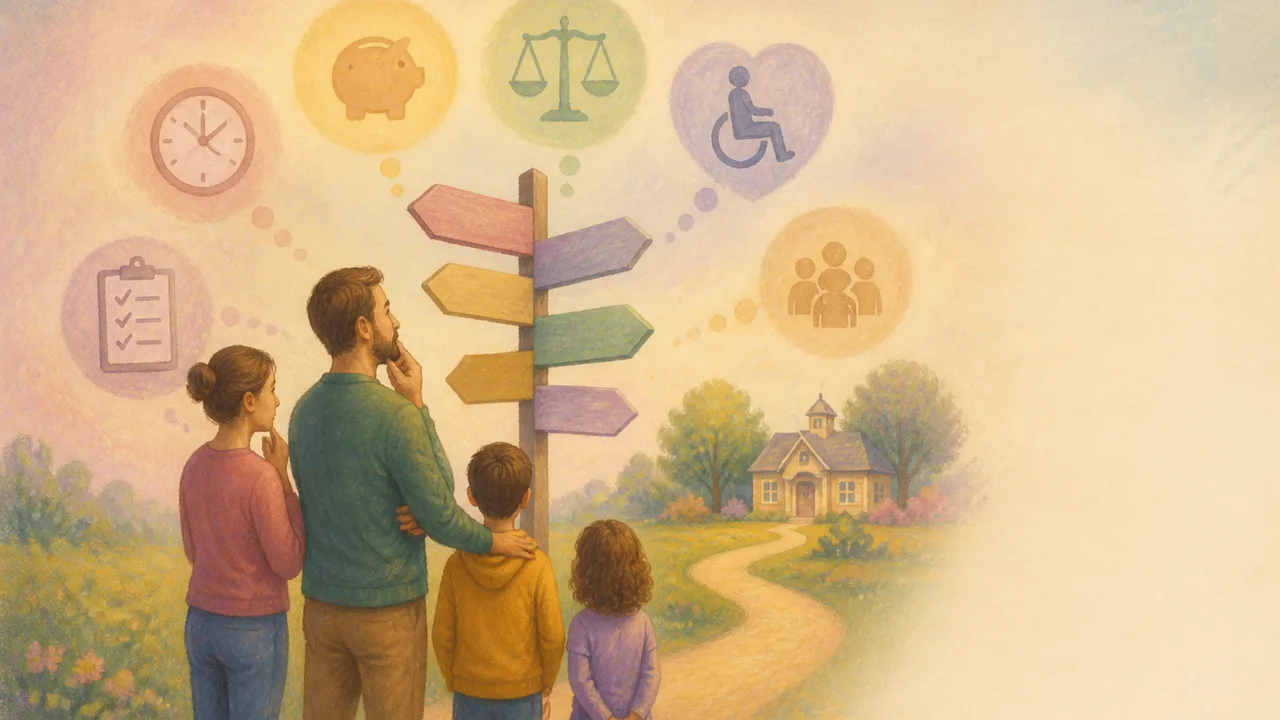
Homeschooling is not just a schooling decision, it is a family decision. It affects far more than curriculum and academics, touching everything from teaching time and socialization to finances, legal requirements, technology, disability support, and the day-to-day impact on a parent’s work and a child’s routine.
School is a system: it delivers instruction, but it also schedules your kid's day, feeds them lunch next to other humans, runs recess, fields a soccer team, and routes therapy referrals. Pull a child out of that system and the whole system has to be rebuilt at home, on purpose, by people who also have jobs.
What the Evidence Can and Can't Say
Anyone selling you a definitive answer about homeschool outcomes is selling. Comparisons between homeschooled and conventionally schooled kids are wrecked by selection bias, because families who homeschool differ in resources, motivation, and prior achievement before day one. A kid whose parents can afford one income at home and who was already thriving is not a controlled comparison for anything. No one has run the study that would settle it, randomly assigning children to school or home, and I'd be surprised if any ethics board ever approves one.
So when a curriculum company waves test-score charts at you, ask who took those tests and who paid for the envelopes.
Where the Advice Actually Lands
The mainstream parenting advice is more honest than you'd expect. Parents.com walks through pros and cons and lands on: weigh how each factor hits your own circumstance, then trust your call. Focus on the Family notes that homeschooling gives families the greatest autonomy to customize curriculum and schedule, but that all decisions and financial costs fall on the parent, which it admits can be daunting. HomeSchool ThinkTank makes the budget point plainly: homeschooling can run on a tight budget or with lots of extras, and the key is knowing what your family can actually manage.
Even crowd wisdom converges there. A long-running Parenting Stack Exchange thread notes that most homeschool parents treat daily friction with their kids as opportunities for growth, and warns that if you don't see it that way, the arrangement will grind you down. Overcome With Us puts it in one line: it's rewarding, but it's not right for everyone, so examine your motivations and your child's needs first.
Every one of these sources is gesturing at the same thing: the decision is about capacity, not conviction.
The Movement Question Nobody Puts on the Checklist
Here's the item I'd add, because it's the one this column exists to ask: what happens to your kid's body?
School, whatever its academic flaws, is a physical-activity machine. Recess, PE class, walking to the bus stop, the walk between classrooms, the pickup basketball game at lunch. Public health guidance puts school-age kids at around 60 minutes of moderate-to-vigorous activity per day, and school supplies a large chunk of it by default. Homeschooling deletes that default. Nobody is auditing whether your Wednesday included a sprint.
This matters for motor development, not just calorie burning. Fundamental movement skills like running, throwing, balancing, and catching are built through practice and instruction during childhood, and kids who don't get both fall behind in ways that track into adolescence. A homeschooled kid also loses the low-stakes talent-discovery layer: the coach who spots the swimmer, the rec league that turns a clumsy ten-year-old into a midfielder by fourteen. Youth sports access becomes something you must actively arrange, pay for, and drive to, which stacks it onto the same parent-capacity ledger as everything else.
If you homeschool, the honest plan treats movement as a scheduled line item, same as math: a daily activity block, at least one structured physical skill activity per week, and an actual count of whether the 60-minute target is being hit. If you can't name where those minutes come from, the arrangement is missing something.
The Vibes Economy of Homeschool Products
Now the part I'm contractually obligated to enjoy: the marketplace. Homeschooling's growth has spawned a curriculum and co-op industry, and it runs on the same wellness-industry playbook I flag in fitness: emotional branding, unverifiable claims, and the word "evidence" deployed as decoration.
Look at how these products are pitched. "Customize your curriculum to fit your needs best," Focus on the Family promises, which is true and also means you've become your own curriculum review board with no accreditation office. Enrichment co-ops market "whole-child" learning and "natural development" the same way a supplement brand markets "cellular health." Neither phrase survives contact with a controlled study, and neither is meant to. When the customer is an anxious parent and the product is a promise, marketing beats methodology every time.
The defense is boring and it works: ask for outcome data from anyone selling you an educational product, ask what population it was measured on, and treat "backed by research" with no citation as "backed by vibes."
The Services Layer, and the Law's Actual Limits
A related trap: families of kids with disabilities often assume the school district's supports travel with them. They often don't. In the U.S., the Individuals with Disabilities Education Act (IDEA) governs special education services for students in public schools, and what a homeschooled child is entitled to, including therapies or specialized instruction through the district, varies by state because states classify homeschoolers differently. The Psychology Today piece is right to list disability support as a first-order question. If your child has an IEP, the practical move is to get the district's services position in writing before you withdraw, not after.
If You're the Kid Reading This
Hi. You live inside this arrangement and, funny enough, you're the stakeholder with the most data. If your family homeschools, you're entitled to a say in whether it's working. That means saying out loud what's not working: the curriculum that makes no sense, the weeks with zero friends in them, the fact that your entire social life is a Tuesday co-op. A good version of this plan has a review clause, and you should be in the room for it, not the subject of it. Ask for that. It's a reasonable request, and a parent who frames obedience as the price of education has told you something you should act on.
The Review Clause
The single worst version of this decision is the ideological one, where homeschooling becomes an identity and every semester gets evaluated against the identity instead of the child. The fix is mechanical: pick a review date, define exit criteria in advance (academic progress measured by something external, peer contact that's actually happening, the adult's capacity holding up), and treat the arrangement as renewable, not permanent.
A setup that fits one kid in third grade can be wrong for the same kid in seventh. Write the exit criteria down now, while you're calm, so future you is deciding with a plan instead of a meltdown. If the criteria are met, you've done the thing well. If they're not, leaving is the successful outcome, not the failure of one.
More Like This

Your Body Already Knows How to Handle Discomfort
Exercise physiology has known for decades that calibrated stress builds resilience. So why does the wellness industry keep selling you comfort instead?

Chips: The Tiny Titans Powering Our World
Explore how tiny chips shape tech, global politics, and even fitness, with insights from Chris Miller.

Handwriting Beats Typing for Learning, Studies Find
New research shows handwritten notes improve memory and recall more than typing. Here's what the science says — and what it actually means for kids and parents.

How Sports Actually Bring People Together
Sports are celebrated as a universal unifier—but how does that actually work, and when does it fall short? We map the real science and the real limits.
How Big Tech Took Over America's Classrooms
Natasha Singer's NYT reporting reveals how Apple, Google, and Microsoft shaped every layer of the K-12 education supply chain. Here's what that actually means.

5 Life Regrets That Are Actually Real (With Caveats)
The Art of Improvement's viral regret video gets a lot right — but the gap between what you *should* do and what you *can* do is where self-improvement content always falls apart.

Gut Health Is Real. Most Gut Products Are Not.
Vox talked to doctors and researchers at Cedars-Sinai about what gut health actually means—and why most of what's being sold to you doesn't hold up.

Sugar, Soda, and Mental Health: What the Research Shows
New research links high sugar intake—especially from soda—to depression and anxiety. Here's what the science actually says, and what it doesn't.