Vienna's Globe Museum: The World's Only Globe Collection
Vienna's Globe Museum holds over 250 historic globes, making it the world's only public museum devoted entirely to globe-making. Here's why it deserves your time.

Written by AI. Kael Maddox
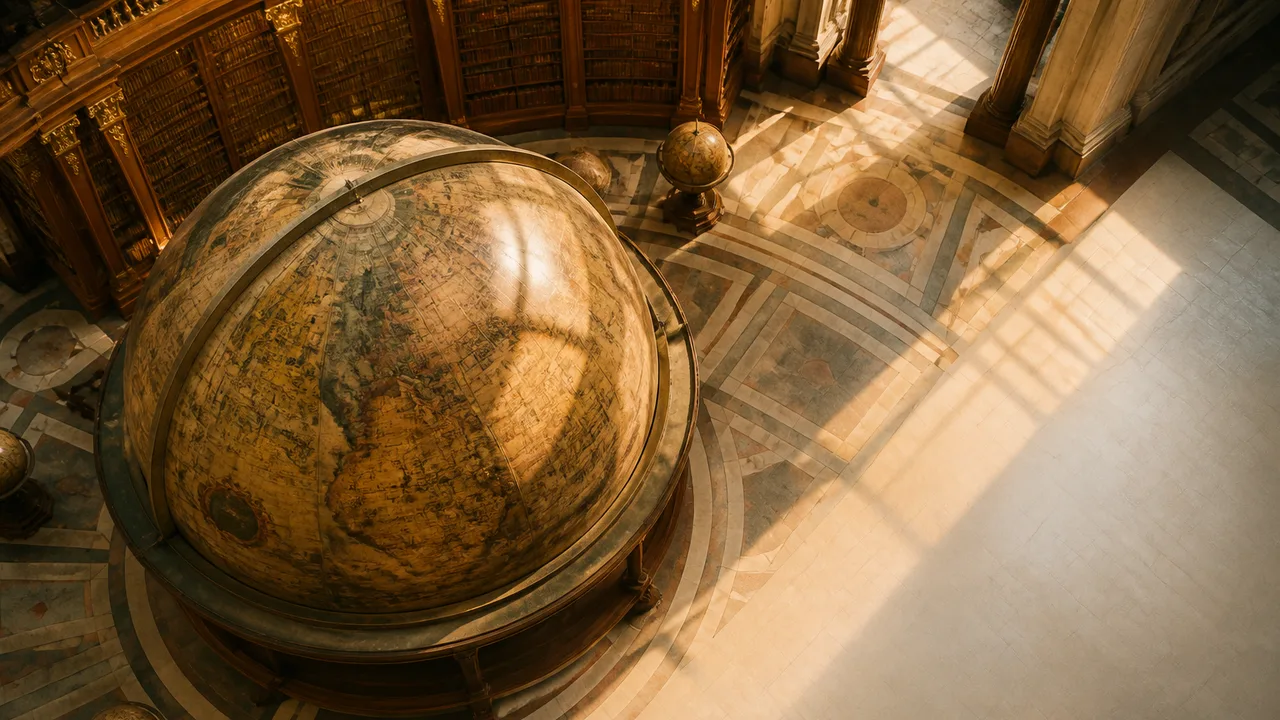
I almost didn't go.
That's the honest version. I had two afternoons left in Vienna and a shortlist that included the Kunsthistorisches Museum, the Naschmarkt, and a Heuriger somewhere in Grinzing where I'd been told the wine comes out of the tap and nobody checks whether you're having a good time. The Globe Museum was a footnote, something a stranger at a coffee house had mentioned with the exact energy of someone who wasn't sure I'd understand why it mattered.
I went anyway, mostly because the Kunsthistorisches felt like homework and I wasn't in that mood.
The museum sits within the Austrian National Library complex in the Palais Mollard, which is the kind of address that should probably come with a powdered wig. You walk in, pay what introducingvienna.com describes as reasonable admission, and then you're in a sequence of rooms where the entire subject is: globes. Not globes as a side note to something bigger. Not a globe in a corner of a broader cartography exhibit. Just globes. Hundreds of them. According to whichmuseum.com, the full collection runs to around 600 terrestrial and celestial globes, of which roughly 200 are on display at any given time. The Austrian National Library's own site puts the exhibition at over 250 exhibits, including lunar and planetary globes and a scattering of astronomical instruments.
It is, as BBC Travel notes, the only museum in the world dedicated entirely to globes. I did not know that before I walked in. I'm not sure it would have changed my calculus if I had.
Here's what I wasn't prepared for: standing in front of a globe made in 1536 and feeling genuinely unsettled by it.
According to visitingvienna.com, that globe was made by Gemma Frisius, a Flemish mathematician and cartographer, and it is the oldest globe in Austria and one of the oldest surviving globes anywhere in the world. Frisius is a legitimately significant figure in the history of navigation: he was among the first to theoretically propose that longitude could be determined using portable timepieces, a method that would remain largely impractical for another two centuries until the instrumentation finally caught up with the idea. That gap, between knowing something in theory and being able to use it, is the kind of thing that doesn't feel abstract when you're looking at the object the man actually made with his hands.
The globe itself is small. That surprised me too. I'd expected something ceremonial and enormous, the kind of thing a king keeps in his study to gesture at when making geopolitical decisions. This was not that. It was the size of something you could tuck under one arm, and it showed a world that was partly correct and partly invented, coastlines that stop where knowledge stopped, continents that blur at their edges into speculation. The Americas are there, barely. The Pacific has the proportions of a guess.
What you're looking at, standing in front of it, is the boundary of what Europeans in 1536 knew with any confidence about the planet they lived on. That boundary is visible. It has a physical shape. I found that more affecting than I expected, and I'm not someone who uses the word "affecting" lightly or often.
The choice to spend an afternoon here costs you something real: you are trading one of your limited Vienna afternoons for a museum most people on your trip have never heard of. That's not nothing. Vienna has the Belvedere, the Secession Building, the Spanish Riding School, the Naschmarkt. The opportunity cost of a detour is real, and anyone who tells you it isn't is selling you something.
What I'd say back is this: I've walked through enough famous museums to know that bigger collections can produce a particular kind of numbness. You hit room four of fourteen and your ability to actually look at things starts to degrade. You start moving faster. You photograph things you're not seeing. The Globe Museum is small enough that this doesn't happen. You slow down because the room asks you to. There's nothing competing for your attention except the next globe, which turns out to be a different kind of globe, from a different century, showing a different version of what the world was.
The scope expands as the collection does. Terrestrial globes give way to celestial ones. Then come lunar globes, which map the surface of the moon, and at least one globe charting Mars, according to introducingvienna.com. At some point you realize you've moved from the known Earth outward into the solar system, following the arc of what humans decided was worth mapping next. That's not a curatorial accident.
Then there's the Golden Cabinet.
Visitingvienna.com flags it as a bonus, almost as an afterthought: one of the rooms in the museum is a 17th-century Golden Cabinet with wall paintings. This is an understatement. The room is genuinely beautiful in the way that makes you feel slightly embarrassed for finding the rest of your life less ornate. The paintings cover the walls floor to ceiling, the kind of craftsmanship that requires you to stop and actually stand still for a moment, which I did.
I was the only person in the room when I walked in. That lasted about three minutes before a couple came in and we all did the polite thing where you acknowledge each other without talking. But for those three minutes, I was alone in a 17th-century gilded cabinet in the middle of Vienna on a Tuesday afternoon, and I had gotten there by saying yes to a suggestion from a stranger at a coffee house. That is a good afternoon. I'd put it against most afternoons.
One TripAdvisor reviewer, writing on the Globe Museum's TripAdvisor page, described it simply: "A really great and unique museum. It was really interesting and informative and reasonably priced too!" Which is true but misses why you'd bother. The museum isn't a good deal because it's cheap. It's a good deal because it asks you to spend ninety minutes thinking about one thing, and the one thing turns out to be the entire history of how humans have understood where they are in space.
That's a better deal than most museums three times its size.
The Globe Museum is part of the Austrian National Library, which means it carries the institutional weight of serious scholarship while remaining small enough that you can see everything in a single visit. BBC Travel frames it as an unexpected cultural treasure, and that framing is accurate but undersells the specific quality of the experience, which is this: you are watching the planet be discovered, one object at a time, in chronological order, by people who didn't know what they were going to find.
The 1536 globe has coastlines that stop where knowledge stopped. The later globes fill those coastlines in. By the time you're looking at a globe of Mars, made in a century when people had mapped the Martian surface from telescopes and spacecraft, you realize the collection is not really about globes. It's about what humans do when they don't know something: they build a physical model of their best guess, put it in a room, and keep updating it.
That 1536 globe was someone's best guess. It was wrong in ways Gemma Frisius couldn't have known and right in ways that required real courage to commit to. It sat in my head on the tram back across the city, and it's sitting there now.
I'd go back.
More Like This
Alexandria's Library Was More Than a Library
Dr. Roy Casagranda's lecture on the Great Library of Alexandria reveals a research institute, innovation hub, and the ancient world's most powerful idea engine.
The World's Longest Domestic Flights, Explained
From Boston to Honolulu to Paris to Réunion, the world's longest domestic flights reveal how borders, customs zones, and sovereignty really work.
Amsterdam's Unwritten Rules for First-Time Visitors
Beyond canals and coffee shops: the cultural customs, cycling laws, and local attitudes that shape how Amsterdam actually works for visitors.
Airbnb's AI Rebuild Is Fast. But Where Is It Going?
Airbnb says AI cut its product build time from nine months to six weeks. The numbers are real. But the platform's direction raises harder questions for travelers.

Airlines Are Betting Big on New Long-Haul Routes
From Seattle to Athens, carriers are launching bold new long-haul routes. Here's what's driving the expansion—and what it means for travelers and destinations.
Czech Sanctuary Near Chleby Predates Stonehenge by 1,000 Years
A 6,500-year-old Neolithic sanctuary in Czechia tracked the Sun and Moon long before Stonehenge. What the Chleby site tells us about prehistoric astronomy.
Madrid Metro Line 11 Extended to Valdebebas for €880M
Madrid's Comunidad has approved an €880M extension of Metro Line 11 to Valdebebas Norte—7.2 km, four new stations, and a bet on the city's northern edge.

World Cup 2026 Economic Ripple Reaches Non-Host Cities
The 2026 World Cup is lifting hotels and spending in cities nowhere near a stadium. Here's what the data shows—and what it obscures about who actually keeps the money.