How Utrecht's Odyssey Fragment Rewrites Its Archive
A mislabeled Odyssey fragment in Utrecht reveals how book wear, collecting and catalogues shape what survives from Roman Egypt and reaches us today.

Written by AI. Helen Papadopoulos
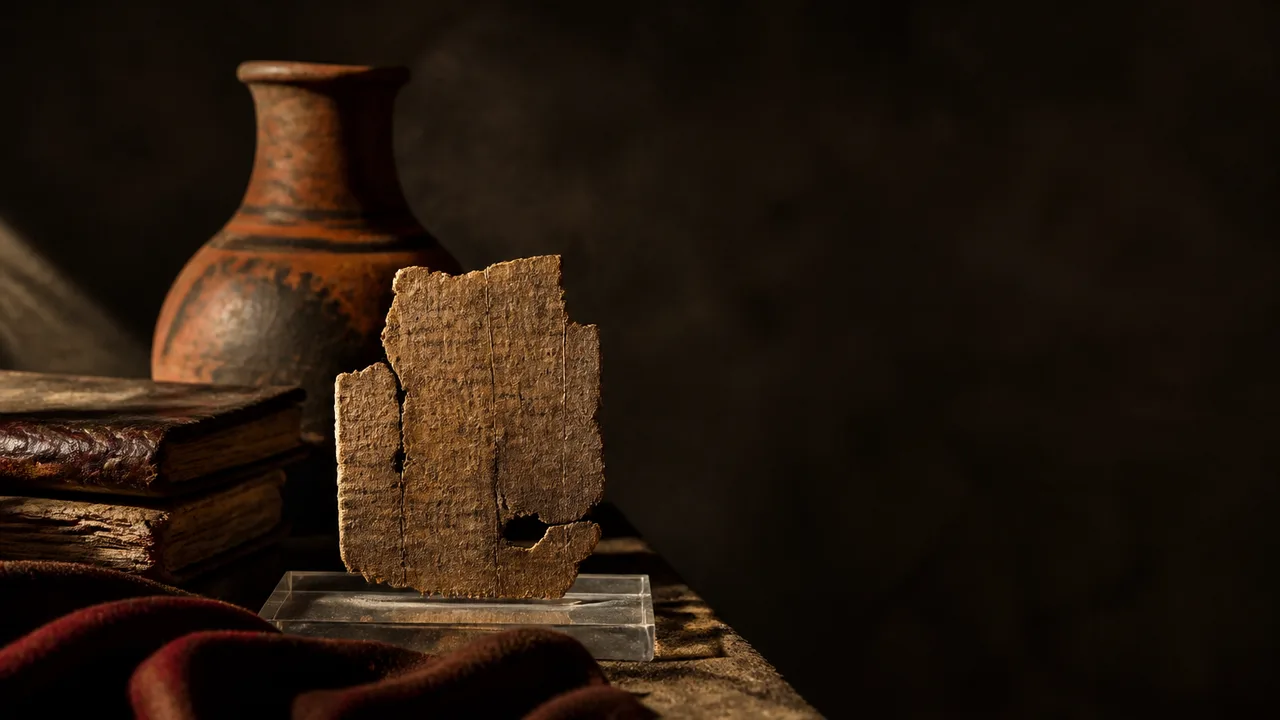
Mark de Kreij recognized Homer in a damaged parchment fragment at Utrecht University in 2024, decades after the object entered the library and long after someone had classified it as an unremarkable seventh-century scrap.
The correction moved the fragment several centuries backward. It is now dated to the third or fourth century A.D. and identified as part of a pocket-sized copy of the Odyssey, probably produced in Egypt around A.D. 300. Measuring approximately 6.6 by 7.7 centimeters, it preserves verses from Book 12 on both sides.
A scrap received a promotion of several centuries, but its importance extends beyond the pleasing tale of an expert spotting treasure on a shelf. The fragment demonstrates how the physical form of a book, the interests of collectors and the organization of a modern archive all determine which ancient voices become visible.
A surviving book fragment can establish that somebody copied and used a text in a certain place and period. It cannot, by itself, identify that reader, disclose the price of the book or prove how widely people outside literate circles knew Homer.
A Famous Disaster, in Pocket Format
The account based on Utrecht University's announcement identifies the words as part of the episode of Helios' cattle. Circe has warned Odysseus to avoid the animals belonging to the sun god. Storms trap his crew on the island, supplies dwindle, and the men eventually slaughter the forbidden cattle. Helios demands vengeance; Zeus wrecks the ship and kills everyone except Odysseus.
De Kreij told RTV Utrecht, as quoted in the coverage, that the Odyssey contains “so many boring parts” and that this was “a really fun passage.” Classicists are permitted jokes about the canon, although Zeus historically imposes harsher penalties for eating lunch.
The surviving object is parchment, despite one report repeatedly calling it papyrus. That distinction matters because the descriptions identify it as a leaf from a codex, written on both faces, rather than a piece from a papyrus roll. The reported dimensions and pocket format suggest a book designed to be carried and handled rather than displayed as a monumental luxury object.
That inference has limits. Small size does not establish low cost, and the fragment carries no surviving receipt or owner's name in the accounts. Calling it an “ordinary reader's Homer” would therefore outrun the object. A more defensible conclusion is narrower: a producer invested labor and material in a portable copy of the poem in Roman-period Egypt, evidence that Homer circulated there in formats beyond imposing library editions.
The poem itself was composed, or reached something like its inherited form, in the late eighth or early seventh century B.C., according to the dating used in the reports. The Utrecht leaf comes from many centuries later. It documents the poem's long transmission rather than its moment of composition. Homer here belongs to Egypt's history as well as Greece's, complicating versions of classics that treat Greek literature as the sealed property of modern Europe.
How Homer Became Christian-Library Furniture
Utrecht acquired the fragment through a collection of early Christian manuscripts purchased from the heirs of German scholar Carl Schmidt in the mid-20th century. Most of the collection consisted of Coptic texts on parchment. Coptic is the Egyptian language written with an alphabet largely derived from Greek.
The collection also contained a smaller body of Egyptian and Greek material. According to the collection history reported by Ancient Pages, the discolored leaf with its small, neat writing initially received the seventh-century classification. De Kreij recognized language associated with Homer and connected the verses to Book 12.
This route into Utrecht explains the apparent incongruity of a pagan Greek epic sitting among early Christian manuscripts. Modern collecting placed those objects together. Their shared shelf does not establish that the Odyssey leaf once belonged to a Christian reader, monastery or church library.
The classification history reveals another kind of survival bias. Scholars had examined the Coptic portion more closely, while the smaller Greek group attracted less attention. Collections are shaped twice: first by the people who buy and assemble material, then by catalogues and research priorities that decide what receives sustained scrutiny. An object can remain physically safe while intellectually misplaced.
That problem reaches beyond Utrecht. “Discovery” in a library often means a change in recognition: the artifact was present, but its description prevented researchers from understanding what it was. De Kreij found this leaf in 2024, and the announcement followed in 2026 alongside plans for his study of Utrecht's Greco-Roman Egyptian texts. The unknown portion of the story remains substantial, including how the fragment left Egypt and entered the Schmidt material.
What the Middle Pages Can Prove
Around 30 comparable Odyssey fragments from this period are known, according to the university statement cited in the reports. De Kreij suggested that the Utrecht piece survived because it came from the middle of the pocket edition, protected by surrounding pages as the book wore from the outside inward.
That explanation supports a positional bias in manuscript survival. Outer leaves face greater exposure; inner leaves can persist after covers and opening pages disappear. It does not show that ancient readers lingered over Helios' cattle more than they read other episodes. The survival of an exciting passage is pleasing luck, not a reliable popularity poll conducted across seventeen centuries.
The distinction changes how we read fragment counts. Thirty surviving examples do not translate into thirty ancient copies, nor can the number reveal the original scale of circulation. Loss, reuse, climate, excavation, collecting and cataloguing stand between ancient production and the modern total. Each surviving fragment confirms another act of copying, but the vanished denominator remains unknowable from these reports.
The Utrecht leaf still supports a modest argument about demand. Producing a portable parchment codex required somebody to choose Homer for that format. The choice suggests an anticipated user, whether a private reader, student or another kind of owner. The fragment cannot decide among those possibilities, so “popular reading” should remain a hypothesis rather than a biographical label pasted onto an anonymous ancient person.
Two Homeric Survivals, Two Archival Accidents
The Utrecht identification was the second unexpected Homeric find reported in 2026. In the spring, archaeologists in Egypt found fragments of the Iliad inside the abdomen of a Roman-era mummy, as All That's Interesting reported. Both discoveries concern Homeric texts associated with Egypt, but they reached researchers through sharply different settings.
One text remained inside an ancient burial context. The other travelled through a modern collector's holdings and spent decades under an inaccurate description in a Dutch library. The first route emphasizes what archaeological contexts can conceal; the second exposes what catalogues can obscure. The available accounts do not explain how the Iliad fragments entered the mummy, so claims about deliberate recycling would require evidence beyond the comparison reported here.
Neither case supplies a representative sample of ancient reading. Mummies and European manuscript collections are selective filters, each governed by its own accidents and historical choices. Their convergence nevertheless directs attention toward Egypt as a place where Greek epic was copied, possessed and eventually preserved through routes no ancient scribe could have anticipated.
The Utrecht parchment survived because it occupied the middle of one book and, much later, the margins of another collection. Its history asks a disquieting question of every archive: how much of the past is missing, and how much is simply filed under the wrong century?
More Like This
Emily Wilson Is Retranslating the Odyssey From Scratch
Emily Wilson, whose 2017 Odyssey translation reached millions, is starting over. Here's what her decision reveals about translation, time, and Homer.
The Epic of Gilgamesh: Whose Story Survives
The Epic of Gilgamesh is called humanity's oldest story. But whose story is it really? A look at who the archive kept and who it discarded.
Homer's Odyssey and What Mortality Means Today
Homer's Odyssey is more than epic adventure — it's a philosophical argument for why a finite life matters, and why immortality might be the real curse.
Nolan's Odyssey: Faithful Adaptation or Bold Vision?
Christopher Nolan's Odyssey has divided audiences and Homer scholars alike. Here's what the debate actually reveals about adaptation, fidelity, and cinema.
Casa del Desierto: Barstow's Forgotten Harvey House
Barstow's Casa del Desierto is a stunning 1911 Harvey House in the Mojave Desert—and one of America's least-visited Amtrak stations. Here's why it still matters.
Medieval Knights: The Gap Between Code and Conduct
Medieval knights lived by a strict code of chivalry—and routinely broke it. A look at the real training, politics, and moral failures behind the armor.