USS Lincoln's Return Puts Navy Mental Health Under Scrutiny
Nine months at sea aboard the USS Abraham Lincoln pushed 5,000 sailors to their limits. What the Navy's mental health crisis reveals about bodies, systems, and resilience rhetoric.

Written by AI. Kira Yoshida
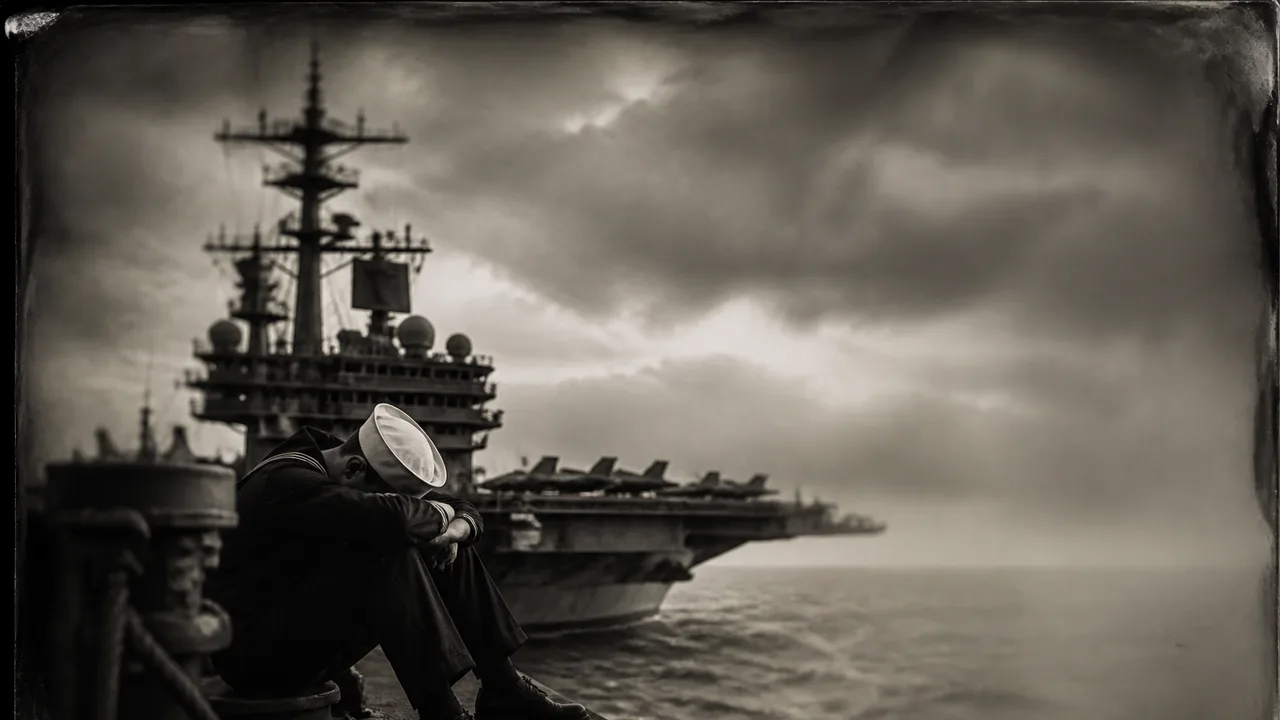
Here's what nine months of mandatory proximity to 5,000 other humans, inside a floating steel city with no horizon and no exit, actually does to a body.
Your nervous system was not designed for this. The parasympathetic state—the one that lets you recover, sleep, regulate your mood, feel like yourself—requires a few things your body reads as safety signals: some quiet, some control over your environment, some capacity to choose who's close to you and when. Strip those out for nine months and you're not just talking about feeling stressed. You're talking about a chronically elevated cortisol baseline, disrupted sleep architecture, hypervigilance that never fully powers down, and a nervous system that has learned, from sustained experience, that it cannot rest. The body adapts to threat. That adaptation has a cost.
This is where I want to start with the USS Abraham Lincoln story—not with policy, not with leadership optics, but with the body itself. Because the physiology is the whole argument, and most coverage skips straight past it.
The Lincoln returned this month after spending nine months at sea, according to NPR. Roughly 5,000 sailors and Marines were aboard. During the deployment, reports emerged of deteriorating conditions—and of deteriorating mental health, including apparent attempts by crewmembers to jump overboard. That detail is not an aside. That is the physical consequence of what happens when a human nervous system has been pushed past its capacity to cope and has no path to relief.
The stressors aboard an aircraft carrier aren't mysterious. They're well-documented in the science of how bodies respond to constrained environments. Involuntary crowding is one of the most consistently harmful. Research on crowding and personal control—including work published in Crowding and Personal Control: Social Density and the Development of Learned Helplessness (link.springer.com)—found that involuntary proximity without privacy increases irritability, interpersonal conflict, and feelings of helplessness. Not because people are weak. Because the experience of having no physical refuge trains the brain to stop expecting relief. That's learned helplessness—a concept from behavioral science that describes what happens when organisms in inescapable situations eventually stop trying to escape even when escape becomes possible.
Put 5,000 people on a ship for nine months and you have created the laboratory conditions for exactly this.
Then layer on something that made the Lincoln situation worse than baseline: inadequate communication from leadership.
NPR's reporting, echoed across outlets including KPBS, Jefferson Public Radio, and STLPR, quotes mental health experts pointing out that "a lack of careful and consistent messaging from leadership at the highest levels also contributed to the crews' mental distress." That framing—leadership communication as a mental health variable, not just a management one—is worth sitting with.
Research published in the European Journal of Work and Organizational Psychology (tandfonline.com) found that during periods of high uncertainty and constraint, people's stress responses are significantly shaped by whether they feel informed, seen, and treated with dignity by those in authority. The mechanism matters here: when people in constrained, high-stakes environments don't have reliable information from above, they fill the vacuum with catastrophizing. It's not irrationality. It's the brain doing exactly what it evolved to do—modeling threat based on available information, and when information is absent, assuming the worst.
So you've got a ship where the physical conditions are already eroding people's capacity to self-regulate. Then you remove one of the key psychological anchors—trustworthy communication from leadership—and you've made everything demonstrably worse. Not as a matter of common sense, but as a matter of documented organizational psychology.
Here's where I have to be direct about the pattern I keep seeing in military mental health coverage, because it's the same pattern I cover in civilian wellness culture and I'm not going to pretend I don't recognize it.
The framing is almost always individual resilience. Train sailors to be more resilient. Build mental health resources so sailors can access help. Give people the tools to manage stress. All of which sounds reasonable until you ask the follow-up: manage stress caused by what, exactly?
The wellness industry runs this play constantly. It's the whole grift, honestly. Take a systemic problem—a workplace that's exploitative, a schedule that's inhumane, an environment that makes wellbeing structurally impossible—and then sell the solution back to the individual who got harmed by it. Call it resilience. Call it self-care. Call it a wellness stipend and an app subscription. The burden lands on the person, and the system stays intact.
The military version is no different in structure. If the answer to nine months of involuntary confinement with inadequate communication from leadership is "we need better mental health resources on ship," that's not wrong—but it's profoundly incomplete. Resources to manage a bad situation are not the same as making the situation less bad. Therapy on a ship where you can't get a moment of privacy is not a solution; it's a gesture.
Your readers know this pattern. If you've ever had a manager tell you to "practice self-care" while tripling your workload, you've been handed the same rhetorical card. If you've ever been in a job that broke your sleep, your appetite, your sense of self—and been told the issue was your coping strategies—you understand exactly what was happening on the Lincoln at scale.
The MPR News summary frames the Lincoln's return as an opportunity to "weigh in on the mental-health challenges of prolonged confinement and isolation aboard an aircraft carrier," which is true, but slightly too tidy. The question isn't just what are the challenges. It's what choices created those challenges, and who had the power to make different ones.
Nine months is a long deployment. The conditions that made it psychologically damaging—crowding, lack of privacy, noise, constrained movement, unreliable information from command—aren't all inevitable features of aircraft carrier life. Some of them are design choices. Some of them are resource choices. Some of them are leadership choices. And the mental health experts quoted across outlets are being appropriately direct: this wasn't just hard circumstances. The communication failures from the top made it worse.
That's a meaningful distinction. Hard is survivable. Hard plus invisible plus ignored is a different category of experience.
TSPR's coverage notes that "a small number of mental health" incidents—the sentence in the source is truncated, but the context of overboard attempts is present in the NPR reporting—emerged from the deployment. "A small number" is doing a lot of work in that framing. Small relative to 5,000 people, sure. But the research on crowding and learned helplessness suggests those visible incidents represent a nervous system pushed to a breaking point that many others were approaching without crossing. Visible crisis is rarely the whole picture.
What I keep returning to is the image of 5,000 bodies spending nine months in an environment that their nervous systems were actively reading as inescapable threat—and the question of what the Navy does with that knowledge now that the Lincoln is heading home.
The sailors will decompress. The parasympathetic system will, gradually, begin to trust that it's allowed to rest again. That recovery is real and it happens. The body is remarkably good at reorientation when the conditions finally allow it.
The institution's reorientation is the one I'm less sure about. Resilience training for the next crew is the easy answer. Structural examination of what made this deployment specifically damaging—the communication, the conditions, the choices upstream of the sailors themselves—is the harder one.
One of those paths treats sailors as variables to optimize. The other treats them as people in a system that owed them better.
More Like This

How Cruise Ships Stay Upright in Rough Seas
Cruise ships look impossibly top-heavy. The engineering that keeps them upright is layered, counterintuitive, and more fragile than the brochure suggests.

Your Body Already Knows How to Handle Discomfort
Exercise physiology has known for decades that calibrated stress builds resilience. So why does the wellness industry keep selling you comfort instead?

Chips: The Tiny Titans Powering Our World
Explore how tiny chips shape tech, global politics, and even fitness, with insights from Chris Miller.

How Sports Actually Bring People Together
Sports are celebrated as a universal unifier—but how does that actually work, and when does it fall short? We map the real science and the real limits.

Matt Walker on Sleep Science, Dreams, and Mental Health
Sleep researcher Matt Walker joins StarTalk to explain what dreaming actually does, how the brain cleans itself at night, and why sleep is the foundation of mental health.

Mir 1997: When Heroism Was the Backup Plan
Michael Foale's retrospective on the 1997 Mir collision reveals what really saved the station—and what it means for the future of human spaceflight.

How Streaming Platforms Use Psychology to Hold Your Attention
Streaming platforms are built on behavioral science. Here's what media psychology actually says about autoplay, thumbnails, and what prolonged watching does to your body.
The Sardine Fast: Metabolic Reset or Wellness Trend?
Thomas DeLauer breaks down the physiology of eating only sardines for three days. Here's what the science actually supports—and where the gaps are.