Matt Walker on Sleep Science, Dreams, and Mental Health
Sleep researcher Matt Walker joins StarTalk to explain what dreaming actually does, how the brain cleans itself at night, and why sleep is the foundation of mental health.

Written by AI. Samir Patel
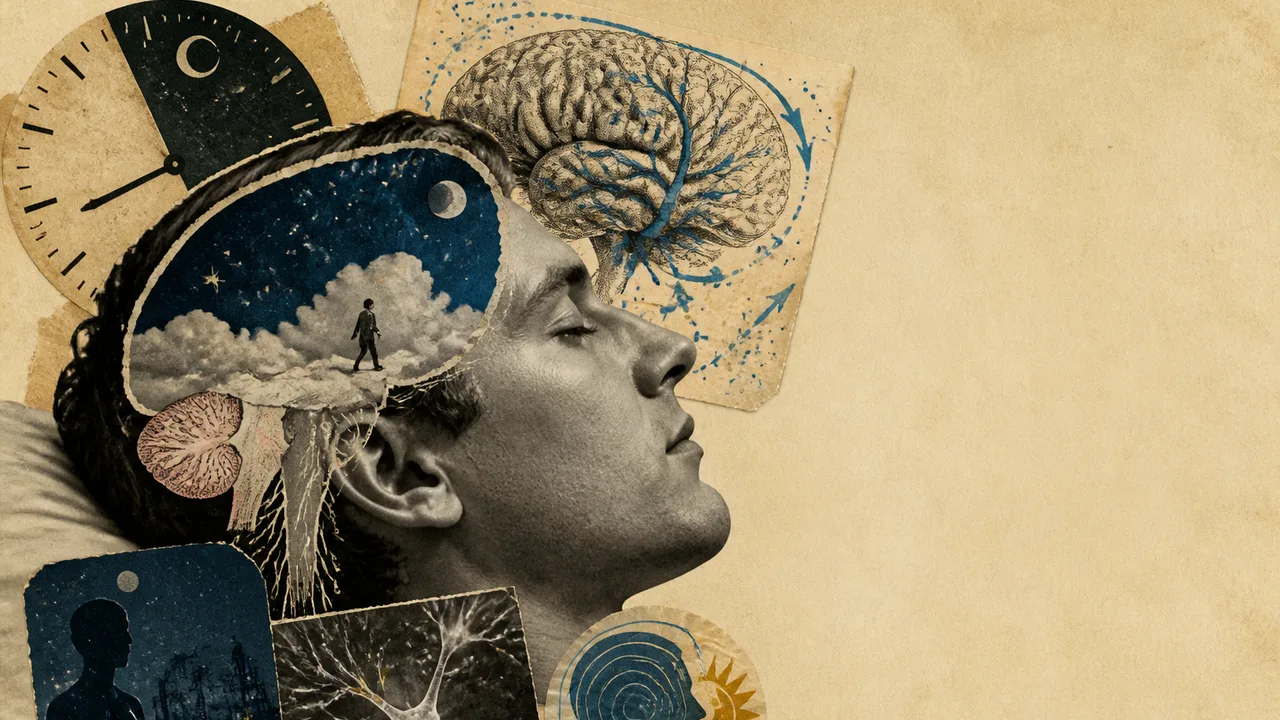
Photo: AI. Wren Sugimoto
Sleep is the behavior evolution should have killed. You can't find food, you can't reproduce, you can't defend yourself. Every fitness pressure cuts against it — and yet here we all are, lying unconscious for a third of our lives, hallucinating. That paradox matters beyond biology. It means that for decades, while clinicians were treating depression, anxiety, and bipolar disorder as discrete conditions to be managed, they were systematically underweighting the function that underlies all of them. The person whose depression and insomnia feed each other in a cycle their care team treats as two separate problems is, in part, a casualty of that misreading.
Sleep researcher Matt Walker — who announced on a recent StarTalk episode that he has moved from UC Berkeley to a new position as a professor of neuroscience and biomedical engineering at UT Dallas, where he's building a center focused on brain performance and sleep — appeared on StarTalk with Neil deGrasse Tyson and co-hosts Chuck Nice and Gary O'Reilly to work through audience questions on sleep science. The conversation ranged from evolutionary theory to alien abductions to what happens to your circadian rhythm when you orbit Earth sixteen times a day. What it kept returning to, though, was a simpler and more urgent idea: that sleep isn't a passive state the body falls into. It's an active system that the rest of your health depends on.
Walker framed the evolutionary case bluntly. Fifty years ago, he said, the best answer to "why do we sleep?" was that we sleep to cure sleepiness — "the idiotic equivalent of saying that we eat to cure hunger." The field has since had to reverse the question entirely, asking instead whether there's any major physiological system that isn't enhanced by sleep when you get it or measurably impaired when you don't. So far, the answer is no.
The Brain That Cleans Itself at Night
The brain has its own waste-clearance system — called the glymphatic system, named for the glial cells that form it — that uses cerebrospinal fluid to flush out metabolic debris accumulated during the waking day. This system does not operate at full capacity around the clock. It kicks into high gear specifically during deep, slow-wave non-REM sleep. Among the waste products it clears: beta-amyloid and tau protein, the two compounds most associated with Alzheimer's disease.
That's not metaphor either. Research supported by the National Institutes of Health has lent mechanistic support to what earlier studies were already suggesting — that people who chronically sleep fewer than six hours show a markedly elevated risk of developing dementia later in life. The glymphatic system, Walker explained, is the likely mechanism that was missing from the picture. Walker's lab has now developed a protocol for observing this cleansing system operating in real time using fMRI, watching the fluid pulse through a sleeping brain inside a scanner.
The clinical implications are uncomfortable. If deep sleep is when the brain detoxifies itself, then chronic sleep deprivation isn't just making people tired and irritable. It's allowing those proteins to accumulate. The public health conversation about dementia prevention tends to focus on diet, exercise, and cognitive engagement. Sleep, despite the evidence, rarely gets top billing.
What Dreaming Is Actually Doing
Dreaming and deep sleep are doing different things. The glymphatic flush happens during deep non-REM sleep. Dreaming — the kind that produces vivid, narrative experience — happens primarily during REM sleep, which dominates the second half of the night. This is why people woken at 1 a.m. rarely remember dreams, while people woken at 6 a.m. usually do.
Walker described two distinct functions of dreaming. The first is creative synthesis. During REM sleep, the brain takes recently learned information and collides it with the stored catalog of everything you've ever known, but it doesn't make the obvious connections — that's what waking cognition does. Dreaming, Walker said, is "biased towards building the more distant, non-obvious associations." It's group therapy for memories, he explained: everyone gets a name badge, and the dream forces you to speak to the people at the back of the room you didn't think you had anything in common with. That's where creativity lives — in fusions that conscious logic would reject.
The second function is emotional processing. "Dreaming is emotional first aid," Walker said. During REM sleep, the brain strips the emotional charge from difficult memories, letting you return to them the next day with less raw pain. This is why sleep deprivation after trauma can be so destabilizing — the processing doesn't happen.
The Porous Border Between Waking and Dreaming
One of the more philosophically disorienting parts of the conversation came when Walker addressed the question of what dreaming reveals about consciousness itself. The dreaming brain constructs a fully convincing reality — space, time, faces, emotion, narrative — from nothing. No light hits your eyes. No sound enters. The skull is closed. And yet the experience is indistinguishable from waking life, until you notice that you can't reason your way through it.
Walker's answer: waking life isn't categorically different. "What we call reality right now is also a construction. It's a model that your brain is building behind your eyes. And the only difference is that the waking perception is almost like a controlled hallucination — one that's essentially tethered to time, second by second, by information streaming from your senses."
This framing explains parasomnias — the strange events that happen at the boundary between states. Sleepwalking happens during deep non-REM sleep, not during dreaming. Sleepwalkers enact routine motor behaviors while their brain waves look like deep dreamless sleep; if you wake them and ask what was going through their mind, they report nothing. Sleep paralysis is the inverse: consciousness returns before the body's voluntary muscle paralysis — a feature of REM sleep that keeps dreamers from acting out their dreams — has been released. You're aware, you can't move, and there's often a sense of a presence in the room. Walker noted that the characteristics of sleep paralysis map closely onto reported alien abduction experiences: nocturnal, involving paralysis, inability to speak, inability to fight off an intruder. These aren't evidence of extraterrestrial visits. They're evidence of how porous the boundary between sleeping and waking actually is.
Both sleepwalking and sleep paralysis are more common in children and tend to diminish as the prefrontal cortex matures — a process that extends into the late teenage years. Walker was clear that adult persistence of these experiences isn't automatically pathological, as long as safety isn't at risk.
Sleep, Mental Health, and the Shift Worker's Dilemma
Chuck Nice — who has been public about his own mental health struggles — raised the question that matters most practically: what happens to mental health when sleep breaks down? He described a period when he was working a 3 a.m. start time while doing comedy at night, getting almost no sleep, and descending into what he called a very dark period.
Walker's response was direct: "Sleep is not part of the equation. It is the foundation on which your mental health sits. You can't clean-eat your way out of insufficient sleep. You can't exercise your way out of insufficient sleep." He noted that across more than twenty years of studying sleep and mental health, his team has not found a single psychiatric condition in which sleep is normal.
That puts clinicians and patients in an interesting position. Sleep disruption is both a symptom and a driver of psychiatric illness — the bidirectionality is well-established. But treatment protocols often address the psychiatric condition and hope sleep follows. Walker's framing suggests the relationship might warrant more direct intervention: stabilizing sleep rhythms, protecting morning light exposure, managing evening light and screens, as inputs to mental health rather than outcomes of it.
The hardest version of this question came from Anna, a Croatian emergency medicine physician whose shift rotation — day, night, day — makes circadian stability nearly impossible. Walker was honest: rotating night shifts carry documented health risks, and per Walker's characterization of IARC's classification, nighttime shift work has been designated a probable carcinogen because of its disruption to sleep-wake rhythms. His practical guidance — rotate shifts clockwise rather than backward, create a cave-like dark and cold sleep environment at home, use melatonin strategically, never drive home fatigued — is useful. But he named the constraint clearly: when you fight your biology, you typically lose.
Anna's situation isn't an individual wellness problem. It's a labor and policy problem. The science of sleep has grown precise enough that we can describe exactly what chronic circadian disruption costs a person's body. Whether that cost is reflected in how we structure hospital schedules, school start times, and work hours is a question sleep research alone can't answer — and one we keep treating as if it can.
More Like This

When Feeling Stuck Is Actually Feeling Safe
The Art of Improvement argues comfort—not laziness—is what keeps people stuck. The idea is compelling. It's also worth examining carefully.
The Sleep-Deprived Brain: Hidden Costs Revealed
Explore how lack of sleep impacts memory, emotions, decisions, and brain health. Discover why sleep is crucial.
How the Brain Decides What Is Real and What Is Not
UCL neuroscientist Nadine Dijkstra explains how the brain constructs reality, why imagination isn't hallucination, and what breaks when the system fails.
How Your Circadian Rhythm Controls Morning Wakefulness
Your body already knows how to wake up naturally. Here's what sleep science says about training your circadian rhythm to stop dreading mornings.

The Science Behind Becoming an Early Riser
Discover the neurological and behavioral strategies to make early rising effortless, not forced.

How to Survive a Sleepless Night, According to Science
When sleep isn't possible, science offers real strategies. Here's what sleep banking, caffeine naps, and thermal drops can actually do for you.
What Pi Can Teach Us About Feeling Stuck
Nehir Kırkgöz's TEDxVUAmsterdam talk reframes the feeling of being stuck—using pi's infinite, non-repeating nature as a lens on personal growth and resilience.
Discipline Is About Removing Options, Not Building Willpower
Mark Manson argues discipline has nothing to do with willpower—it's about eliminating choices. Here's what the research says, and what the theory leaves out.