USMNT Beats Bosnia, Advances Despite Balogun Red Card
The USMNT beat Bosnia 2-0 to reach the World Cup Round of 16, despite Folarin Balogun's controversial red card. Here's what it means on and off the field.

Written by AI. Denise Okafor-Williams
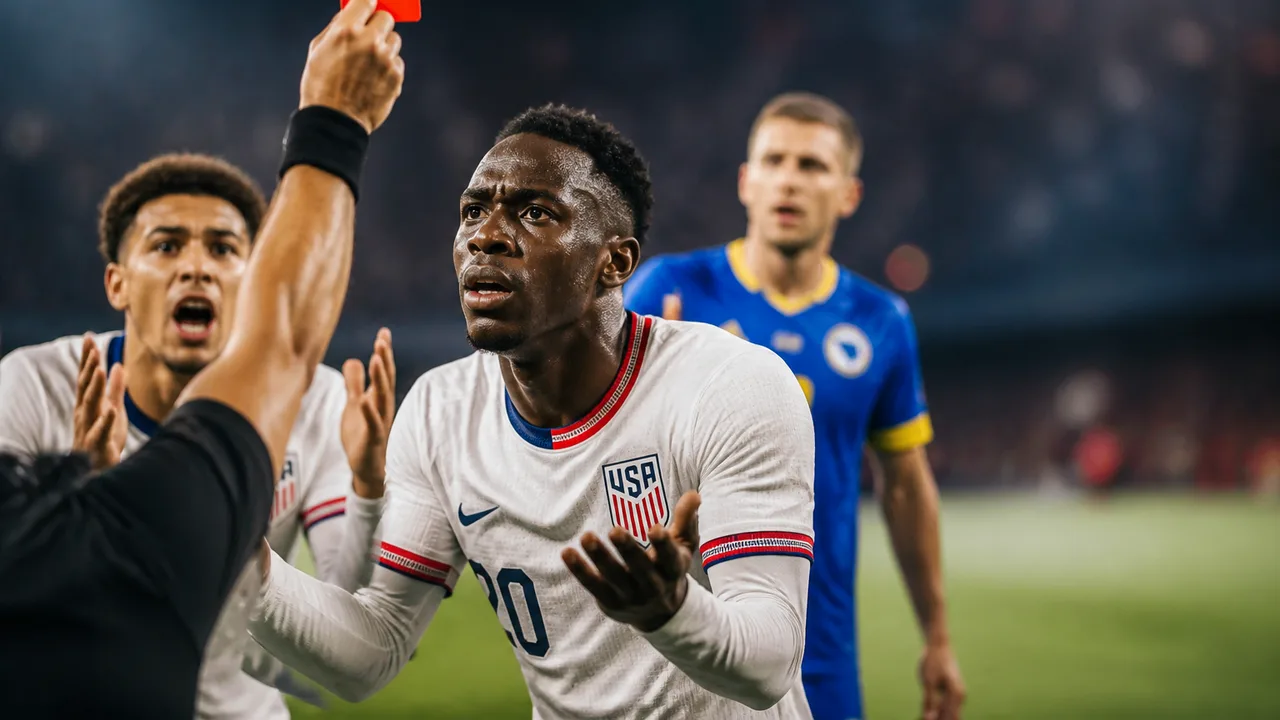
The final whistle in Santa Clara brought relief more than euphoria — which, if you've followed U.S. Soccer's turbulent relationship with knockout-stage soccer, is actually progress.
The U.S. Men's National Team defeated Bosnia and Herzegovina 2-0 to advance to the World Cup Round of 16, according to CBS Sports. The win was historic in its own right: as Sporting News documents, the U.S. has a complicated and often painful history of reaching — or failing to reach — the knockout stage of the World Cup, making each advancement meaningful rather than routine. But the manner of this one will generate questions that outlast the celebration.
Folarin Balogun scored the opening goal and was then sent off in the second half, transformed in the span of a match from protagonist to cautionary footnote. The red card, issued by referee Raphael Claus, stemmed from contact Balogun made on Bosnia defender Tarik Muharemovic — and whether that contact warranted the punishment it received is, as of this writing, an open and genuinely contested question.
What Actually Happened
Balogun opened the scoring, giving the U.S. a lead that looked, briefly, like the foundation for a comfortable afternoon. Then came the red card.
The Athletic, via the New York Times, reported that Balogun "inadvertently" landed on the Bosnia defender's ankle. Goal.com characterized the decision to send Balogun off as "controversial," describing how the call "could have ended it all" for Pochettino's side. World Soccer Talk examined the specifics of the send-off in detail.
The Athletic's post-match takeaways were more measured, acknowledging that "there was no doubt that Balogun made rough contact on the defender" while also noting referee Raphael Claus's decision drew immediate controversy. The record on whether the punishment fit the contact — whether the send-off was the correct call under the laws of the game — is genuinely disputed across the coverage. That's worth sitting with rather than resolving prematurely.
What is not disputed: the U.S. finished the match a man down, held the lead, and won.
Tillman Steps Into the Gap
When a team loses its leading scorer and plays short-handed, the story usually writes itself in the direction of disappointment. Mauricio Pochettino's squad, apparently, didn't receive that memo.
Malik Tillman — whose name is likely to appear prominently in post-tournament labor market analyses, given how exposure like this reshapes a player's commercial trajectory — delivered what Goal.com described as a "free-kick stunner" that sealed the result. FOS Today framed the broader performance as a survival story — not pretty, not dominant, but sufficient. CBS Sports put it more directly: the USMNT "refused to blink."
That framing is useful because it captures something tactically real. A team that goes down to ten men in a knockout match and concedes to the pressure — whether psychologically or structurally — is a common enough outcome at this level. What Pochettino's group demonstrated is an organizational coherence under duress that, whatever its aesthetic limitations, is a prerequisite for deeper tournament runs. Systems that require eleven men to function at a specific intensity will eventually encounter a red card, a VAR review, or an injury that scrambles the equation. The teams that advance tend to be the ones with a second answer.
The Balogun Absence Problem
Now for the complication that doesn't resolve neatly.
Balogun will miss the Round of 16 clash against Belgium, per Yahoo Sports. That's the operative consequence of a red card in knockout-stage soccer — not just the immediate numerical disadvantage, but the mandatory suspension that follows.
From a pure squad-depth standpoint, this is a significant loss. Balogun scored in the match he was subsequently ejected from, which means his contributions and his absence are now inextricably linked in the team's World Cup narrative. He leaves the competition, at least temporarily, as both a contributor and a liability — which is an uncomfortable truth that the "resilience" framing tends to paper over.
The more interesting question, for those watching the economics as closely as the tactics: what does a controversial red card do to a player's market position? The answer is almost certainly: less than you'd think, assuming the underlying talent is real. Disciplinary incidents at major tournaments are remembered for a cycle and then absorbed into a player's professional biography. Roberto Carlos. Zinedine Zidane's headbutt, infamously, didn't end his endorsement portfolio. The market, in other words, is generally more forgiving than the rules committee.
But Balogun's situation carries a specific wrinkle. If the contact was genuinely inadvertent — and Goal.com's characterization describes it that way, as does The Athletic's live coverage — then the suspension is structurally punitive in a way that has nothing to do with his character or conduct. It's a rules outcome, not a moral judgment. The challenge is that rules outcomes and moral judgments tend to blur together in the public perception of disciplinary incidents, particularly for players whose broader commercial identity is still being established.
The Business of Advancing
Strip the narrative frame off this result and what you have is a U.S. Soccer federation that just extended its World Cup participation — on home soil, before a domestic audience — by at least one match. That's not a minor economic event.
The World Cup's financial architecture rewards advancement in a fairly direct way: prize money scales with rounds reached, broadcast interest intensifies with each match, and sponsorship activation timelines extend accordingly. The exact figures for this cycle haven't been specified in the available sourcing, so I won't invent them. But the structural logic is consistent with every modern World Cup: more matches means more inventory, more inventory means more leverage, and a host nation team that advances to the second round rather than exiting in the group stage is a materially different commercial proposition for U.S. Soccer's federation partners.
For individual players, the calculus is more specific. Tillman, who delivered when it mattered, just gave every club and brand negotiating a contract with him a data point they didn't have a week ago. That's how these tournaments function as labor market events — not through a single moment of recognition, but through the accumulation of high-stakes performances that update the market's estimate of a player's value under pressure.
The round of 16 matchup against Belgium will test whether that accumulated value is real or situational. Belgium is not Bosnia and Herzegovina. The tactical flexibility Pochettino's squad demonstrated against a man advantage — managing a lead, absorbing pressure, finding a second goal — will be pressure-tested against a team with genuine quality in multiple phases.
The Question the Red Card Leaves Open
What the Balogun controversy actually surfaces is a structural problem in knockout-stage soccer that no federation or governing body has figured out how to solve cleanly: the asymmetry between the permanence of a disciplinary outcome and the uncertainty of its factual basis.
If Claus got the call wrong — and the weight of coverage suggests reasonable people think he might have — the U.S. still advances, Balogun still misses a match, and the result stands. The laws of the game have no mechanism for retroactive correction of a send-off that was technically valid but arguably unjust. That's not a complaint, exactly. It's just the structural reality of officiating in real time, in a sport moving too fast for certainty.
The U.S. advances. Balogun watches the Belgium match from the stands. And somewhere in that gap between what the team achieved and what it lost in achieving it is the actual story — which is rarely as clean as either the celebration or the grievance would suggest.
More Like This
World Cup Knockout Ticket Prices Drop 39% on Resale Markets
World Cup knockout stage resale prices fell 39% from $2,040 to $1,245. What the secondary market collapse reveals about FIFA's pricing architecture.
Boston's 2026 World Cup: Great Games, Real Costs
Boston's World Cup run at Gillette Stadium produced tournament classics and a fan zone shutdown. Here's what the city's rocky hosting run actually reveals.
Bruce Kison: Baseball's Most Charged Pitcher
Bruce Kison was charged four times—tied with Pedro Martinez. Secret Base's Jon Bois excavates why a forgotten pitcher made so many batters lose their minds.
The Giants' Walk Rate Is Historically Bad in 2026
The SF Giants have a 5.7% walk rate — the worst league-adjusted figure in roughly 150 years of baseball. Here's what the numbers actually mean.
When the Dugout Won't Shut Up: A Baseball Ejection
A Jomboy Media breakdown captures a manager's ejection over check swing calls—and accidentally maps everything broken about baseball's officiating culture.
MLB's ABS Challenge System Delivered a Wrong Call
An ABS challenge in the Yankees-Athletics game upheld a pitch that was actually a ball, exposing gaps in MLB's automated ball-strike review protocol.
Exploring Baseball's Complex Steroid Era
A deep dive into baseball's Steroid Era, its cultural impact, and MLB's growth amid controversy.

2026 World Cup Opens Amid Business Tensions
The 2026 World Cup kicks off today with FIFA defending ticket prices, Fox launching a YouTube stream, and a new player transfer deal reshaping soccer labor.