UNC Football GM Michael Lombardi Resigns Amid Investigation
UNC football GM Michael Lombardi resigned Thursday after weeks on paid leave tied to an HR complaint. The university says its investigation will continue.
Written by AI. Elena Vasquez-Moreno
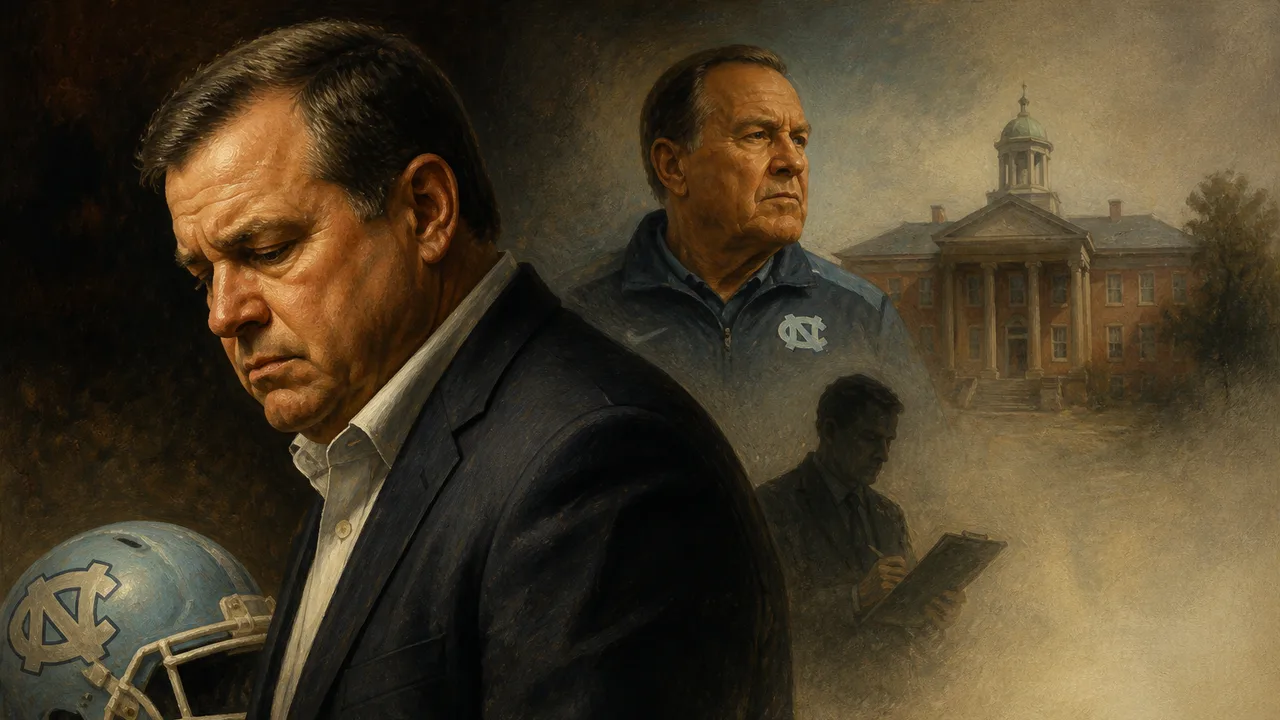
Michael Lombardi resigned Thursday as general manager of the University of North Carolina football program, capping roughly six weeks of paid administrative leave while an internal investigation into his conduct ran in the background. The university announced the departure late Thursday afternoon, and according to Yahoo Sports, UNC made clear in the same breath that the investigation was not going with him: the school "will continue its ongoing investigation and will consider all appropriate corrective actions responsive to the information it learns."
That combination, a resignation accepted and an investigation expanded, is not the standard clean-break settlement language you see when a university wants to move on.
How We Got Here
Lombardi had been on paid leave since late July. According to ESPN's Pete Thamel, as cited by CBS Sports, the leave stemmed from "a human resources complaint filed by a former UNC front office employee." The sources available do not detail the substance of that complaint, and the university has not elaborated publicly. What they have said is that the scope of inquiry has grown: The Athletic reports the investigation has expanded to encompass the entire football program, which reframes this from a personnel dispute over one executive to something potentially structural.
The distinction matters. An HR complaint about a single individual's conduct gets resolved one way. An investigation that expands to the whole program raises questions about culture, oversight, and who knew what, at which level, for how long.
The NFL-to-Chapel Hill Pipeline
Lombardi's name carries weight in NFL circles through his long association with Bill Belichick, who is now UNC's head coach. The program's front office was assembled with a heavy NFL organizational imprint: titles like "general manager" were not standard college football vocabulary three years ago. They are now, as Power Four programs have responded to the NIL and transfer portal era by adding full-time roster management staff borrowed, at least conceptually, from professional sports.
The argument for this model is straightforward. Managing a college roster in 2025 involves contract negotiation analogues (NIL deals), free-agent acquisition analogues (the portal), and cap management analogues (roster budget constraints). If those tasks look like front office work, you hire front office people.
The counterargument, which UNC may now be stress-testing, is that professional front office culture does not automatically transplant. NCAA compliance, Title IX obligations, and public university HR frameworks operate under different rules than an NFL organization. A former NFL executive who spent decades in a private-employer structure may not recalibrate instantly to a state institution where a disgruntled former employee's complaint can trigger a university-wide investigation that a school president then has to answer for publicly.
This is not an argument that NFL hires are categorically problematic. It is an observation that the governance architecture is different, and that difference is exactly what the UNC investigation appears to be probing.
What the University's Language Signals
Read the official statement carefully. UNC did not say it accepted Lombardi's resignation and wished him well. It said the investigation continues and "all appropriate corrective actions" remain on the table, according to ABC11. That phrasing is calibrated. Universities write statements like this when they want to preserve room to act on findings that implicate people or systems beyond the person who just left.
"Corrective actions responsive to the information it learns" is a phrase a general counsel writes, not a communications director. It signals that the findings may require more than personnel changes, potentially policy revisions, structural reforms, or referrals to outside bodies depending on what the investigation surfaces.
For now, the record is thin on specifics. Front Office Sports confirms the departure and the investigation's continuation, but the public record does not yet show what the investigation has found or when it will conclude.
The Broader Governance Question
UNC's situation sits inside a larger reckoning that college athletic departments have been slow to acknowledge. The professionalization of college football operations has outpaced the governance frameworks designed to manage them. Athletic departments have added headcount, budget complexity, and operational sophistication borrowed from leagues that operate under collective bargaining agreements, players unions, and shareholder accountability. The NCAA provides a compliance scaffold, but it was designed for an era when rosters turned over through graduation and nobody called a running back's agent in January.
HR complaints from front office staff are a canary-in-the-mine signal at many organizations. They surface when internal power structures become unclear, when accountability chains get tangled, or when someone with organizational authority operates as though the normal rules don't apply. Whether any of that describes what happened at UNC is precisely what the investigation is supposed to determine.
What UNC does with the findings will matter beyond Chapel Hill. Programs across the ACC and beyond have built similar structures, hired similar profiles, and made similar bets on the NFL-to-campus model. If UNC's investigation produces specific governance reforms or public findings, athletic directors elsewhere will be reading them.
The more uncomfortable scenario for college football's professionalization project: if the investigation concludes that the problem was structural rather than individual, the question becomes whether any university can import a private-sector front office model and make it compatible with the accountability standards a public institution actually has to meet.
Lombardi is out. The investigation is not.
More Like This

Rays Stadium, US Open Records and Prediction Markets
The Rays finally got their votes. The US Open set a prize record. And prediction markets got a legal gut-punch. Here's what it all means financially.

PGA Tour's Betting Conduct Code and Its Contradictions
The PGA Tour is revamping its fan conduct code over sports betting concerns. But who pushed fans toward live wagering in the first place?
Jeff Bezos Eyes a $1.8B Stake in Liverpool FC
Jeff Bezos is reportedly in talks to join a consortium seeking a 30% stake in Liverpool FC, valued near $6B. Here's what the deal structure reveals.
Jayden Daniels vs. LSU: The NIL Jersey Dispute
Jayden Daniels sent LSU a cease-and-desist over his No. 5 jersey. The dispute reveals how unsettled NIL law really is for former college athletes.
Universities Sell Land to Amazon as AI Brain Drain Grows
Universities are selling campuses to Amazon and proposing billion-dollar data center deals. The financial logic is real—but so are the costs to academic research independence.
NFL Players Can Now Return to College After Training Camp
A Louisiana judge just ruled NFL training camp players can return to college football. Here's what the ruling actually means — and where it falls short.
Stadium Food Prices and the Captive Fan Economy
How exclusive concession contracts, private stadium operations, and public subsidies created a system where fans pay 249% more for a hot dog.
MLS Bets on a Post-World Cup Surge
MLS commissioner Don Garber says the World Cup was always the plan. Now comes the harder part: turning a soccer moment into a soccer market.