Universities Sell Land to Amazon as AI Brain Drain Grows
Universities are selling campuses to Amazon and proposing billion-dollar data center deals. The financial logic is real—but so are the costs to academic research independence.

Written by AI. Raj Mehta
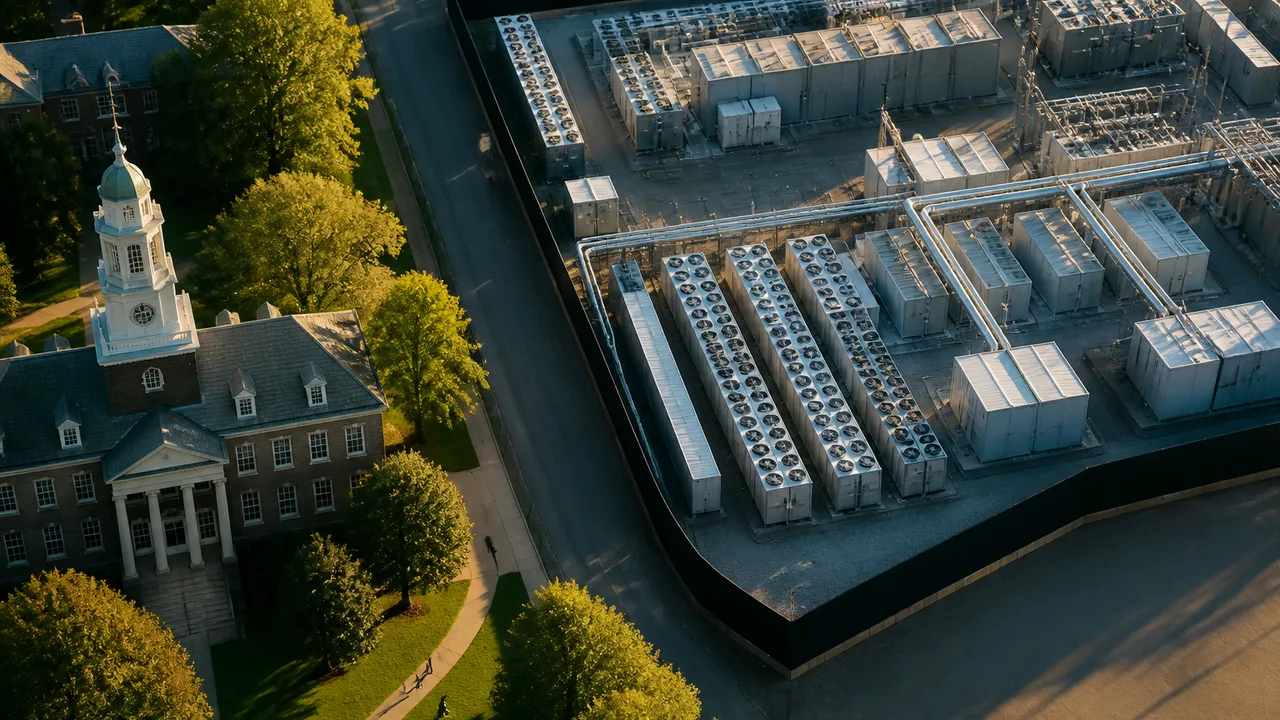
There is a particular kind of asset repricing that happens when a new technology reshapes what land is worth. It happened with railroads. It happened with fiber. It is happening now with AI infrastructure — and universities, sitting on real estate they acquired over decades for entirely different purposes, are discovering that the market has a use for their land that pays considerably better than classrooms.
The clearest example so far: George Washington University sold its Virginia campus to Amazon Data Services, according to The Washington Post. That campus is in Ashburn — which is not incidental. Ashburn, Virginia is the data center capital of the world by some measures, home to a dense concentration of hyperscale facilities that process a significant share of global internet traffic. GWU wasn't just sitting on land; it was sitting on land inside Amazon's preferred expansion corridor. The market came to them.
The University of Michigan's proposed $1.2 billion data center project represents the same logic at a different scale, according to Fortune. As Fortune puts it, universities are "finding themselves sitting on property that can be worth more as AI infrastructure — not classrooms, laboratories or research space."
That sentence is doing a lot of work. Worth more to whom, over what time horizon, and under what deal structure — those are the questions that determine whether these transactions are smart financial stewardship or a long-term transfer of academic autonomy to corporate infrastructure players.
The Deal Structure Is the Story
When university administrators describe these arrangements, they often emphasize that a developer "will shoulder the costs" — meaning the university doesn't bear construction risk. That framing is meant to reassure. But the mechanism matters enormously, and the available reporting doesn't fully clarify which structures are in play across these deals.
The three most common arrangements in commercial real estate of this kind are structurally distinct. In a sale-leaseback, the university sells the asset outright and then leases back space or use rights — it gets liquidity now but loses the underlying ownership and, typically, long-term control over land use. A ground lease lets the university retain ownership of the land while a developer builds and operates on top of it, generating ground rent but preserving the institution's ability to reclaim the asset when the lease expires. A joint venture splits both the economics and the governance, giving the university an ongoing stake but also ongoing entanglement with a commercial partner whose interests may diverge from academic ones over time.
Why does this matter? Because in each structure, the answer to "who controls this asset in 2045" is different. A university that executes a 99-year ground lease has nominally retained ownership but functionally ceded the use of that land for a century. A university that takes a joint venture stake in a data center has, in effect, become a real estate investor with a corporate partner — and that changes incentive structures in ways that are hard to reverse.
Amazon's acquisition strategy for data center land is straightforward: the company is in a multi-year race to build out hyperscale AI compute capacity, and it needs power-adjacent, connectivity-rich land in markets where zoning and community opposition are manageable. University campuses — particularly those near existing fiber corridors and power substations, with institutional credibility that can smooth local approval processes — fit that profile. The GWU-Ashburn deal didn't happen because Amazon was being generous. It happened because that land was genuinely useful to Amazon's infrastructure buildout, probably more useful to Amazon than to a regional university running satellite programs.
Not Just an American Problem
It would be a mistake to read this as a story about American higher education's financial pressures. The capital-versus-independence tension is playing out across systems organized very differently, and the contrasts are instructive.
In the UK, where university finances have been under sustained pressure from tuition fee caps and shifting government grant structures, institutions have been exploring commercial partnerships with AI companies for compute access and research funding. The governance question there is slightly different — UK universities operate under regulatory frameworks that require them to demonstrate public benefit, which creates at least a formal check on deals that might hollow out research independence. Whether that check is meaningful in practice is a live debate among UK academics.
South Korea presents a different model worth examining. There, government-coordinated investment in AI infrastructure — through agencies like the Korea Institute for Advanced Study and through the national AI strategy — has meant that universities haven't faced the same binary choice between selling assets or going without compute. The state has taken on infrastructure costs that American universities are now effectively outsourcing to Amazon and Microsoft. That's not a simple lesson to apply elsewhere; South Korea's model reflects industrial policy choices and state capacity that most governments haven't matched. But it does clarify what the American situation actually is: not a natural market outcome, but a policy choice. When public research infrastructure isn't funded publicly, it gets funded by whoever wants it — and that party's interests shape what gets built and what gets studied.
The Talent Pipeline Problem
The land deals are visible. The talent flow is harder to track but potentially more consequential.
Since the public launch of ChatGPT in late 2022, concerns about an AI brain drain from academia have become a recurring theme in higher education. Security technologist Bruce Schneier's blog flagged the trend as early as March 2026, noting that "academia is already losing out" as machine-learning researchers migrate toward industry roles. The pull factors are well understood — compensation differentials between top academic AI positions and industry roles at major labs can be substantial, and the compute resources available in industry dwarf what most university research groups can access independently.
This is where the land deals and the talent deals connect. When a university converts research space into data center infrastructure, it is not simply changing what sits on a piece of ground. It is signaling — to current faculty, to prospective PhD students, to postdocs weighing their options — what the institution's relationship with commercial AI development will be. That signal can cut both ways. Some researchers may see proximity to industry infrastructure as an asset. Others will read it as a sign that the institution's priorities are shifting in ways that compromise the independence that makes academic research valuable in the first place.
Student reactions are already surfacing this tension. In Colorado, GovTech reports that students at several universities have pushed back against multi-million-dollar AI company agreements, raising concerns about environmental impact, data privacy, and what one might loosely call epistemic integrity — the worry that institutional entanglement with AI companies compromises whose questions get asked and whose interests shape the answers.
Brookings frames the broader dynamic usefully: data centers have become, as the institution argues, "the symbol of citizen frustration about AI" and "the proxy for citizen feedback on AI itself." The debate over land use, Brookings notes, "represents the crystallization of broader" concerns about who controls AI infrastructure and therefore who shapes AI's development. On university campuses, that crystallization is arriving with particular sharpness because the stakes aren't just local land use — they're the independence of the institutions that are supposed to produce critical knowledge about the technology itself.
The Unanswered Question
The financial logic available to universities right now is genuinely compelling, and it would be reductive to dismiss every deal as a capitulation. Real estate that generates capital for endowments, laboratory construction, or financial aid is not inherently corrupting. The question is what governance structures surround the transaction — who retains control over adjacent research priorities, what restrictions (if any) apply to how proceeds are deployed, and whether the deal is structured so that the university can actually walk away from the relationship if it needs to.
None of the available reporting answers those questions in detail for the GWU or Michigan deals. That opacity is its own finding.
What's clear is that the market has decided university land is infrastructure. What's not yet clear is whether universities have decided — with full awareness of the long-term implications — what they are.
More Like This

Brand Authority Is Pricing Power—and Finance Knows It
Ryan Deiss's five brand "authority triggers" map onto real financial metrics. A global markets reporter translates what that actually means for valuations and beyond.

GameStop's $56B eBay Bid: What the Math Actually Says
GameStop bid $56B for eBay despite a $12B market cap. We broke down the financing—shares that don't exist, a non-binding bank letter, and a CEO incentive worth examining.

Eminent Domain Is Being Used to Build Data Centers
Power companies in Georgia and Pennsylvania are using eminent domain to seize private land for AI data center infrastructure. Here's what that actually means.

Cloud Giants Win the AI Investment Race
Investors are going all-in on AI—but the winners aren't scrappy startups. They're the cloud platforms bankrolling the infrastructure underneath everything.

What 10 Million Cold Emails Reveal About Selling
Austin Schneider sent 10M cold emails and found 6 patterns that actually drive replies. Here's what globally-minded sellers need to know—and where the framework breaks.

U.S. PhD Admissions Fall 15%: A Threat to Science
PhD admissions at top U.S. research universities dropped 15% this fall. Here's what that means for the science pipeline—and why it's harder to fix than it looks.

How Caterpillar Built a Century of Industrial Dominance
From crawler tractors to AI data centers, Caterpillar's $67.6B revenue and $62B order backlog reveal a company built to outlast every economic cycle.

Earning vs. Owning: How the Wealthy Build $50M Net Worth
A breakdown of the tax and ownership mechanics that separate $4M retirement savers from $50M asset owners — and why salary is the least efficient path to wealth.