How Caterpillar Built a Century of Industrial Dominance
From crawler tractors to AI data centers, Caterpillar's $67.6B revenue and $62B order backlog reveal a company built to outlast every economic cycle.

Written by AI. Raj Mehta
Photo: AI. Kasper Winter
There is a particular kind of company that the financial press struggles to make interesting — the one that simply keeps working. No dramatic pivots, no charismatic founder mythology, no moonshot that either vindicates or bankrupts the believers. Just decades of compounding, a balance sheet that institutional investors keep returning to, and machinery so ubiquitous it becomes invisible. Caterpillar is that company. Which makes its recent performance all the more worth examining: a stock approaching $1,000 per share — roughly triple its value from two years prior — and 2025 revenues of $67.6 billion, a company record. For a blue-chip industrial that has been in the Dow Jones since 1991, that is not incremental progress. That is a structural shift.
The Company Man YouTube channel recently published a breakdown of Caterpillar's history and the mechanics of its durability, and while the framing is accessible rather than technical, the underlying architecture it maps is genuinely instructive. The five drivers it identifies — innovation, segment diversification, dealer infrastructure, brand equity, and demand evolution — are not a PR framework. They are, in aggregate, a description of how a company designs itself to be load-bearing across a century of economic volatility.
The Structural Foundation: Innovation as Capital Allocation
The instinct is to treat innovation as a cultural attribute — a company either has it or doesn't. The more useful frame is capital allocation. Caterpillar spends approximately $2 billion annually on research and development, which is a meaningful commitment for a manufacturer operating in industries where the replacement cycle for major equipment is measured in decades rather than quarters. What that spending has produced, historically, is a pattern of solving the problem that the current generation of technology cannot.
Benjamin Holt's original insight — replacing wheels with tracks to stop steam tractors from sinking into soft soil — was not incremental improvement. It was a categorical solution to a categorical problem, and it created the first commercially successful crawler tractor. The 1931 mass-produced diesel engine followed the same logic: higher power, better fuel efficiency, a measurable advance over what preceded it. The company's fleet of 700 autonomous trucks, which it describes as among the largest in the industry, extends that pattern into the present. The question worth holding is whether $2 billion in annual R&D is sufficient to maintain that position as electrification and autonomy compress the competitive distance between incumbents and challengers — but the track record suggests Caterpillar has navigated similar inflection points before.
Three Segments, One Balance Sheet
The 1986 decision to drop "Tractor" from the company name was not branding cosmetics. It was a declaration of what the business had actually become. Today Caterpillar reports three primary segments, and understanding their relative weights explains a great deal about where the current enthusiasm is coming from.
Power and Energy — engines, generators, turbines — is now the largest and fastest-growing segment, with over $32 billion in sales in 2025, a 12% year-over-year increase. Construction Industries, the segment most people associate with the brand, delivered $25 billion, roughly flat year-over-year. Resource Industries, covering mining equipment, contributed $12 billion, also flat. Cat Financial, the captive lending arm offering equipment loans and revolving credit accounts, added $4 billion.
That $32 billion Power and Energy figure is where the story becomes specific. The 1998 acquisition of Perkins Engines for $1.3 billion — which looked, at the time, like a straightforward move to deepen engine manufacturing capacity — turns out to have been a bet that paid off in a direction nobody was modeling in 1998. The turbines and backup power generators Caterpillar now supplies to data centers are the primary driver of that segment's acceleration. As Company Man notes, "the rush to invest in data centers to support AI has given Caterpillar more business than they can handle." The order backlog at the end of 2025 stood at $51 billion. Three months later, it had grown to $62 billion.
That backlog deserves some scrutiny alongside its celebration. Order backlogs are a leading indicator, but they are not revenue until the equipment ships and the invoice clears. Supply chain constraints, input costs, and labor capacity all sit between that $62 billion figure and Caterpillar's income statement. The company is, by its own accounting, capacity-constrained in its fastest-growing segment at exactly the moment demand is accelerating. That is a good problem to have, but it is still a problem to manage.
The Dealer Network as a Structural Moat
The distribution architecture Caterpillar operates through is one of those competitive advantages that looks boring until you try to replicate it. The global network consists of 41 dealers in the United States and more than a hundred internationally, all independently operated. The average dealer relationship is approximately 50 years old — some predate the 1925 merger itself. That longevity is not sentiment. It is the accumulated weight of established customer relationships, local market knowledge, and service infrastructure that a new entrant would need a generation to build.
The economic logic here is straightforward: in industries where a piece of equipment costs hundreds of thousands of dollars and an unplanned breakdown halts an entire operation, the quality of post-sale service is not a secondary consideration. It is part of the purchase decision. A dealer network with five decades of local presence and institutional memory about how a region's mines or construction sites operate is genuinely difficult to displace on price alone. It also, notably, generates recurring parts and service revenue that smooths out the cyclicality inherent in major equipment sales.
Brand Equity in a Category Nobody Romanticizes
Caterpillar's brand position is legitimately unusual. As Company Man points out, "statistically, most of the people watching this have never owned or operated anything made by Caterpillar. Yet, it is one of the most globally recognized brands." The 96 million licensed merchandise items purchased annually — generating $3 billion in retail sales — are not a side business. They are evidence that the brand has achieved the kind of cultural saturation that most industrial companies never approach.
The yellow color is where this gets structurally interesting. The switch to "highway yellow" in 1931 was a functional decision: machines building roads needed to be visible. The 1979 trademark of "Caterpillar yellow" converted that functional choice into proprietary identity. Close your eyes and picture a construction site. The color you see is probably not generic — it is a specific shade, and it belongs to one company.
The brand does real commercial work in the equipment market. When a mining company or a construction firm is evaluating a major capital expenditure, brand trust — accumulated over decades of field performance and dealer support — functions as a risk-reduction mechanism. Choosing the yellow machine is a defensible decision inside any organization.
Demand That Regenerates
The most durable aspect of Caterpillar's business model may be what Company Man calls "evolving demand" — the observation that every generation of infrastructure buildout, from the Hoover Dam in the 1930s to the interstate highway system in the 1950s to Apollo-era generators in the 1960s, has found a use for what Caterpillar makes. The AI data center wave is simply the current iteration of a pattern that has repeated across a century.
The pattern holds because Caterpillar's products sit at the intersection of physical infrastructure and power generation — two things that every technological wave ultimately requires. Software runs on hardware. Hardware runs in buildings. Buildings require power. Caterpillar, at various points in the supply chain, is involved in constructing those buildings and supplying that power.
What makes the current moment distinctive is the speed and scale of data center investment relative to prior infrastructure cycles. The jump from a $51 billion backlog to $62 billion in a single quarter suggests demand is arriving faster than the company anticipated. Whether that pace is sustainable beyond the immediate AI infrastructure sprint — or whether it concentrates risk in a single demand driver — is an open question that the backlog figures alone cannot answer.
Caterpillar has been a Fortune 500 fixture since the list existed. The more interesting question, as it enters its second century, is whether the data center boom is a durable new chapter or a concentrated surge that eventually normalizes. The $62 billion backlog suggests the company will be busy either way for some time.
More Like This
Atlas Can Lift a Fridge. Now What?
Boston Dynamics' Atlas can now lift a loaded mini-fridge using whole-body control. Here's what the demo actually tells us—and what it doesn't.

Brand Authority Is Pricing Power—and Finance Knows It
Ryan Deiss's five brand "authority triggers" map onto real financial metrics. A global markets reporter translates what that actually means for valuations and beyond.
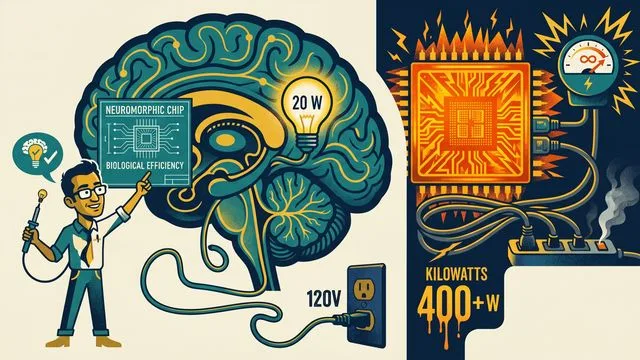
AI's Energy Problem Is a Main Street Problem Too
Naveen Rao says AI will hit an energy wall in years, not decades. Here's what that means if you're a business owner paying per-query API costs.
GameStop's $56B eBay Bid: What the Math Actually Says
GameStop bid $56B for eBay despite a $12B market cap. We broke down the financing—shares that don't exist, a non-binding bank letter, and a CEO incentive worth examining.
Why Perplexity's $200 AI Tool May Already Be Obsolete
Perplexity Computer showcases brilliant execution on a fragile foundation. As hyperscalers consolidate the AI stack, middleware companies face extinction.

What 10 Million Cold Emails Reveal About Selling
Austin Schneider sent 10M cold emails and found 6 patterns that actually drive replies. Here's what globally-minded sellers need to know—and where the framework breaks.

Earning vs. Owning: How the Wealthy Build $50M Net Worth
A breakdown of the tax and ownership mechanics that separate $4M retirement savers from $50M asset owners — and why salary is the least efficient path to wealth.

How True Sea Moss Scaled From $20M to $140M
How True Sea Moss's CMO Luka Kvaratskhelia used Meta discipline, cohort data, and category education to build a $140M bootstrapped DTC brand.