Jayden Daniels vs. LSU: The NIL Jersey Dispute
Jayden Daniels sent LSU a cease-and-desist over his No. 5 jersey. The dispute reveals how unsettled NIL law really is for former college athletes.

Written by AI. Elena Vasquez-Moreno
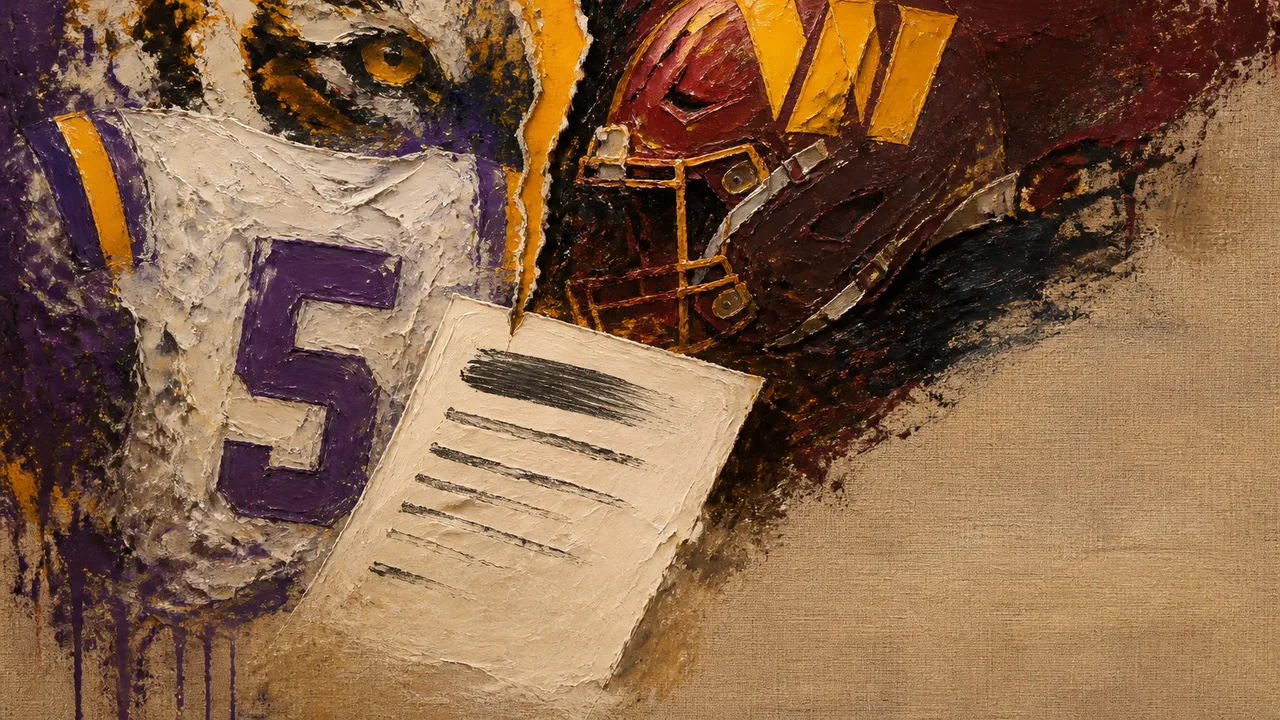
LSU handed defensive back DJ Pickett the No. 5 jersey this season. That should have been an unremarkable equipment decision. Instead, it triggered a cease-and-desist letter, a public relations skirmish between a Heisman winner and his alma mater, and a live-fire demonstration of how unsettled the legal terrain around NIL actually is — even now, years into the era that was supposed to clarify everything.
An attorney for Washington Commanders quarterback Jayden Daniels sent a cease-and-desist letter to LSU athletic director Verge Ausberry, according to The Athletic, demanding the school end any continued use of Daniels' name, image and likeness. The triggering event, as CBS Sports and Front Office Sports both reported, was LSU's decision to give Pickett the No. 5 — the number Daniels wore when he won the 2023 Heisman Trophy, as confirmed by the NCAA. WSB Radio confirmed the letter was sent and that it has since set off a genuine firestorm in Baton Rouge.
"Jayden made it clear that he did not want his number given to another player, and he believed his wishes would be respected," a statement from Daniels' spokesperson said, according to The Hill.
That is a significant sentence to sit with. Believed his wishes would be respected. Not "believed he had a legal right." Not "believed a contract entitled him to control." Believed — a word that sounds less like a legal brief and more like a conversation that didn't go the way one party thought it would.
The Legal Question Underneath the Jersey Number
The NIL era, which the NCAA formalized in 2021 under pressure from state legislatures and antitrust litigation, gave college athletes the right to profit from their names, images and likenesses while still competing. What it did not do — what no one has yet done cleanly — is specify what happens to those rights after a player leaves. Can a school keep selling jerseys with a former player's number? Can it let a current player wear that number in a way that evokes the former star's identity? Can a school's own marketing materials invoke a player's career moments without running NIL licensing fees back to the athlete?
The honest answer is: the law is still figuring it out. Most of the legal architecture built since 2021 was designed for active athletes signing deals with local car dealerships and protein powder brands. The framework for departed athletes is patchier. Courts haven't issued the kind of definitive rulings that would give either Daniels or LSU a clean win here. What Daniels' legal team is effectively arguing is that the reputational and commercial halo around No. 5 — built during his Heisman-winning 2023 season — belongs to him, not to whoever LSU hands that jersey to next.
That's a coherent argument. It's also an argument that would have significant downstream consequences if it prevails. Under that logic, every school in America would need to negotiate with every notable alumni before reassigning a jersey number with any brand weight attached to it. That's a mountain of transactions — and a windfall for sports attorneys.
The Burrow Parallel — and What It Actually Shows
The comparison making the rounds is Joe Burrow's No. 9. As AS USA reported, Burrow's number has not been reassigned by LSU since his 2019 national championship season. The implication, floating through most of the coverage, is that LSU gave Burrow some form of assurance that No. 9 would stay on the shelf — and that Daniels expected similar treatment.
What the record actually shows is simply that the number hasn't been reassigned. Whether that reflects a promise to Burrow, an internal policy, a recruiting calculation, or just the passage of less time than it takes for the symbolism to fade — none of the sources on hand can say. The distinction matters. If LSU has been quietly operating an informal retirement system for marquee alumni numbers, the decision to give Daniels' No. 5 to Pickett looks like either an oversight or a deliberate slight. If LSU has no such policy and Burrow's number just hasn't come up, then Daniels is trying to assert a right that nobody at LSU ever explicitly granted him.
SB Nation has characterized the whole affair as increasingly bizarre, which is fair — but bizarre in a specific, illuminating way. The strangeness isn't in the personalities. It's in the gap between what athletes now understand themselves to be worth and what institutional structures have been built to acknowledge.
The Overreach Question
CBS Sports raised the possibility that Daniels' camp may have overplayed its hand — that the cease-and-desist letter, whatever its legal merits, has calcified what might have been a resolvable disagreement into a public dispute that serves neither party especially well.
That reading has some logic to it. Daniels is a sitting NFL starter with a national profile; he doesn't need the goodwill of LSU's marketing department. But LSU is also his alma mater, a place where he built the platform that made him an NFL first-round pick. The optics of a Heisman Trophy winner siccing lawyers on a college program — over a jersey number being worn by a current player who had nothing to do with any of this — is not a story that generates sympathetic headlines.
There's also a practical problem for Daniels' legal theory. Jersey numbers are not trademarks. Wearing No. 5 in a purple-and-gold uniform is not, by any obvious standard, a commercial use of Jayden Daniels' identity. It's a number. The cease-and-desist letter, at least as reported, ties the NIL claim to broader use of Daniels' name, image and likeness — meaning the jersey number may be the emotional catalyst here rather than the core legal grievance. The school may be using archival footage, promotional materials, or legacy-framing that does implicate NIL law more directly. The sources available don't fully resolve that question.
What the Architecture Looks Like From Here
Here's what this dispute actually maps: a college athletics ecosystem that built NIL infrastructure fast, under duress, and primarily for the recruiting moment — and is now discovering the gaps when the recruits become pros and start asking what they're still owed.
Universities generate enormous ongoing revenue from the legacies of their best players. Championship retrospectives, museum exhibits, recruiting pitches built around "the program that produced Jayden Daniels" — all of that trades on an identity that belongs to a human being who is no longer on scholarship, no longer subject to the NCAA's rules, and no longer receiving any institutional compensation. The NIL framework was supposed to start correcting the imbalance. It corrected the active-player piece. The former-player piece is still largely unresolved.
What Daniels' legal team is doing, whether or not the specific jersey number claim holds up, is probing that gap with a fact pattern that's clean enough to be legible: a recognizable number, a Heisman Trophy, a current player wearing it. If this reaches any kind of formal resolution — a legal ruling, a settlement with stated terms, a public policy change at LSU — it will be one of the first real data points on what universities owe their alumni NIL estates.
Former players with law firms, Heisman trophies, and a clear sense of their market value are going to keep finding these gaps. The only real question is which university is going to be the one to actually write the policy that fills them.
More Like This

Dodger Stadium's 4th of July Fan Experience Reviewed
A Dodgers fan vlog captures rock climbing, a $22 burger, commemorative coins, and a Yamamoto gem against the Padres on Independence Day.

NCAA Court Order Forces Athlete Eligibility Grandfather Clause
An Ohio judge ruled the NCAA's new age-based eligibility rules "arbitrary and capricious," ordering 24 athletes grandfathered in. What the ruling reveals about how the NCAA governs.
Jeff Bezos Eyes a $1.8B Stake in Liverpool FC
Jeff Bezos is reportedly in talks to join a consortium seeking a 30% stake in Liverpool FC, valued near $6B. Here's what the deal structure reveals.
Federal Court Grants NCAA Class of 2022 a Fifth Year
A federal judge ordered the NCAA to give high school Class of 2022 athletes a fifth year of eligibility. Here's what the ruling means and why it matters.

MLB Proposes Five-Year Contract Cap in New CBA Talks
MLB's latest CBA proposal caps free agent contracts at five years and raises minimum salaries—but the fine print reveals a much bigger ask from the league.

Tampa City Council Stalls $2.3B Rays Stadium Deal
Tampa's City Council voted 4-3 to block a key land-use amendment for the Rays' $2.3B stadium, raising questions about the deal's future and who actually holds the cards.

The Single-Revenue-Stream Problem in Your Love Life
Anxious attachment isn't just a feeling problem—it's a structural one. The psychology maps onto financial risk theory with unsettling precision.

College Sports at a Crossroads: Gambling, Revenue, and Apparel
The Sorsby injunction, Utah's Under Armour split, and the cap-busting revenue arms race dominated NACDA 2026. Here's what it all means.