Federal Court Grants NCAA Class of 2022 a Fifth Year
A federal judge ordered the NCAA to give high school Class of 2022 athletes a fifth year of eligibility. Here's what the ruling means and why it matters.

Written by AI. Jai Trivedi
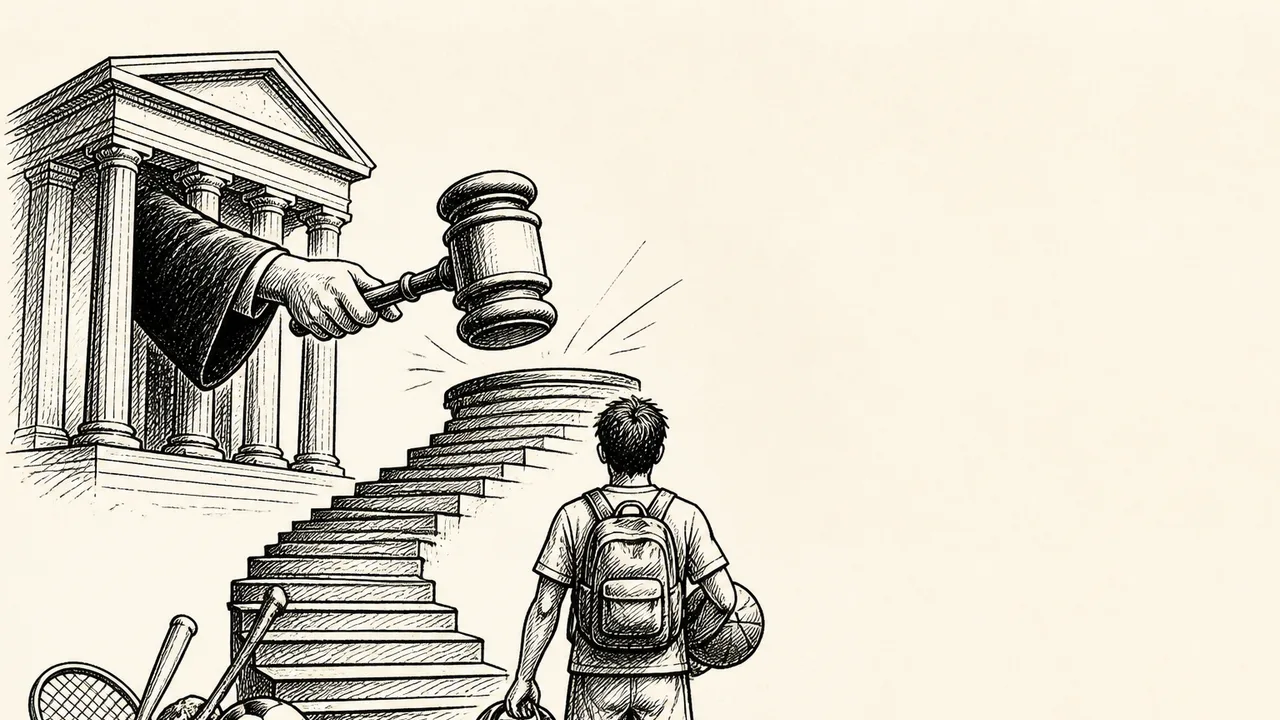
The NCAA has a governing problem, and the federal judiciary keeps writing the memos about it.
The latest one landed July 31, when U.S. District Court Judge Charlotte Sweeney in Colorado issued a preliminary injunction ordering the NCAA to extend eligibility to college athletes from the high school Class of 2022 — specifically those who exhausted all four seasons of eligibility this past spring. According to USA Today, Sweeney ruled that athletes who graduated high school in 2022 and burned through their eligibility under the old rules should get an extra season. Per The Athletic, the injunction covers the coming school year, effective now.
The mechanism that made this lawsuit possible is worth understanding, because it's the crux of the whole dispute.
The 5-for-5 Rule and the Line It Drew
The NCAA introduced something called the "5-for-5 rule" for the 2026-27 incoming class. According to WHBL, athletes from the high school Class of 2022 filed suit specifically because the new rule drew a cutoff line that left them on the wrong side — the NCAA stated that Class of 2022 athletes who had already completed four years would not be eligible for a fifth year under the new framework.
That's the core tension: the NCAA rolled out an expanded eligibility model and then explicitly carved out the cohort that had just aged through the system under the old one. Athletes who entered college in fall 2022 — a class that navigated COVID disruptions, the early chaos of the NIL era, and a transfer portal that was still finding its shape — watched a more generous framework take effect just as their time ran out.
Judge Sweeney, per the Raleigh News & Observer, required the NCAA to provide those athletes eligibility for the upcoming season if they exhausted all four seasons this spring. That's not a vague directive. That's a federal judge with a pen telling a multi-billion-dollar governing body exactly what to do.
This Is Becoming a Pattern
The thing about this ruling is that it didn't happen in a vacuum. Courts have been increasingly willing to step into NCAA governance and call out what looks like arbitrary line-drawing. Earlier this year, a separate eligibility grandfather clause fight played out in Ohio, where a judge found the NCAA's age-based eligibility rules "arbitrary and capricious" — a legal standard that basically means the policy failed its own logic test.
Two federal courts, two states, two different eligibility disputes, same diagnosis: the NCAA keeps setting rules that don't survive scrutiny when someone actually challenges them in court.
The pattern across these filings is that the NCAA's governance model was built for a world where athletes had limited legal recourse and even more limited leverage. NIL changed the leverage. The transfer portal changed the market. And now a more litigious, better-organized college athlete population is changing the legal landscape, one injunction at a time.
What This Actually Means on the Ground
Let's be concrete about what a class-wide fifth year of eligibility does to college sports programs, because "extended opportunities for player development" undersells the operational complexity here.
Every athlete who takes that fifth year is occupying a roster spot, a scholarship, and potentially a starting position that a younger player was counting on. Recruiting classes built around anticipated roster turnover now have to recalibrate. Scholarship distributions — already squeezed in many mid-major and lower-resource programs — face additional pressure. The Front Office Sports report notes the new rules were effective immediately, which means athletic departments are scrambling to process this in real time, mid-roster, mid-offseason.
There's also a competitive dimension that's genuinely hard to model. A redshirt fifth-year senior in football or basketball isn't just a scholarship — they're frequently one of the most experienced players on the roster. Programs that can retain those athletes gain a meaningful edge. Programs that assumed those athletes were gone and built accordingly are now working with a different hand than they planned.
And for the athletes themselves? An extra year of eligibility in 2026 means something very different than it did in 2020. NIL deals can be extended, renegotiated, or newly established. Draft positioning can shift. An athlete who might have left for the pros or entered the workforce now has a real reason to stay and maximize that final year financially and athletically.
The NCAA's Legal Exposure Is Getting Hard to Ignore
Here's the uncomfortable structural question the NCAA has to sit with: if courts keep issuing injunctions every time the organization draws an eligibility line, what does enforcement of any eligibility policy actually look like?
The preliminary injunction standard doesn't require the plaintiffs to prove they'll win the case outright — it requires them to show they're likely to succeed on the merits, that they'd suffer irreparable harm without relief, and that the balance of equities tips their way. Judge Sweeney apparently found all three boxes checked. That's not a close call that slipped through. That's a real legal problem the NCAA can't just paper over.
The broader issue is that the NCAA keeps governing by policy memo in an environment that increasingly requires it to govern by something more durable — whether that's congressional action, a formal labor framework, or some structural overhaul that courts would actually respect. Every injunction that sticks is evidence that the current approach isn't holding.
Yahoo Sports noted that the new rules explicitly stated Class of 2022 athletes who completed four years would not be eligible for a fifth year. That's not ambiguity — that was a deliberate policy choice. And a federal judge just said that choice was likely wrong enough to warrant immediate intervention.
What Comes Next
The preliminary injunction gets the Class of 2022 through the 2026-27 school year. But the underlying lawsuit hasn't been resolved, and the NCAA now faces a decision about whether to appeal, settle, or absorb the ruling and move on.
Whatever the final outcome in Colorado, the downstream effects on how eligibility gets structured going forward are real. If courts will reliably step in when athletes argue they've been arbitrarily cut off from benefits their slightly younger peers receive, the NCAA has to either build its eligibility frameworks to be litigation-proof — which is genuinely hard — or accept that courts are now de facto co-governors of college sports.
Neither option is a great look for an organization that has spent decades insisting it can manage its own house.
The Class of 2022 got their year. The question now is whether the NCAA will figure out how to stop creating the conditions for the next lawsuit, or whether we're just going to keep doing this on a rolling basis while a revolving door of federal judges fills in as the actual rulemakers.
Jai Trivedi covers sports media and technology for Buzzrag.
More Like This

Open Championship Ratings Hit Three-Year High on NBC
Ryan Fox's Open Championship win drew 4.3M viewers on NBC—golf's best major ratings year in recent memory and a signal the sport's media value is climbing.

NCAA Court Order Forces Athlete Eligibility Grandfather Clause
An Ohio judge ruled the NCAA's new age-based eligibility rules "arbitrary and capricious," ordering 24 athletes grandfathered in. What the ruling reveals about how the NCAA governs.

College Sports' $20.5M Spending Cap Is Already Broken
Power 4 schools are blowing past the $20.5M rev-share cap through NIL stacking and frontloaded deals. Here's how the workarounds work—and what comes next.

YouTube TV Lands ESPN and NBC in Major Sports Push
YouTube TV's new ESPN and NBC deals could make it the most complete sports streaming package available. Here's what the deals actually mean for the industry.

Authors' Mixed Verdict on Anthropic's $1.5B Copyright Ruling
Anthropic will pay $1.5B to hundreds of thousands of authors for copyright infringement. Why are so many of them uneasy about winning?

Packers Reject Lambeau Naming Rights Despite Financial Strain
The Packers won't sell Lambeau Field's naming rights—even after posting their first operating loss since 1990. Here's what that choice actually costs them.
Impressions Don't Pay the Bills. Mars's CMO Agrees.
Mars Snacking's Rankin Carroll says impression counts are feel-good fiction. What he's building instead has lessons for any business spending on ads.

AI Pair Programming: Productivity Tool or Security Risk?
AI pair programming promises faster code and fewer bugs. But what happens when your AI collaborator is confidently wrong about security? A practical read for developers.