Troy Aikman's ESPN Talks Test an NFL Repair Premium
Troy Aikman's unresolved ESPN deal shows how NFL rights, a 10% league stake and Monday Night Football talent shape the price of stability for viewers and ESPN.

Written by AI. Jai Trivedi
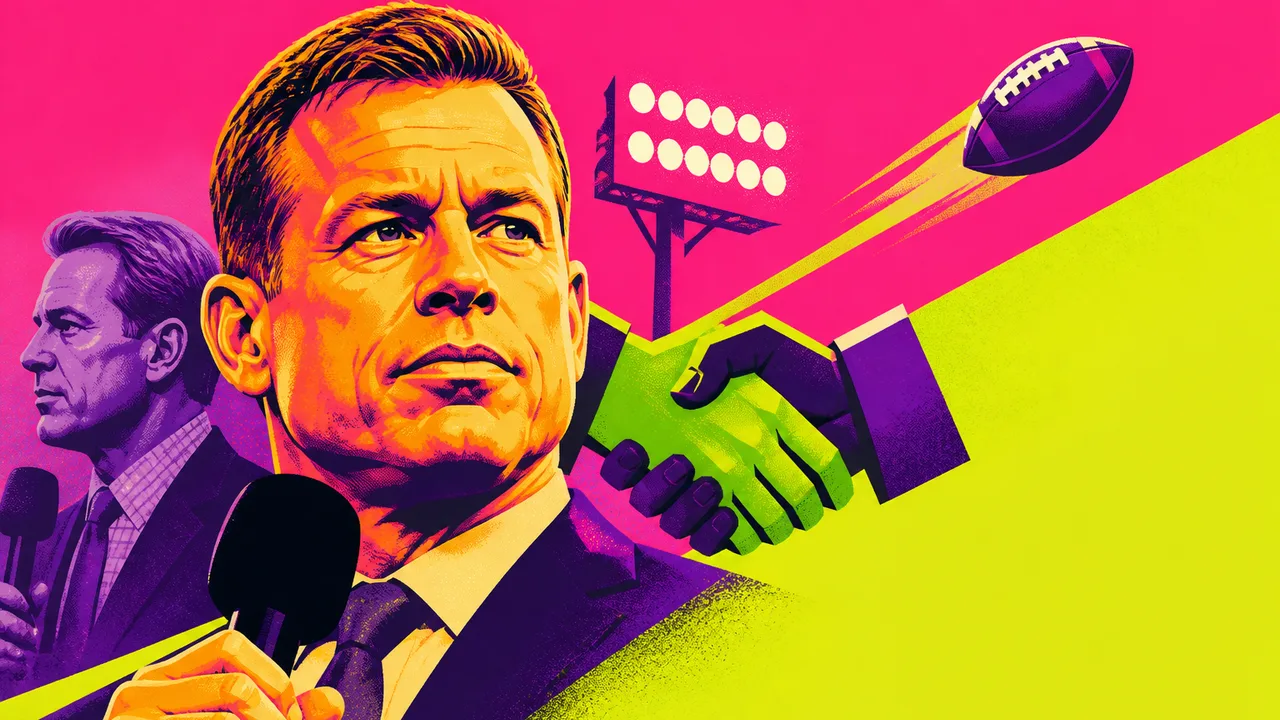
Troy Aikman expected a new ESPN contract before the 2026 NFL season started, and he is still waiting.
“I thought something would be done prior to the start of this season,” Aikman told Richard Deitsch on the Sports Media Podcast. “It’s not. When it might get done, if it gets done, is anyone’s guess.”
The unresolved deal arrived just after Aikman’s partner, Joe Buck, reportedly agreed to a six-year ESPN extension. That arrangement would keep Buck as the network’s lead NFL voice through its second Super Bowl telecast in 2031.
That sequence makes Aikman’s status look like a familiar talent negotiation: one star is signed, his longtime partner wants his number called next, everybody discovers the strategic value of a podcast microphone.
But Aikman supplied a more interesting way to price his work. He said ESPN hired him and Buck in 2022 partly to help repair the network’s relationship with the NFL. The open question is whether ESPN should keep paying a diplomatic premium after the diplomacy worked.
Aikman is Selling More than Fourth-Down Analysis
Aikman told Deitsch that his ESPN assignment extended beyond calling games.
“I came over in 2022 in large part to kind of help mend the relationship with ESPN and the NFL,” he said in Sports Media Watch’s interview account. Aikman credited Buck and others, then pointed to the NFL’s 10 percent stake in ESPN as evidence that “the fence has been mended.”
That framing doubles as his contract pitch. ESPN did not merely buy an analyst with three Super Bowl rings and decades of Fox experience. It bought instant credibility for a Monday night production that had spent years cycling through Steve Levy, Jason Witten, Joe Tessitore, Brian Griese and Booger McFarland.
In 2022, ESPN spent heavily to remake the “Monday Night Football” booth, committing roughly $33 million a year to Troy Aikman and Joe Buck. Sports Business Journal reported that Aikman received $18 million annually and Buck $15 million annually on five-year deals. The investment bought ESPN something immediately valuable: a broadcast team viewers already knew, arriving as the network worked to strengthen its relationship with the NFL.
What the public record does not show is that the league rewarded ESPN with a better schedule because Buck and Aikman were in the booth. Nor does it reveal ESPN’s current offer, Aikman’s asking price or why negotiations were allowed to spill into the season. The idea that ESPN now considers the original “repair premium” unnecessary is plausible, but it remains an inference rather than a reported fact.
The business logic behind that inference is straightforward. ESPN paid a premium for established talent at a moment when it was trying to elevate both the Monday night product and its standing with the NFL. Aikman has said that repairing that relationship was part of the assignment. Since then, the connection has deepened dramatically, including through the NFL’s agreement to acquire an equity stake in ESPN. From the network’s perspective, that raises an obvious question: how much of the job it originally paid Aikman to help accomplish is still unfinished?
Aikman has an equally strong counterargument. Stability is not a one-time purchase. A repaired relationship still requires maintenance, particularly when the other party controls the most valuable live programming in American television. And viewers encounter ESPN’s NFL product through Buck and Aikman every Monday night, not through the ownership structure behind it.
That is the contract tension: ESPN may see much of the original repair work as completed, while Aikman can argue that his value now lies in keeping the relationship, and the broadcast built around it, from slipping backward.
The Thaw Started Before Buck and Aikman
ESPN and the NFL had accumulated years of baggage before the duo reached Bristol. Awful Announcing traces the relationship’s low point to around 2016, when ESPN’s investigative coverage included concussions and player protests, and its Monday night package was receiving weaker schedules. The outlet connects those tensions with the network’s unstable booth and the league’s treatment of the package.
Money then did a large amount of the couples therapy. In 2021, ESPN agreed to an NFL rights deal averaging a reported $2.7 billion annually. The agreement kept Monday Night Football and placed ESPN in the Super Bowl rotation for the first time.
That chronology limits the credit Aikman and Buck can claim. ESPN secured its Super Bowl rights in 2021, before either broadcaster arrived from Fox. Jimmy Pitaro had already made improving relations with the NFL a priority after succeeding John Skipper.
The booth still mattered. ESPN had secured premium inventory, then needed a presentation that looked worthy of it. Buck and Aikman offered the broadcasting equivalent of buying the furnished apartment: expensive, polished and ready for Monday night without another round of auditions.
The scale also helps. Using $18 million as the reported floor for Aikman’s annual pay, ESPN’s $2.7 billion average annual rights payment is 150 times that salary floor. It does show why an eight-figure announcer contract can remain strategically small beside the rights relationship it supports.
ESPN therefore has two prices to consider. One covers Aikman’s work as an analyst. The other covers continuity, brand recognition and whatever relationship value the network believes he still carries. The public evidence cannot tell us how ESPN divides that bill.
His 2022 Exit Gives the Leverage Some Teeth
Aikman’s position becomes easier to read beside his last negotiation. Near the end of his Fox tenure in 2022, he spoke more openly about uncertainty and expressed interest in Amazon’s Thursday Night Football package. He ultimately joined ESPN after roughly two decades at Fox.
His language now is softer. Aikman said he would like to keep working with Buck “100%,” and Sports Media Watch noted that his current remarks fall well short of his public uncertainty in 2022.
The comparison has limits. In 2022, Amazon had just entered the exclusive NFL streaming business and ESPN could sell Aikman a complete Monday night reset. Today, Buck is reportedly locked into ESPN for six more years, giving Aikman a powerful reason to stay and ESPN a powerful reason to assume he might.
Potential alternatives could keep that assumption from becoming complacency. Prime Video's Kirk Herbstreit’s contract is expiring, and at CBS, Tony Romo’s return is unlikely and J.J. Watt is still proving himself beside Jim Nantz. They could be viewed as solid options to replace Aikman.
Aikman has also shown that the Buck partnership does not fully dictate his choices. He left Fox for ESPN in 2022 while Buck still had a year remaining on his Fox contract and no guarantee of a release. Buck eventually followed.
That history gives Aikman’s comments more weight than routine negotiation theater, even if leverage building is part of the exercise. He has moved before, and the NFL’s broadcast market may have openings. He also has a partner, a premium assignment and a repaired league relationship waiting at ESPN.
The likeliest outcome may still be a reunion because ESPN has already secured Buck and spent four seasons rebuilding Monday Night Football around the pair. Yet the delay exposes a question larger than who calls the next third-and-seven: once a star broadcaster helps solve a network’s strategic problem, does his price rise because he succeeded, or fall because the problem is gone?
More Like This
Why Big Streamers Built a Sports Lobbying Alliance
Amazon, Netflix and YouTube are taking their sports streaming fight to Washington as regulators revisit media rights, fan access and a 1961 antitrust law.

Seahawks Sell for $9.6 Billion in Record NFL Deal
The NFL unanimously approved the $9.6B Seahawks sale to the Khosla family. Here's what the record price tag says about where NFL franchise values are headed.
Stephen A. Smith Tests Sports Media's Political Reach
Stephen A. Smith's 2028 speculation shows how sports media can convert recurring attention into political capital, while creating new risks for ESPN and its audience.
NFL Schedule Expansion Draws Greed Criticism
Joy Taylor calls the NFL's schedule expansion "greedy." Here's the economic logic behind the push—and why the pushback deserves a serious look.
George Washington: The Man Behind the Monument
From battlefield defeats to a death made worse by his own doctors, Washington's life is more complicated than the marble monument version suggests.
WoW Gold-Making in Patch 12.0.7: Strategies and Trade-offs
ElonCS breaks down cross-realm flipping, crafting, and burnout management in WoW Midnight's Patch 12.0.7. Here's what actually works and what it costs you.