Tribute Acts Are Saving UK Venues — At What Cost?
Tribute acts are keeping UK music venues financially afloat — but as nostalgia fills the calendar, what space remains for original artists?

Written by AI. Priyanka Desai
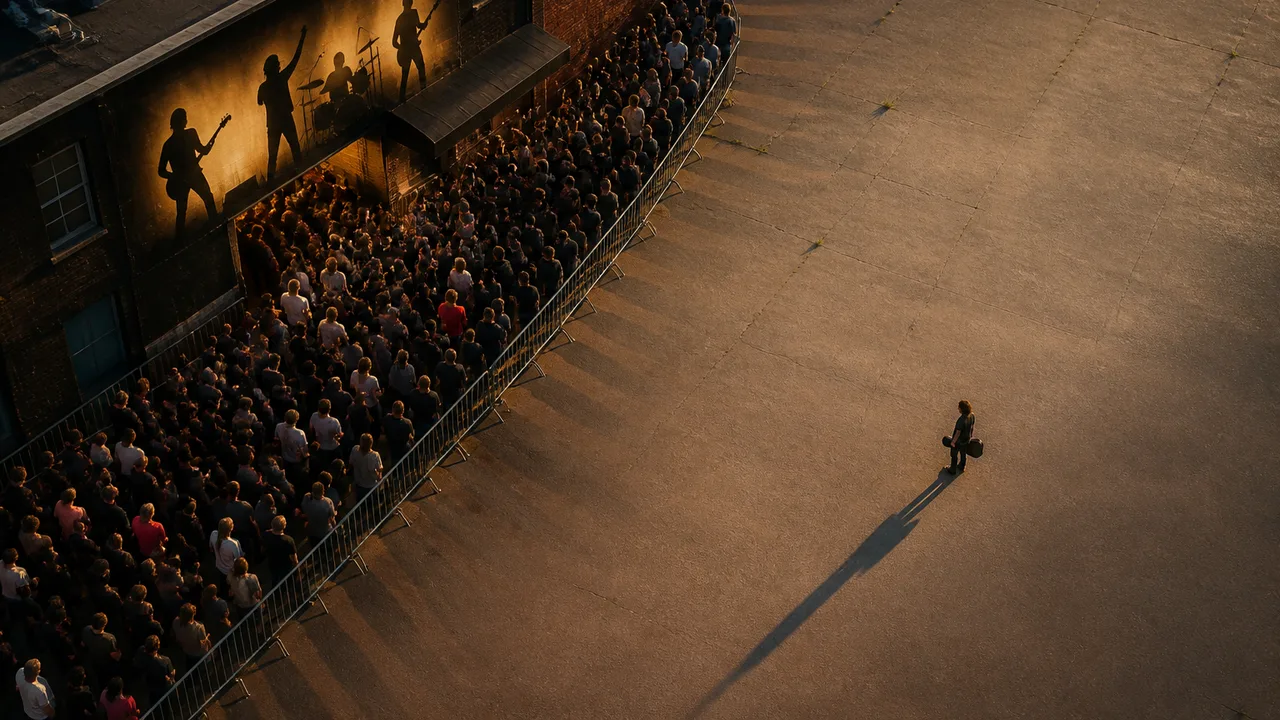
Somewhere in Britain tonight, someone is backcombing a beehive and rehearsing Amy Winehouse's phrasing in a mirror. Somewhere else, a venue manager is looking at next month's bookings and feeling, for the first time in a while, like the numbers might actually work.
These two facts are not unrelated.
The financial logic is real
The Guardian reports that tribute acts have become a genuine financial lifeline for the UK's live music venues — venues that have spent several years walking a tightrope between covering costs and closing permanently. The claim embedded in that headline — that tribute acts have put the live music scene "back in the black" — is a strong one, and the economics behind it are straightforward enough to follow.
Tribute acts cost significantly less to book than established original artists. They carry no tour rider mythology, no management fees calibrated against arena revenues, no expectations of headline festival slots. What they carry instead is a predictable crowd. A well-reviewed Amy Winehouse tribute or a convincing Robbie Williams act arrives with a pre-formed audience — people who know exactly what they want and are willing to show up on a Tuesday to get it.
An industry-facing discussion on Reddit's r/bandmembers lays out the structural appeal directly: tribute acts offer venues a reliable draw without massive overhead, fans an accessible high-quality experience, and musicians a sustainable career path in an increasingly volatile industry. That's three simultaneous problems solved by one booking decision. It's the kind of efficiency that makes venue programmers look smart — which is probably why it's spreading.
An unnamed Ohio-based promoter, quoted via The Good Men Project, puts it plainly: "Our job is to find the very best of the tribute bands. The very best Fleetwood Mac band, the very best Rolling Stones band." Worth noting: this is an unnamed source cited through a secondary outlet — a thin anchor for a structural industry claim. But it tracks with what venue managers on both sides of the Atlantic are reportedly doing: treating tribute act curation as programming strategy, not filler.
What the performers actually do
The dismissive version of this story writes itself: tribute acts are karaoke with better production values. That version is wrong, and the performers themselves make the counter-argument most effectively.
The Guardian quotes one performer in terms that reframe the whole enterprise: "This is more than sticking on eyeliner, backcombing the beehive and putting on really expensive, uncomfortable shoes. It's a feeling. That gut-wrenching first love that kicks you in the stomach; having your heart broken." That's not someone describing mimicry. That's someone describing emotional transmission — the same thing any performer worth watching is trying to do.
TSE Entertainment makes the preservation argument: tribute bands create experiences steeped in authenticity that resonate with fans old and new, preserving the legacy of music through passionate homage. The word "authenticity" in that sentence will make some people wince — authenticity is usually what gets abandoned when you're performing as someone else. But there's a version of it that holds: emotional fidelity, if not biographical fidelity. The audience isn't being fooled. They know what they bought. What they're buying is the feeling the original music produces, delivered live in a room with other people who feel the same thing.
Elvis impersonators are widely credited as an early template for the tribute act format — ProTributeBands.com, a commercial directory, notes this history, though the site isn't a scholarly source on music history. What it does illustrate is how long the format has been commercially viable: long enough to have developed professional infrastructure around it.
The scaling question
One of the more interesting structural shifts is what happens when tribute acts stop playing small rooms. The BBC profiles Fell Out Boy, a Fall Out Boy tribute act, who have been playing as the act for more than a decade — a timeframe the BBC reporting confirms directly. Their strategy: pair with other tribute acts on the same bill. "We've found when we put two bands together, we can start scaling it to much bigger venues," according to the BBC piece.
That's a meaningful data point. It suggests tribute acts aren't simply filling the gap left by original artists who can no longer afford to tour small venues — they're building their own parallel economy with its own scaling logic. Two tribute acts sharing a bill means shared production costs, doubled draw, and venue capacity that would have been unreachable for either act alone.
ProTributeBands.com observes that intimate theaters and historic music halls are coming alive with tribute programming — the implication being that these are spaces which struggled to survive on original music bookings alone.
The question the Guardian doesn't fully resolve
The Guardian's framing — tribute acts put live music "back in the black" — carries an implicit assumption worth examining: that the revenue generated by tribute programming flows back into an ecosystem that also supports original artists. It might. It might not. The data to confirm it isn't in the reporting.
Consider what "back in the black" actually requires. A venue running tribute acts every weekend generates cash. Whether that cash cross-subsidizes original artist nights, or whether venue programmers simply discover that tribute acts remove all the financial risk of trying something new, depends entirely on who's making the booking decisions and what their incentive structure looks like. Both outcomes are plausible, in different venues, in different proportions.
The concern from original artists is structural rather than sentimental: if tribute acts reliably outsell emerging acts, the rational venue response isn't to cross-subsidize the risk — it's to reduce it. Calendar slots are finite. A venue that books twelve tribute nights per month and two original artist nights isn't hostile to new music; it's just running a business in a way that makes the math work.
What would actually answer this
The metric that would clarify the Guardian's claim is a before-and-after breakdown of venue programming calendars — specifically, the ratio of tribute act bookings to original artist bookings over the last five years, cross-referenced against venue survival rates in the same period. If venues running heavy tribute schedules also maintained or grew their original artist programming, the rising-tide argument holds. If they didn't, the financial rescue came with a programming trade-off that the "back in the black" headline obscures.
That dataset doesn't appear to be publicly available, and none of the sources here provide it. Which means the Guardian's claim is directionally plausible — tribute acts are generating revenue that venues need — but the second half of the story, about what that revenue enables or forecloses, remains genuinely open.
The performers know their craft is real. The venues know the bookings work. What nobody has cleanly answered yet is whether the live music scene being "back in the black" is good news for the whole ecosystem — or just for the part of it that already knows all the words.
More Like This
Unpacking Orwell's Critique in 'Animal Farm'
Explore George Orwell's 'Animal Farm' as a critical lens on power dynamics and its relevance today.
London Games Festival 2027 Gets a New Central Venue
London Games Festival moves to the Business Design Centre for April 2027. Here's what the venue shift means for fans, devs, and the festival's global ambitions.

AI Training Data: The Legal Vacuum No One Is Filling
AI companies built trillion-dollar products on data they never paid for. Courts are starting to push back—and Congress still hasn't shown up.

How Technology Is Reshaping the Live Sports Venue
From AI-driven personalization to AR glasses and sensory rooms, sports venues are in the middle of a tech arms race—and the fan is both the beneficiary and the product.

Spider-Noir Breakdown: Easter Eggs & Ending Explained
Spider-Noir's color coding, WWI villain origins, and comic Easter eggs mapped and analyzed—what Lord and Miller actually built in 8 episodes on Prime Video.
Metallica Close the M72 World Tour in London
Metallica wrapped a three-year world tour at London Stadium in July 2026. Here's what the shows revealed about the band's enduring live power.

Rina Hidaka and Yūma Uchida Announce Birth of First Child
Voice actors Rina Hidaka and Yūma Uchida welcomed their first child. Here's what the arc of Hidaka's career tells us about what comes next.

How Low-Budget Films Achieve High Production Value
Budget doesn't determine production value — craft does. Here's how filmmakers use light, sound, and design to make cheap movies look expensive.