Ten Barn Owl Chicks Hatch in Fermanagh
Two barn owl pairs reared ten chicks at undisclosed Fermanagh sites this summer—an above-average brood that signals real progress in Northern Ireland conservation.

Written by AI. Nadia Marchetti
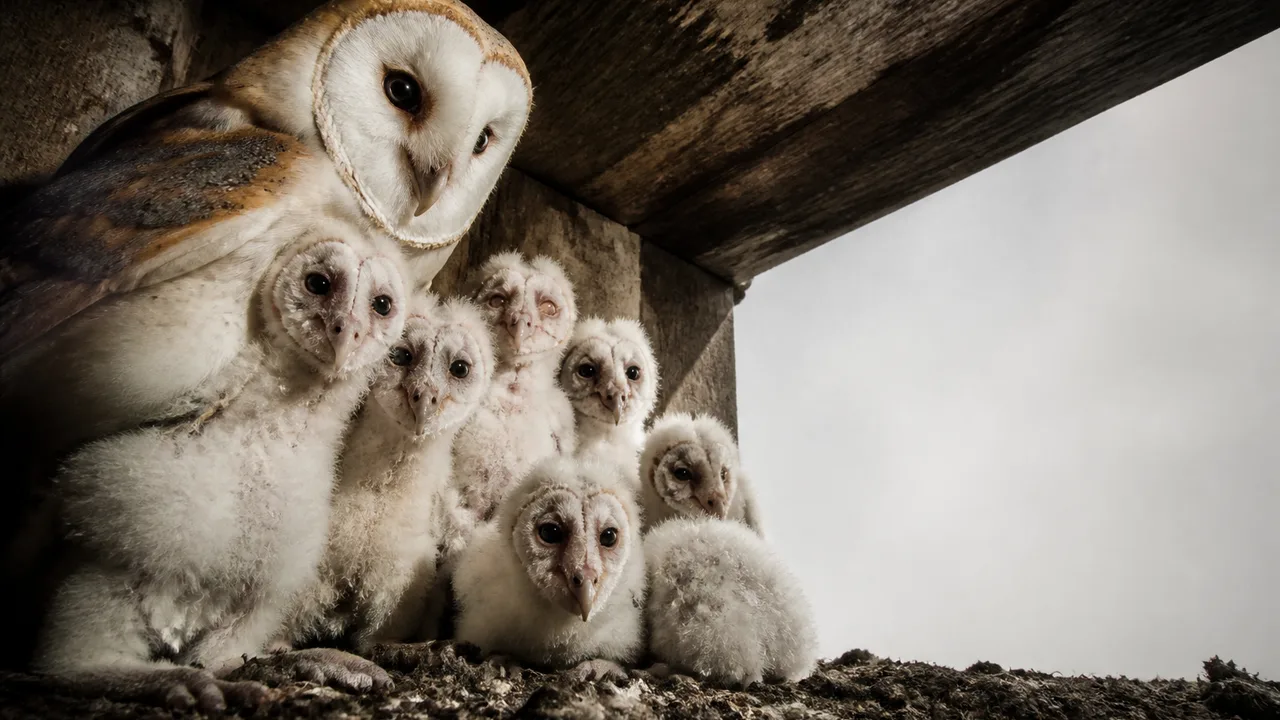
Somewhere in County Fermanagh—at locations that will stay deliberately unnamed—two pairs of barn owls sat on nests this summer and did something that nobody wanted to take for granted: they raised five chicks each.
Ten barn owl chicks, alive, healthy, from two nests. That's the whole story, and also somehow more than the whole story.
Barn owls (Tyto alba) are not cryptids. They are not mysterious. They are, however, genuinely rare in Ireland, and they have been getting rarer in ways that are depressingly well-documented: grassland lost to intensive agriculture, old barns converted or demolished, rodenticide poisoning filtering up the food chain, and a climate that periodically delivers the cold wet winters these birds—which hunt by sound over open ground—handle very badly. The pattern of decline is familiar to anyone who follows European farmland birds. The Fermanagh news doesn't reverse that pattern. But it does complicate the narrative of inevitable loss, which is worth examining seriously.
What actually happened
Ulster Wildlife, the Northern Ireland conservation charity, discovered the two successful nest sites during farm visits in Co Fermanagh this summer. According to ITV News, the charity specifically noted that a brood of five chicks is above average for barn owls—a detail worth sitting with, because it means this wasn't just a good year. It was a notably productive year, by the species' own standards.
Katy Bell, senior conservation officer with Ulster Wildlife, put the result in context without overselling it. "After such a difficult breeding season last year for barn owls," she said, "finding two successful nest sites, each with five healthy chicks, is fantastic news." That quote appears across RTÉ, Agriland.ie, and Agriland.co.uk—and the specific mention of last year's difficulty is doing real work. This isn't a conservationist claiming a trend from two data points. It's someone measuring one good summer against an immediately preceding bad one, and being honest about both.
BBC News reports the sites as undisclosed—which is standard practice for vulnerable species, and worth noting not as a mystery but as deliberate, responsible fieldwork. Publicizing the exact location of a barn owl nest in a country where the population is small enough that individual pairs genuinely matter is the kind of thing that can go wrong in multiple directions: disturbance, egg collection, the simple well-intentioned footfall of birdwatchers who don't mean any harm but cause it anyway.
Why five chicks is the number to focus on
Barn owls are not exactly reliable breeders. The species lays clutches typically ranging from four to seven eggs, but fledging rates are sensitive to prey availability in ways that are almost brutally direct. Barn owls feed almost exclusively on small mammals—primarily field voles and wood mice in the Irish context—and their breeding success tracks vole cycles with an accuracy that makes them one of ecology's better living instruments. When vole populations crash, barn owl reproduction crashes with them. When the grass is long and prey is abundant, nest productivity climbs.
That both Fermanagh pairs fledged five chicks each—a figure ITV News confirms is above average—implies something meaningful about prey abundance this summer at those specific sites. It suggests that whoever is managing the land around those nests has, intentionally or not, created conditions where small mammal populations are doing well enough to support two above-average broods simultaneously. That's not nothing. That's actually quite a lot.
The broader implication connects to what BBC News describes as barn owls being "crucial indicators of ecosystem health." The phrase gets used often enough that it risks sounding like boilerplate, but the mechanism is specific: a thriving barn owl pair requires not just a nest site but an intact food web below it. Grassland that supports voles. Field margins that haven't been stripped. A landscape managed with enough tolerance for wildness that the whole chain holds together. When barn owls breed successfully, they're not just producing barn owls—they're reflecting the health of everything underneath them.
The farm connection
One aspect of this story that deserves more attention than it typically gets in wildlife coverage is where these nests were found: on farms. Ulster Wildlife's discovery came during routine farm visits, which means farmers in Fermanagh were either actively supporting barn owl habitat or at minimum tolerating the kind of landscape management that makes it possible. That's not incidental.
The relationship between modern agriculture and barn owl decline is direct and well-established. Grassland improvement, silage production replacing hay, the loss of rough field margins, and the conversion of old farm buildings have all contributed to reducing the habitat these birds depend on. Fermanagh, as a county, has historically retained more traditional farming landscapes than parts of eastern Northern Ireland—and that matters. But it doesn't happen automatically, and it doesn't persist without farmers making choices, sometimes at real economic cost, to maintain the kind of land that wildlife can use.
The sources don't give us detail on what specific management practices supported these nests, and the site locations are deliberately withheld—so there's a limit to what can be said here. But the fact that Ulster Wildlife found these nests through farm visits, rather than through remote sensing or chance sighting, points to an ongoing relationship between conservationists and landowners that made the discovery possible. That infrastructure—the trust, the access, the communication—is often the invisible variable in conservation success stories, and it rarely gets the credit it deserves.
The honest accounting
Ten chicks from two nests is genuinely good news. It would be dishonest to pretend otherwise, and it would also be dishonest to extrapolate it into a species recovery.
Barn owls in Ireland remain rare. The population is small enough that individual breeding pairs are counted and monitored, which is itself a sign of how precarious things are—nobody counts individual breeding pairs of robins or blackbirds. One excellent breeding season, following Katy Bell's account of a difficult previous year, is more like a respite than a reversal. The threats that drove the population to its current level—habitat loss, agricultural intensification, rodenticide contamination—haven't gone away. They're structural, not seasonal.
What this summer demonstrates is that when conditions are right, barn owls can respond. They have the biological capacity for above-average productivity. The question conservation work keeps bumping into is whether human land-use decisions will hold those conditions in place long enough, and across enough sites, to turn individual good seasons into population-level recovery.
Two nests in Fermanagh can't answer that question. But they do suggest it's answerable—which, in the current state of Irish wildlife conservation, is itself a thing worth saying clearly.
The ten chicks will disperse. Some will survive their first winter, which for a barn owl is the hardest test. Some won't. And somewhere in Fermanagh next spring, if the voles are still there and the nest boxes haven't been disturbed, maybe two pairs of owls will do this again.
More Like This

We've Been Teaching Heisenberg's Uncertainty Principle Wrong
The story we tell about Heisenberg's Uncertainty Principle is misleading. Professor Aephraim Steinberg explains what the textbooks got wrong—and what's right.
Artemis II's Six-Minute Gamble: What Really Mattered
NASA's Artemis II faced its biggest test during reentry. But the mission's real significance might be what happened at a crater called Carroll.
The Aurochs Is Gone. Should We Bring It Back?
The wild ancestor of cattle vanished in 1627. Now scientists are using back-breeding to resurrect it—and the ecological stakes extend across all of Europe.
Chapel Head: Time Team Digs the Cambridgeshire Fens
Time Team's "Beacon on the Fens" investigates Chapel Head in Cambridgeshire, uncovering a medieval chapel, Saxon pottery, and layers of prehistoric occupation.
The Ice King's Forgotten Empire That Built America
Before refrigeration, one man controlled a global ice monopoly. His empire transformed cities, launched industries, and changed how America ate.
Bigfoot, Werewolves, and the Science of Strange Sightings
From Georgia dashcam footage to Brazilian backyards, cryptozoology meets real wildlife science—and the answers are often stranger than the legends.

Neil deGrasse Tyson on UFO Whistleblowers and Alien Life
Neil deGrasse Tyson takes the UFO whistleblowers seriously—but his demand is simple: stop describing aliens and produce one. A rigorous look at what he actually said.

Cold War Flashes and Alien Technosignatures
Astrophysicist Beatriz Villarroel's VASCO project found mysterious flashes in 1950s sky photos linked to nuclear tests. Here's what the evidence actually shows.