How a Tanzanian Fossil Redrew the Dinosaur Timeline
A Tanzanian dicynodont links Africa to dated South American rocks, challenging the age of Nyasasaurus and the earliest known dinosaur record.

Written by AI. Amelia Nwofor
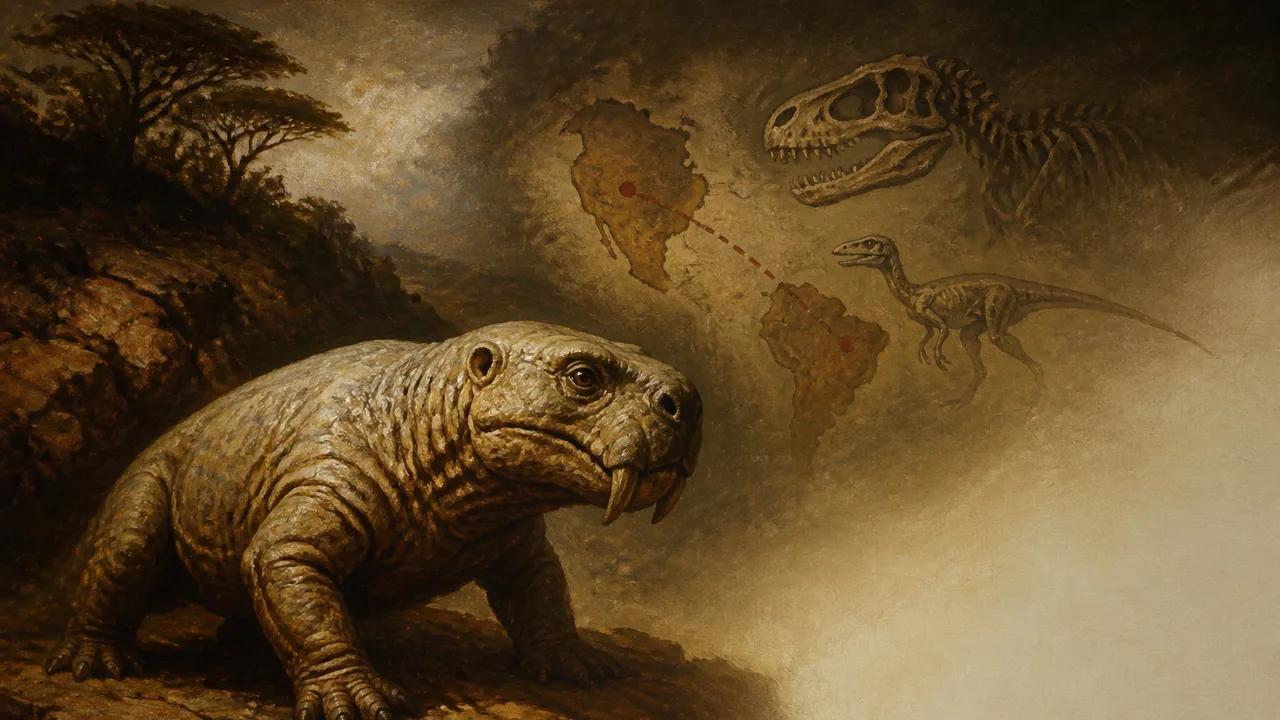
A fossil collected in Tanzania in 1963 has weakened the case for placing the world’s earliest known dinosaur in the same rocks.
The specimen belongs to a newly named plant-eating dicynodont, Dinodontosaurus isiyavamanda. Dicynodonts were beaked, often tusked members of the mammal lineage that lived before dinosaurs became dominant. The animal matters here because its genus had previously been confirmed only in South America.
That geographical match gives paleontologists a new way to estimate the age of Tanzania’s Manda Beds. The mid-to-upper Lifua Member of those beds also yielded Nyasasaurus parringtoni, announced in 2012 as a possible earliest dinosaur. If the Tanzanian rocks formed alongside younger South American deposits containing Dinodontosaurus, then Nyasasaurus also moves forward on the Triassic calendar.
The study supports that younger interpretation. It does not directly date Nyasasaurus, remove it from the dinosaur family tree or identify a different first dinosaur. It revises the geological scaffolding under an already conditional record.
A 63-Year Route from Specimen to Species
A British Museum and University of London expedition recovered the principal specimen, NHMUK PV R 12710, in Tanzania in 1963. Its partial skull and skeleton entered the Natural History Museum’s collections in London, where some of the expedition’s material remained only partly examined.
A second specimen, NMT RB462, was collected in 2012 from another exposure of the mid-to-upper Lifua Member. Researchers brought the two finds together using X-ray computed tomography, surface imaging and anatomical comparison. A detailed account of the analysis reports that Bayesian and parsimony-based family-tree analyses both placed the Tanzanian animal within Dinodontosaurus.
Its anatomy supplied the taxonomic case. Features including tab-like projections on the frontal bones connected it with the genus, while details of the palate, temporal bar and lower jaw distinguished it from the South American species D. brevirostris and D. tener. The researchers named the new species D. isiyavamanda, referring to the land of the Wamanda people in the region where the fossils were found.
This sequence matters because the age revision begins with identification. CT scans do not produce a date by themselves. They help establish what animal the bones represent; that classification then permits comparison with fossils elsewhere. A museum drawer becomes part of a geological clock only after the anatomy survives that chain of tests.
The chain still has unfinished links. A University of Bristol account of the research says much of the postcranial skeleton, meaning the bones behind the skull, has yet to be studied fully. Further comparison with South American material could refine the diagnosis. That unfinished work does not erase the reported cranial evidence, but it makes triumphal language about a settled dinosaur timeline premature.
How One Herbivore Moves a Dinosaur
Paleontologists often correlate rock layers by comparing the fossils found within them. If the same distinctive group occurs in two sequences, the overlap can indicate that the rocks formed during a similar interval. This is biostratigraphy: using life’s changing cast of characters to line up geological chapters.
The Tanzanian layers had previously been compared with fossil-bearing deposits in South Africa. Those comparisons supported an Anisian, or Middle Triassic, age of about 247 million to 242 million years. Dinodontosaurus creates another comparison, this time with Brazil’s Dinodontosaurus Assemblage Zone and Argentina’s Chañares Formation.
The published account quoting the paper’s conclusion places the mid-to-upper Lifua Member in the late Ladinian to Carnian, spanning intervals of 242 million to 227 million years ago. The researchers had previously treated it as Anisian, from 247 million to 242 million years ago.
The argument proceeds in three steps. First, anatomical and phylogenetic analyses place the Tanzanian species in Dinodontosaurus. Second, the same genus occurs in better-constrained South American fossil sequences. Third, radiometric dates associated with those South American sequences provide an age anchor for the Tanzanian rocks. The Bristol account says those sequences may be as much as 10 million years younger than the South African rocks used in the earlier comparison.
The 10-million-year figure, then, is not the result of directly radiometrically dating the Tanzanian fossil. It emerges from what happens when one cross-continental correlation is replaced by another. That may sound like a technical distinction, but it is the difference between measuring the fossil’s age and inferring it—and therefore the difference between what the evidence shows and what the headline can legitimately claim.
The South American comparison has a clear advantage: it connects Tanzania with a genus once known only from South America and with rock sequences described as securely dated. Its limitation follows from the same method. A shared genus supports broadly equivalent ages, while genera can persist across time and occupy large areas. The study’s language reflects that uncertainty: the Lifua Member was “likely” deposited alongside the Brazilian and Argentinian units, and Tanzania’s dinosaur candidates are “probably” no older than South America’s.
What Changed for Nyasasaurus
When Nyasasaurus parringtoni was presented in 2012, its claim to exceptional antiquity depended partly on the assigned age of the Manda Beds. Nautilus describes that earlier status as the oldest known dinosaur claim, while the newer work shifts the field of contenders toward South America.
The new study leaves the Nyasasaurus fossil physically unchanged. Its classification as a possible dinosaur also remains a separate question from the age of its surrounding rocks. What changes is its position in time. Under the younger correlation, the specimen may be broadly contemporary with early dinosaur records from South America rather than substantially older.
This comparison clarifies why “oldest known” is a fragile label in paleontology. Such a record depends on at least two judgments: researchers must identify the organism correctly and place its rock layer accurately. Dinodontosaurus isiyavamanda affects the second judgment through evidence assembled for the first. A taxonomic revision of a tusked herbivore can reorder dinosaur history without touching a dinosaur bone.
The case also sharpens the role of museum collections. Fieldwork in 2012 supplied the second specimen, but the partial skeleton collected in 1963 provided the long-preserved material needed for the species diagnosis. New imaging and comparison turned that stored fossil into evidence for a different geological correlation. Collection care can preserve unanswered questions for tools and reference material that do not yet exist.
None of this establishes the precise birthplace or first appearance of dinosaurs. The South American formations become stronger comparison points under the proposed correlation, while the fossil record remains incomplete and the Tanzanian age rests on biostratigraphic inference. Additional study of the skeleton and the Manda Beds could narrow that uncertainty or alter the comparison again.
For now, the useful correction is narrower: Nyasasaurus may still belong near the beginning of dinosaur history, but its claim to stand several million years ahead of the South American record has lost much of its geological support. The fossil collected in 1963 did not supply a new first dinosaur. It exposed how much every “first” depends on the clock beneath it.
More Like This

How the Asteroid Impact Ended the Dinosaur Era
Explore the catastrophic asteroid impact that ended the dinosaurs, its immediate aftermath, and the long-term environmental changes.
Why All Mammals Share Seven Neck Bones
Giraffes and humans both have seven cervical vertebrae. The evolutionary reason involves Hox genes, cancer risk, and the surprising anatomy of the diaphragm.
First Adult T. Rex Trackway Found in North Dakota's Hell Creek
A 66.5-million-year-old trackway in North Dakota preserves four giant footprints from a full-grown T. rex, capturing how the tyrant walked before extinction.
The Grand Canyon's Missing Billion Years, Explained
The Grand Canyon holds one of Earth's best geological records—and one of its most puzzling gaps. Here's what geologists know about the missing billion years.
Intelligence Beyond the Brain: Michael Levin's Radical Rethink
Biologist Michael Levin argues intelligence exists on a continuum reaching down to cells and molecules. Here's what the evidence actually supports—and where it gets murky.

The Messy, Brilliant History of Divergence and Curl
How Hamilton's quaternion obsession, Maxwell's electromagnetism, and a self-taught telegraph operator gave us the vector calculus we use today.