Triassic Amphibian Fossils Suggest a Life at Sea
Two armored fossils from Triassic China point to an amphibian that lived at sea. Their bones reveal its habitat more clearly than how it survived salt water.

Written by AI. Priya Sharma
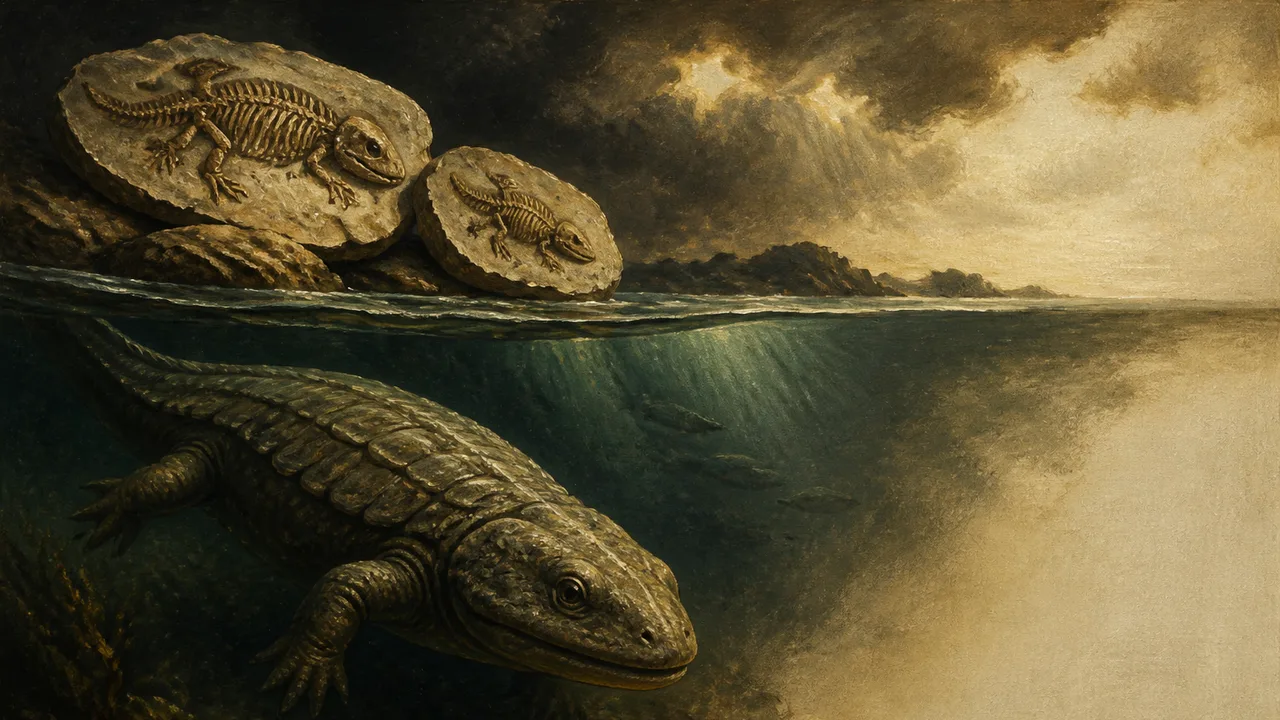
Two nearly complete amphibian skeletons from China have given researchers a reason to redraw one boundary of ancient life: an amphibian may have lived in the open sea. The species, Gerrothorax maritimus, inhabited what is now Guizhou province about 237 million years ago. Lipin Diao and colleagues described it in Nature Ecology & Evolution on October 26, proposing it as the first known fully marine stem amphibian. Their case rests on where the fossils were buried and the chemical signature of their bones.
That proposed habitat is remarkable because none of the more than 8,000 living amphibian species lives in the ocean. Familiar frogs and salamanders have permeable skin that helps them exchange water and gases, but leaves them poorly equipped to manage seawater. G. maritimus belonged to an ancient branch of the amphibian lineage, so the bodies of living frogs cannot serve as a complete physiological blueprint for it. Its fossils can answer a narrower question with much greater force: where did these animals spend their lives?
Three Clues, Three Different Questions
The first clue is geographical. The skeletons came from rock deposited in a Late Triassic sea. Reconstructions place the burial site at least 30 kilometres from land. Guizhou is inland now; the distance refers to the ancient coastline, not a modern map. An offshore burial establishes where remains ended up. By itself, it leaves room for an animal that died elsewhere and drifted out.
The second clue concerns that journey. Both skeletons retain much of their articulation, including delicate fingers. Diao and colleagues argue that a carcass carried more than 30 kilometres through the sea would be unlikely to keep its limbs so intact. Their argument links the burial site more closely to where the animals died. Preservation cannot record every movement before death, but it makes a long postmortem voyage a poorer explanation for these two fossils.
The third clue looks further back than death. The researchers compared strontium isotope ratios in the bones with those in the surrounding sediment and with values expected for Triassic seawater. Strontium enters bone during an animal’s life. Its isotope ratio varies among terrestrial settings, while seawater has a more consistent signature. The bones matched the expected seawater value rather than the rock enclosing them. Corresponding author Ryosuke Motani said the analysis strongly suggested that the bones grew at sea, without substantial contamination from the sediment during preservation.
Each clue does different work. The ancient coastline locates the grave; articulated fingers argue against a long drift after death; bone chemistry points to the environment in which the animals grew. Taken together, they support a marine life history more strongly than an offshore fossil alone could. The inference comes from two individuals, and the isotope result depends on the researchers’ comparison with ancient seawater and their assessment of preservation. Those qualifications belong alongside the conclusion, rather than erasing the agreement between the clues.
Even the phrase “fully marine” carries a question about time. A seawater signature in growing bone supports sustained exposure during life; intact remains far offshore make it plausible that these individuals also died in that environment. G. maritimus lived at sea, potentially throughout its life, rather than merely visiting it.
An Old Relative, a New Habitat
The closest reported relative of G. maritimus, Gerrothorax pulcherrimus, lived in freshwater and was first described nearly a century ago. This comparison gives the discovery its evolutionary context. The lineage was already known through a freshwater animal; the newly described fossils place a close relative far offshore, with a seawater signature in its bones. The question shifts from whether an amphibian reached the sea to how members of this armored lineage could tolerate living there.
Armor inherited from freshwater ancestors may have helped. In freshwater, armor could protect against predators. In seawater, a barrier over the body might also reduce exchange through the skin, changing how an animal acquired water and dealt with salt. Diao and colleagues suggest that reliance on gills and the gut could have made adaptation to the sea possible. The proposed sequence is plausible because it starts with a feature the lineage already possessed. The fossils show armor; they cannot show a measured salt balance in a living Gerrothorax.
Modern amphibians sharpen the comparison while setting a limit on it. Some newts never leave the water, Motani notes, so being an amphibian does not require an adult to alternate between land and water. Those newts do not establish a route into the ocean: freshwater residency and surviving marine salt are different challenges. Likewise, G. pulcherrimus offers a comparison within the genus, not a preserved sequence of generations changing from freshwater dwellers into G. maritimus. The two species show a contrast in habitat and a candidate trait for crossing it.
What might the animal have done on the seafloor? The more complete specimen preserves at least 73.7 centimetres along its midline, with some tail bones missing. It had a flattened, armored body. Motani proposes that its broad mouth and strong hyoid bone, part of the apparatus involved in moving water through the mouth, suited it to ambushing prey by suction. He compares that feeding style with a wobbegong, a bottom-dwelling shark. That is a functional analogy about a possible way to catch food, not a claim that shark and amphibian shared the same anatomy or habitat history.
Armor could have affected more than salt exposure. Motani has suggested it might have helped weigh the animal down near the seafloor, while its retained gills could have supported breathing in water. Those proposals fit an animal built very differently from a living frog. But soft tissues did not survive in these skeletons, leaving the workings of its digestive system and its method of reproduction unresolved. The bones can make the seafloor predator credible without supplying its menu, its salt-handling mechanism or its nursery.
An outside assessment adds scale to the finding. John Long of Flinders University called the fossil a first in light of the absence of fully marine amphibians among living species. He also suggested that marine reptiles might have constrained any wider spread of amphibians into that habitat, a possibility rather than a demonstrated cause. The new species establishes that an armored amphibian lineage apparently made the crossing at least once. Whether other members followed will depend on finding more than these two animals.
For now, G. maritimus leaves a sharply defined picture: two articulated skeletons buried far from land, carrying the chemical signature of Triassic seawater. The armor offers a way to investigate how an amphibian could live there. It is the next question, not the answer already written in the bones.
More Like This
How a Tanzanian Fossil Redrew the Dinosaur Timeline
A Tanzanian dicynodont links Africa to dated South American rocks, challenging the age of Nyasasaurus and the earliest known dinosaur record.
Quantum Field Theory, AI, and the Gravity Problem
Physicist Ross Jenkinson explains how quantum computing and AI could unlock the biggest unsolved problem in theoretical physics: reconciling quantum theory with gravity.

The Mountain Climbing Theorem Explained
Two climbers, one rule: stay at the same height. A deceptively simple constraint leads to a proof that hinges on graph theory and one critical word: finite.