Starship Flight 15's Booster Abort Tests Recovery Rules
SpaceX's Flight 15 booster aborted its tower catch as Ship reached orbit. Why that abort and Ship's return checks test different parts of rocket reusability.

Written by AI. Priya Sharma
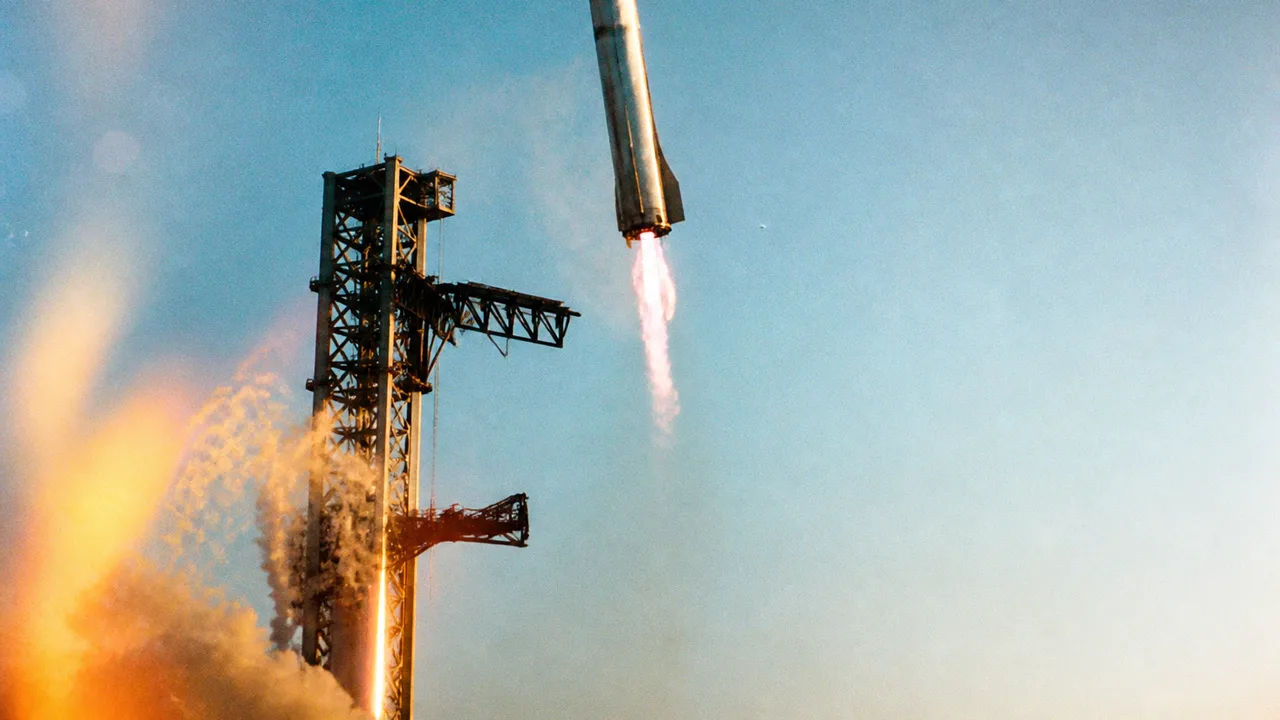
SpaceX’s Super Heavy booster abandoned its planned tower catch on November 13 and diverted toward the Gulf of Mexico, while the Starship spacecraft it had launched continued into orbit. Flight 15 had been designed to bring both stages back to the launch site. Within minutes of liftoff, that double-catch objective was gone, although Ship’s mission was still underway.
The booster detected a guidance, navigation and control issue near the end of its descent and aborted the catch itself, SpaceX spokesperson Dan Huot said. It headed offshore and self-destructed before hitting the water. Huot’s description identifies the category of issue that prompted the abort, but not the underlying fault or the threshold the vehicle crossed. SpaceX lost the opportunity to recover that booster; it also kept a vehicle with a detected control issue from approaching the launch tower.
Ship, the upper stage, reached orbit and released 26 Starlink satellites. As of Saturday morning, SpaceX was still preparing to attempt its first catch of Ship after orbital flight. Its return was scheduled for Saturday afternoon, conditional on checks during the rest of the mission. A successful Ship catch would give SpaceX a new recovery milestone, but it could not restore the booster lost on Friday or complete the planned double catch.
What the Abort Can Tell Us
The sequence makes Flight 15 easier to assess if its objectives are kept separate. Launch and satellite deployment test whether the rocket can perform useful work. A booster catch tests whether the first stage can return to the tower in a condition suitable for capture. Ship’s proposed return adds a longer orbital flight, reentry and a separate tower approach. A result in one column does not fill in another.
For the booster, the observable outcome is narrow: its planned catch was cancelled, and the vehicle went offshore. An automatic abort is a useful feature if it reliably rejects unsafe approaches while permitting safe ones. This flight shows the reject path being used after a reported guidance, navigation and control issue. The cause of that issue, and whether the abort rules would make the right decision across other failures, remain open questions. Calling the missed catch an uncomplicated success would overlook the lost hardware; calling it an uncomplicated failure would overlook the diversion.
Ship’s recovery plan uses its own decision points. SpaceX said it would send Ship back to the launch site only if the systems needed for reentry, its final landing burn and its tower approach were healthy. The plan included three opportunities to choose an early Pacific Ocean return, followed by a possible Gulf splashdown if a catch became unsafe during final approach. The Pacific option addresses problems identified before a South Texas return; the Gulf option addresses conditions nearer the end of that return. SpaceX had therefore planned several ways for Ship’s flight to end without a catch, each at a different point in the sequence.
That structure gives the company room to collect flight data without treating a tower catch as mandatory. It also sets a demanding standard for interpreting a catch: the vehicle has to reach the tower, but it should do so only after passing the checks intended to keep it away when something is wrong. Flight 15’s booster abort demonstrates that a recovery attempt can be cancelled. It does not, by itself, measure how well the whole set of checks works.
Why This Attempt Was Different
SpaceX had caught Super Heavy three times before Flight 15. Those recoveries involved the earlier V1 booster; two of the recovered boosters later flew again. Friday’s planned attempt would have been the first attempt to catch an upgraded V3 Super Heavy. The earlier catches show that tower recovery has worked for previous hardware, while the two subsequent flights show that some recovered boosters could be prepared for another launch. Neither history guarantees a catch for a changed booster.
Ship has a shorter orbital history. It first reached orbit on September 28, during Flight 14, and deployed Starlink satellites. An engine issue then led SpaceX to bring it down in the Pacific Ocean early. Before Flight 15, no Ship had been caught. The stages arrived at Friday’s launch with different records: booster catching had precedents, including reflight, while recovering the spacecraft from orbit remained a first attempt. That is why the missed booster catch and the pending Ship return deserve separate judgments.
There is also a progression within the satellite mission. Flight 14 had reached orbit and deployed a batch of operational Starlinks; Flight 15 did so again. Repeating that portion of the flight gives SpaceX another operational result, even as the recovery objective becomes more ambitious. It cannot tell engineers whether either Flight 15 stage will be ready to fly again. The booster was lost, and Ship’s condition after reentry and any recovery had yet to be assessed in Saturday morning’s update.
Falcon offers a practical comparison, with a clear boundary. SpaceX already operates partially reusable Falcon rockets, but it discards their second stages. SpaceX launch executive Kiko Dontchev described that difference ahead of Flight 15: the company intends to catch both Starship stages. Falcon shows why recovering a first stage can be valuable without making an entire rocket reusable. It is not an engineering stand-in for Starship’s larger vehicles, tower catches or Ship’s return from orbit.
Full recovery would still leave another test. A caught vehicle must be inspected, prepared and flown again; a rapid-reuse system must do that repeatedly for both stages at a pace the operator can sustain. SpaceX has re-flown earlier Super Heavy boosters, but a caught Ship has not yet entered that process. Even if Friday’s planned double catch had succeeded, the time and work required to put both stages back on a launch pad would have remained to be demonstrated.
SpaceX plans to use Starship for satellite launches and is developing a version for NASA’s lunar program. Those uses place different demands on the vehicle, and a booster abort on this test does not settle the prospects of either. For the reusable launch system SpaceX wants to build, the next questions are concrete: what caused the V3 booster to reject its catch, what condition Ship is in after its return, and how often recovered stages can actually fly again.
More Like This

SpaceX Rocket Team Wins First Neil Armstrong Prize
SpaceX's Falcon 9 landing team won the first Neil Armstrong Space Prize, spotlighting reusable rocket engineering, costs, climate and access to orbit.

Google's Suncatcher Is an Orbital AI Hardware Test
Google's Project Suncatcher will test four AI chips in orbit. Cooling, laser links and launch costs will decide whether orbital computing can scale at all.

SpaceX Launches 27 Starlink Satellites as Orbit Crowds
SpaceX launched 27 Starlink satellites from California on Oct. 31 UTC. The routine flight raises questions about orbital traffic, astronomy and satellite disposal.

Starship Flight 15 Tests Recovery, Not Rapid Reuse
SpaceX plans to catch both stages on Starship Flight 15. The test could prove recovery, while refurbishment, reflight and launch cadence remain separate hurdles.

Starship Flight 15 Misses Booster Catch After Guidance Issue
SpaceX says a guidance issue aborted Starship Flight 15's booster catch on November 13. The missed recovery tests abort logic and raises questions about reuse plans.

SpaceX Hits 600 Falcon 9 Booster Reuses
SpaceX reached 600 flight-proven Falcon 9 booster launches on July 13-14, 2026. Here's what that number actually means for spaceflight economics.

The Real Hazards of Space Exploration, Explained
From orbital debris to solar flares and the psychology of deep-space confinement, a rigorous look at what actually threatens human spaceflight.

Khinchin's Constant: The Number Hidden in Most Numbers
Mathematician Richard Elwes explains Khinchin's constant — 2.685 — a number that emerges from almost every irrational number, yet can't be proven for any specific one.