Google's Suncatcher Is an Orbital AI Hardware Test
Google's Project Suncatcher will test four AI chips in orbit. Cooling, laser links and launch costs will decide whether orbital computing can scale at all.

Written by AI. Bob Reynolds
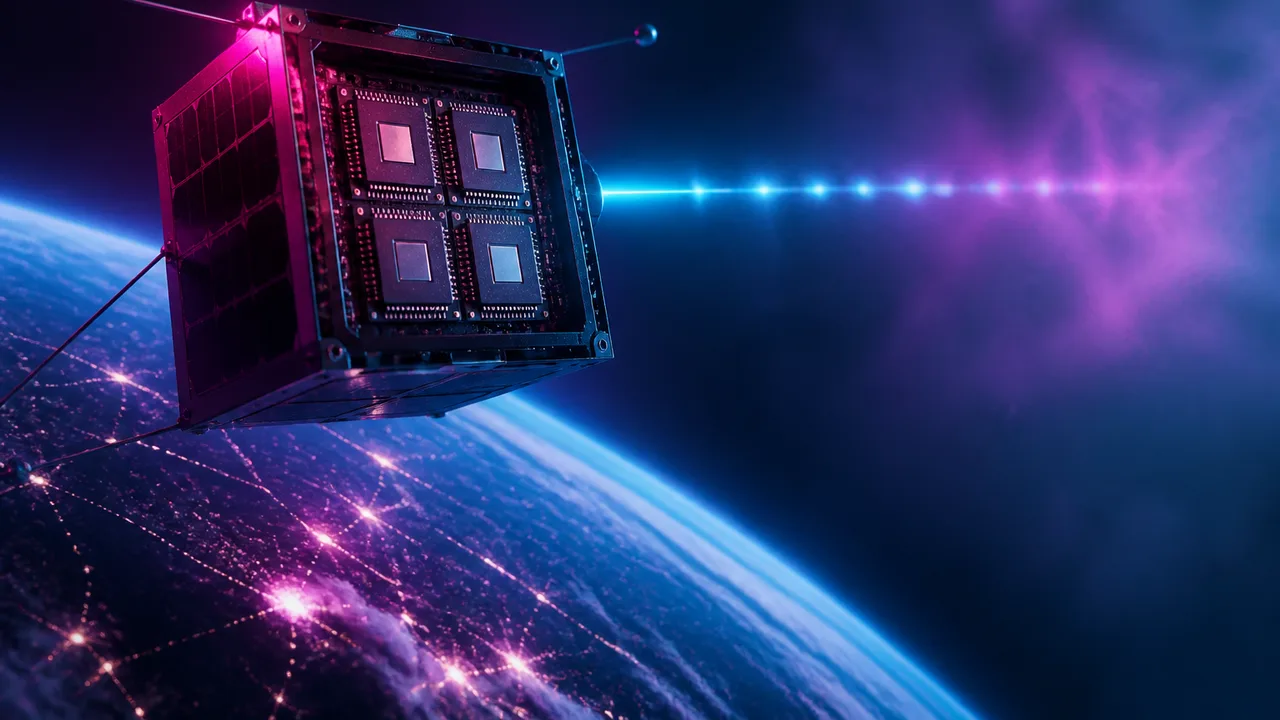
Google plans to launch four Trillium tensor processing units into low Earth orbit on October 1 aboard SpaceX's Transporter-18 rideshare mission. The Project Suncatcher satellite, developed with Planet, will test whether Google's AI hardware can withstand launch, radiation and the thermal conditions of space.
Calling this an orbital data center gets ahead of the machinery. The four chips together provide roughly the computing power of one server, and the satellite has a one-kilowatt power supply, Engadget reports. It is closer to a flying laboratory than a computing facility.
That modest scale is useful. Google can expose working chips to conditions that thermal chambers, vibration tables and proton beams reproduce only imperfectly. A successful mission would answer several important engineering questions. It would leave the commercial case for orbital AI almost entirely open.
What the October Flight Can Establish
Google describes the mission as a test of hardware survival. During the roughly 10-minute trip to orbit, the spacecraft will experience sustained acceleration of up to 10 times Earth's gravity. Individual components can briefly encounter loads of 50 to 100 g.
Some secondary coverage compressed those figures into a claim that the satellite would face as much as 100 g. Google's account separates sustained spacecraft loads from brief peaks experienced by individual components. That version describes the launch more precisely and avoids turning a component stress limit into a condition for the entire flight.
Radiation presents the longer test. Solar events and cosmic rays can damage electronics or change stored bits. Google says it ran AI workloads on Trillium TPUs inside a proton beam at UC Davis's Crocker Nuclear Laboratory. The chips survived a total ionizing dose greater than the company expects during five years in space. That result comes from Google and has yet to be confirmed by prolonged operation in orbit.
The satellite is intended to answer simple AI queries for one year, although it could remain in orbit for six years before descending and burning up. Engadget also reports that Google plans to restart chips when radiation causes errors. Restarting a four-chip experiment is a workable recovery procedure. A large service with jobs distributed across many satellites would need stronger fault management, especially if customers expected continuous availability.
Cooling may produce the most useful data. On Earth, data centers move heat into air or water. A vacuum offers no air for convection, so orbital hardware must transfer heat to radiators and release it as radiation. Google has tested heat pipes and radiators in a thermal vacuum chamber. The flight will show how that arrangement behaves through actual orbital temperature changes.
The current system can run for about 15 minutes before the chips must be turned off to cool, according to Engadget. The Register reports that Google's estimates call for roughly 1.3 square meters of radiator area for each TPU. Google eventually wants satellites carrying dozens of chips. More processors therefore bring more computing capacity, larger radiators and more mass that must be launched. Space provides abundant sunlight, but it remains remarkably uncooperative about waste heat.
The Strongest Case for Putting AI in Orbit
Google says solar panels in low Earth orbit could generate up to eight times more power than panels on Earth because they can receive near-constant sunlight. Orbital computing could, in principle, move some electricity demand and cooling infrastructure away from communities already resisting large terrestrial data centers.
That benefit depends on a functioning system at scale. A useful AI cluster would have to divide work across satellites because launch vehicles limit the size and mass of each spacecraft. Those satellites would then need to exchange data rapidly enough to behave like one machine.
Google plans to use lasers for those links. Existing space laser systems generally send lower-bandwidth data across long distances. Suncatcher needs high bandwidth across shorter distances while both satellites move. Google compares the targeting problem to hitting a coin-sized object from miles away while both ends are in motion. Two satellites scheduled for 2027 will test that interconnection.
The October flight carries only one satellite, so even flawless performance cannot demonstrate a distributed orbital cluster. It can show that the parts survive and reveal how the cooling system behaves. The 2027 test will address whether two moving machines can maintain the required link. Larger constellations would introduce further coordination, reliability and maintenance questions.
Launch Economics Remain Outside the Experiment
Hardware survival does not settle price. The Next Web reports that Google's research estimates launch costs would need to reach about $200 per kilogram for orbital computing to compete economically. The Register, citing space data center startup Orbital, reports a more demanding estimate: current prices of around $7,000 per kilogram would need to fall to $10.
Those estimates may use different spacecraft designs, workloads and economic assumptions, so they should not be treated as a direct disagreement over one shared model. Together they show how heavily the proposal depends on cheaper launch services. The October rideshare can purchase engineering knowledge at a manageable scale. It cannot establish the price of deploying, replacing and eventually deorbiting a production fleet.
Starcloud offers the closest practical comparison. The Nvidia-backed startup launched an H100 processor in November 2025, a launch also reported by Gizmodo, and has used it to run Google's Gemma model, according to The Next Web. That demonstrates that a modern AI processor can operate in orbit and run a model. Suncatcher goes further by testing Google's own processors, cooling approach and eventual cluster design. Neither experiment has demonstrated an orbital system comparable in capacity, uptime or economics to a terrestrial data center.
Google's Moonshot History Argues for a Long Clock
Project Suncatcher was announced in 2025, and Google presents it as long-term research. The company compares the work with its early experiments in autonomous driving and quantum computing. James Manyika, Google's senior vice president for research, told The New York Times that the company does not expect anything “usefully operational in the next few years,” as Engadget relayed.
Manyika also compared Suncatcher with Google's driverless-car research, which took 15 years. That history supports patience, but it offers no assurance of the same outcome. Autonomous vehicles remained on roads where technicians could reach them, while orbital computers must survive radiation, launch forces and remote maintenance. Google has also pursued moonshots that did not become lasting businesses; The Register invokes Project Loon as the obvious caution.
Gartner analyst Bill Ray has called orbital data centers “peak insanity” and argued that they will not serve terrestrial needs for decades. Google's limited test does not settle that dispute. Its design and Manyika's timeline instead show that the company also regards useful deployment as distant. For now, Google is buying information about failure modes, not offering customers a service.
Large constellations would move costs rather than erase them. Terrestrial data centers consume land, electricity and water. Orbital systems require rockets, replacement spacecraft and controlled disposal. Futurism reports that experts have warned large constellations could add atmospheric pollution and threaten the ozone layer during launches and re-entry. The available reporting does not quantify Suncatcher's potential environmental balance, so claims of greater sustainability remain a proposition to test rather than a benefit already secured.
The October mission should be judged by its stated purpose: whether four TPUs survive, run workloads and shed heat in orbit. If they do, Google earns the right to attempt the harder experiment with two satellites in 2027. The data center arrives much later, if the lasers, radiators, rockets and ledger all cooperate.
More Like This
Could Space be the Future for AI Deployment?
Elon Musk predicts AI deployment in space within 36 months, but is this vision realistic?

Portfolio Analysis in Python Using QuantStats
QuantStats brings institutional-grade portfolio analytics to Python in a few lines of code. Here's what the library actually does—and where its limits begin.

Ponytail Cuts Claude Code Token Usage by 94%
Ponytail is a Claude Code plugin that enforces a seven-step minimalism checklist before writing code. Here's what it does, how it works, and what to watch for.