SpaceX Plans Robotic Lunar Factories to Build Satellites
Elon Musk says SpaceX will build robotic satellite factories on the moon. Here's what that actually means—and who gets to decide if it happens.

Written by AI. Mei Zhang
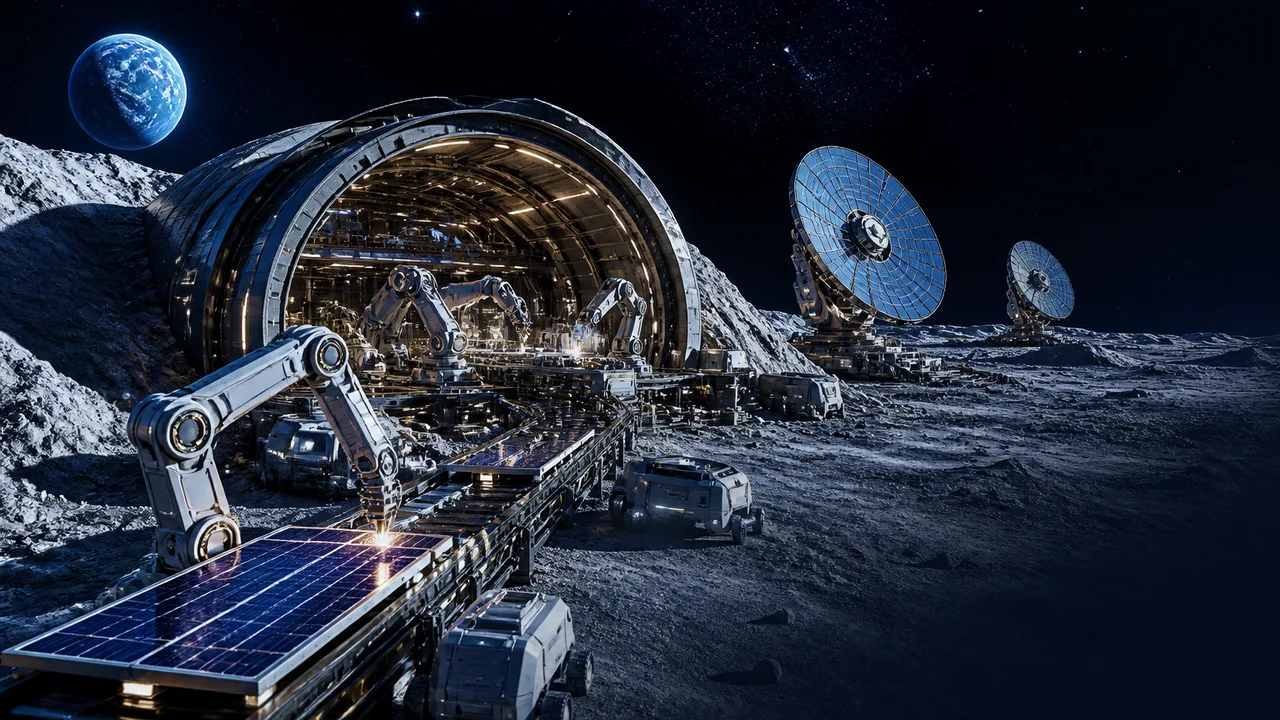
Okay, I need to be honest: when I read this story, the biotech reporter part of my brain short-circuited a little. I spend my days watching scientists argue over who controls a few base pairs in a human genome. And here comes Elon Musk saying SpaceX is going to mine the moon's surface, build robotic factories up there, and manufacture AI compute satellites at a scale he claims could eventually run "1000x the economy of the earth." I'm not even sure which part of that sentence to process first.
Musk made the announcement on August 4th during SpaceX's first-ever quarterly earnings call—the company's debut as a publicly traded entity—and according to Space.com, he was unambiguous: "It's going to happen." Per Fortune, a major pillar of SpaceX's strategic plan now "hinges on establishing lunar-based manufacturing, including factories to produce large-scale AI compute satellites," with the goal of mining the moon's regolith—its dusty, mineral-rich surface layer—as a raw material feedstock. Scientific American frames it plainly: this is a sweeping plan for SpaceX to reach profitability, and lunar factories are baked into the core of it, not tucked into a footnote.
Musk himself called it "pure insanity"—Fortune leads with that quote—which is either refreshing self-awareness or extremely savvy brand management. Probably both.
Here's the thing though: the insanity is structural, not arbitrary. The moon has genuine manufacturing advantages that Earth doesn't. It has no atmosphere to drag on launch vehicles. Its gravity is one-sixth of Earth's, meaning it costs a fraction of the energy to get something off the lunar surface and into orbit compared to lifting it from the ground here. If you're building satellites destined for high Earth orbit or deep space, manufacturing them on the moon and launching them from there isn't crazy—it's actually kind of elegant. The Indian Express notes that SpaceX plans to use robots to "handle much of the construction work," which makes sense given the absence of a breathable atmosphere and the general hostility of the lunar environment to unprotected humans.
The regolith angle is where this gets genuinely interesting to me. Lunar regolith contains silicon, aluminum, iron, and titanium oxides—the stuff semiconductors and satellite chassis are made of. If you can process it in situ rather than hauling raw materials from Earth at tremendous cost, you've changed the economics of space manufacturing in a fundamental way. It's the same logic driving interest in asteroid mining and Mars ISRU (in-situ resource utilization). The moon is just the nearest test bed we have. The engineering challenges are colossal—vacuum sintering, radiation-hardened robotics, power generation in a place where nights last two weeks—but the physics of why you'd want to do this is completely coherent.
And that's exactly where I want to slow down, because this is the part that nobody asked about during an earnings call.
I cover how new technologies get deployed before governance frameworks exist to manage them. I watched CRISPR go from a bacterial immune system to a tool for editing human embryos faster than bioethicists could type position papers. The pattern is always the same: the capability arrives, the governance doesn't, and then we spend years doing frantic catch-up on questions that were actually foreseeable from the start. Lunar industrial-scale manufacturing—carried out by a private company, not a national space agency—is that pattern running at orbital velocity.
The Outer Space Treaty of 1967 says no nation can claim sovereignty over the moon. What it doesn't cleanly address is whether a private corporation can extract, process, and profit from lunar resources at industrial scale. The US passed the Commercial Space Launch Competitiveness Act in 2015, which lets American companies own resources they extract from space—but "owning what you extract" and "running a factory on a shared celestial body" are meaningfully different propositions. Other nations, including China and Russia, have not endorsed that interpretation. The Artemis Accords, which over 40 countries have signed, establish norms around lunar resource use but are not legally binding treaties. The gap between those norms and actual enforcement is enormous, and SpaceX is proposing to operate right in the middle of it.
Who benefits from a lunar economy built by one private company? That question doesn't have a clean answer right now—and MSN reports Musk's stated ambition is to scale output to "1000x the economy of the earth," which is the kind of number that sounds like a meme until you think about what it means for who controls the means of production in that economy. I'm not saying that's nefarious. I'm saying it's a question that deserves to be on the table right now, loudly, before the first robotic drill touches regolith.
As for the timeline question: Scientific American gently observes that Musk "is known for making ambitious timeline predictions that don't always hold." That's doing a lot of work as a sentence. SpaceX has also, undeniably, delivered things that seemed impossible—reusable rocket boosters chief among them. The right frame here isn't "will this happen?" vs. "is this a stunt?" It's "at what pace, under what oversight, and with what decision-making structures along the way?" Starship, SpaceX's heavy-lift vehicle designed for exactly this kind of deep space logistics, is still in active development. Lunar robotic construction at industrial scale requires capabilities that don't fully exist yet. The gap between the earnings call vision and the first poured regolith-concrete wall is wide and full of variables.
What does exist is a publicly traded company that has now told its investors lunar manufacturing is a core profitability strategy—which means this isn't a skunkworks daydream anymore. It's a financial commitment with quarterly accountability attached to it. That changes the incentive structure. SpaceX now has shareholders who will want progress metrics, not just trajectory. That accountability pressure is, weirdly, one of the more grounding forces in this whole story.
The moon is the most-visited celestial body in human history, and we've never left so much as a candy wrapper behind that wasn't deliberate. What SpaceX is describing would be the first permanent industrial footprint off Earth. 🌕
That's not a factory yet. That's a plan on an earnings call. But plans with shareholder pressure and Starship behind them have a way of becoming construction schedules—and the governance conversations need to start well before the robots do.
More Like This

How Maxwell Unified Electricity and Magnetism
A compass needle twitched in 1820 and set off a chain of discoveries that now powers every wireless signal in your life. Here's the physics behind it.

The Neuroscience of Discipline: Automation Over Motivation
Explore how discipline evolves from motivation to neural automation, making actions automatic and emotions irrelevant.

Black Hole Paradox: Are Reference Frames the Key?
Exploring how reference frames might resolve the black hole information paradox.
Texas Is Becoming the Hub of Commercial Space
From SpaceX's Starbase to Firefly's moon landing, Texas has become the center of commercial space. Here's what's driving the shift—and what it costs.
CuspAI's $450M Bet: Who Gains When AI Does Science?
Jeff Bezos and the UK government just backed CuspAI at a $2.6B valuation. The bigger question: what happens to the researchers whose expertise AI now models?
NASA's Moon Base Landers Are Being Built Right Now
NASA's August 2026 moon base update shows real hardware in real facilities — five companies, four landers, and a plan requiring 20+ lunar landings to pull off.
Solar Orbiter Captures First Direct View of the Sun's Poles
Solar Orbiter has captured the first direct images of the Sun's poles, revealing a chaotic magnetic field mid-reversal—and what it means for space weather forecasting.

Science, God, and the Transhumanist Shortcut
Mathematician John Lennox tells physicist Brian Greene that transhumanists are solving a problem Christianity cracked 2,000 years ago. My generation might actually find out who's right.