CuspAI's $450M Bet: Who Gains When AI Does Science?
Jeff Bezos and the UK government just backed CuspAI at a $2.6B valuation. The bigger question: what happens to the researchers whose expertise AI now models?

Written by AI. Carmen Rodriguez
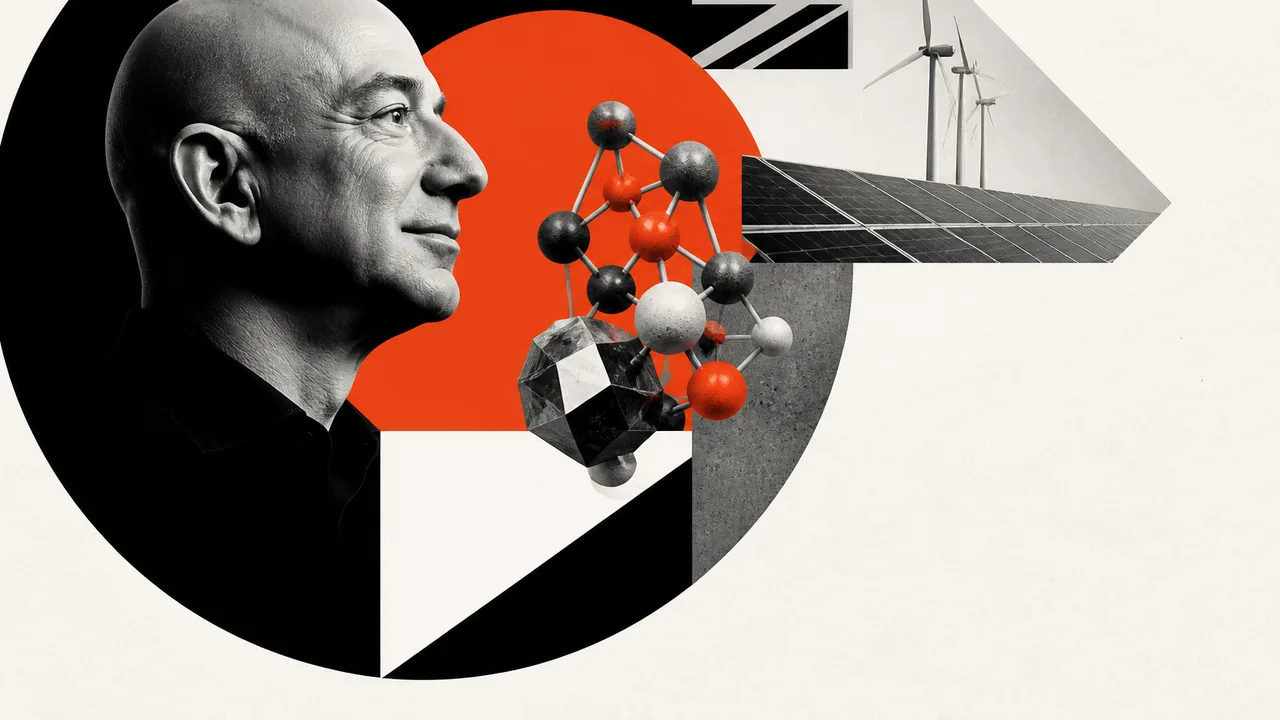
The announcement landed the way these things always do — clean, forward-looking, full of words like "discover" and "accelerate" and "transform." Cambridge-based CuspAI has raised $450 million in a Series B round, according to The Guardian, valuing the two-year-old company at $2.6 billion. The investors include Jeff Bezos's Bezos Expeditions, the UK government's Sovereign AI Fund, and a roster of firms led by Kleiner Perkins and NEA, with Glade Brook Capital Partners and Lux Capital also participating, per CNBC.
The pitch: CuspAI uses AI systems to discover and design new materials — the kind of work that currently takes materials scientists and research chemists the better part of a career to do by hand. Clean energy. Chipmaking. The next generation of semiconductors. All compressed, supposedly, by a model trained to do in hours what a PhD might spend a decade on.
That compression is the story. Not whether the valuation is justified — it's a two-year-old company that went from a $520 million valuation in September 2024 to $2.6 billion today, a five-fold jump confirmed by Tech.eu, and Fortune reported the Series A was $100 million. Those numbers will mean whatever the market decides they mean. The more pressing question is structural: who does this restructure, and who profits from that restructuring?
The Work Being Modeled
Materials discovery is not a generic knowledge job. It's one of the most credentialed, specialized, long-cycle fields in science. A researcher who spends fifteen years mapping the properties of novel compounds under different conditions isn't doing busywork — they're building irreplaceable tacit knowledge about failure modes, edge cases, and the gap between what models predict and what matter actually does when you try to synthesize it.
CuspAI's partnership with Nvidia — reported by CNBC as focused on hunting for new chipmaking materials — is where this gets concrete. The semiconductor industry is under enormous pressure to develop new materials that can push chip performance beyond the limits of silicon. If CuspAI's AI systems can identify candidate materials faster than human researchers can, that's a genuine capability shift.
But capability shifts don't distribute their benefits evenly. There's a version of this where materials scientists use CuspAI's tools and dramatically expand what they can do in a given year — augmentation. There's another version where the number of materials scientists a chipmaker needs to employ drops significantly — replacement. The press materials don't make that distinction. They never do.
What we can observe is the economic logic: $450 million invested in a platform that compresses expert labor into a software system is not primarily a bet on scientists doing more science. It's a bet on the platform capturing value that currently flows through scientific labor markets. That's not a scandal — it's what technology investment does. But it's worth naming plainly.
Bezos in the Room
Jeff Bezos is not just a billionaire with a checkbook. For readers who have followed the Amazon story closely — the warehouse injury rates, the union drives in Bessemer and Staten Island, the productivity surveillance systems baked into fulfillment center floor operations — Bezos's name on a deal about accelerating and automating specialized work carries specific weight.
His investment portfolio has moved in a consistent direction: he's backed longevity research, including Altos Labs, a cellular reprogramming startup that MIT Technology Review described as Silicon Valley's bet on biological rejuvenation. He's invested in aerospace, in AI infrastructure, and now in a platform that automates the research pipeline for physical materials. The through-line is a specific theory of where value is going to accumulate in the next fifty years: computation applied to biology, chemistry, and physics at a scale that individual human experts can't match.
That theory may be right. But it comes with a workforce corollary that doesn't appear in any of the funding announcements. The founder of the company that spent years resisting union recognition in its own warehouses is now backing a startup whose explicit value proposition is making certain categories of scientific expertise cheaper or unnecessary. You don't have to be conspiratorial about it to think it's worth noting.
The Sovereign AI Fund Question
The UK government's participation — through its Sovereign AI Fund — adds a dimension that the investor framing tends to flatten. Resultsense and Reuters via KFGO both confirm the government's involvement, but neither the size of the government's stake nor any public-interest conditions attached to it have been disclosed.
That's a significant gap. When public money goes into a private company at a $2.6 billion valuation, the relevant questions aren't just strategic — they're democratic. Does the UK government hold IP rights to any materials discovered using taxpayer-backed funding? Are there workforce development provisions that would direct any benefit toward UK researchers or manufacturing workers? Does the government have any claim on the commercial applications, particularly if those applications end up serving non-UK chipmakers or defense contractors?
None of those questions have public answers yet. The Sovereign AI Fund exists to ensure Britain doesn't fall behind in the AI race — which is a legitimate policy objective. But "don't fall behind" is not, by itself, a public interest condition. It's a competitive framing that happens to align perfectly with what private investors also want.
Public money with no disclosed public-benefit conditions isn't just a governance question. It's a labor question, because the workers most likely to be affected by a materials-discovery AI — in British research universities, in semiconductor fabrication facilities, in the supply chains that depend on existing materials processes — are the people with the least voice in how that money gets deployed.
The Chip Materials Angle and Supply Chains
The Nvidia partnership is worth holding for a moment. CNBC's reporting frames it as a collaboration to find new materials for chipmaking — which sounds clean and additive until you trace what "new chipmaking materials" means for the existing semiconductor supply chain.
Semiconductor fabrication is a deeply specialized industrial ecosystem. The workers who operate fabs, manage chemical processes, and handle the materials that current chip designs require have built their expertise around specific compounds, processes, and tooling. A shift to new materials — even if it takes years to commercialize — sets a clock running on that expertise. It's not a crisis that arrives overnight, but it's the kind of structural change that, historically, industrial workers find out about after the decisions have already been made.
None of that is CuspAI's fault. They're doing science. But the money behind the science — $450 million, including a government stake and investment from someone whose public legacy includes building one of the most surveilled workforces in American history — comes with obligations that aren't visible in the current disclosure.
What We Don't Know
To be fair to the limits of what's been reported: we don't know whether CuspAI has commitments to research partners, licensing structures that might benefit university labs, or any internal workforce practices worth knowing about. The company is two years old. These are early days for any of those questions to have clean answers.
What we do know is that the story being told about CuspAI — by its investors, by the UK government's implicit endorsement, by the Nvidia partnership — is a story about acceleration and efficiency. It's a story that speaks fluently to capital and to national competitiveness.
The workers whose expertise is being modeled, and the workers downstream in fabrication and supply chains, haven't been given a seat at that table. They rarely are, at this stage. But the decisions made at this stage — about IP, about licensing, about what the platform optimizes for and who controls it — are the decisions that will determine whether AI-powered materials discovery broadens scientific capacity or simply relocates the value it creates.
That question doesn't have an answer yet. The $450 million is a bet on one answer. Someone should be asking about the others.
More Like This
Business Rules 2026: Impact on Labor and AI
Explore how emerging business rules and AI technology reshape labor dynamics and worker dignity by 2026.

Financial Crises Follow Patterns — But Not for Everyone
Kuran Francis maps four recurring patterns behind every major financial crisis. The framework is solid. What it leaves out is the story of who pays when the system breaks.

OpenAI's IPO Is a Regulatory Filing First
The OpenAI and Anthropic S-1s will be financial documents, yes — but first they're SEC filings with disclosure obligations no AI lab has faced before.

Wall Street Knew the Crash Was Coming. Saying So Got You Fired.
Jeremy Grantham's famous poll revealed 398 analysts knew the dot-com crash was guaranteed. A 2003 study shows why none of them said so publicly: accuracy cost careers.

Dubai's Crisis Has a Worker Problem No One's Covering
Dubai's economic model was built on migrant labor with almost no rights. Now, with airstrikes and a blockaded strait, those workers face the worst of the fallout.

Broadcom's $1.7 Trillion Valuation and Who Pays for It
Broadcom's 68% EBITDA margins and $115B FCF consensus are under scrutiny. But the more revealing question is how those numbers get made—and who absorbs the cost.

Druckenmiller's Bets and the Workers Behind Them
Druckenmiller's Q1 2026 portfolio shift reveals capital flows into Natera and YPF—and raises hard questions about the workers those bets depend on.

Zeta Global's AI Growth and the Work It Replaces
Zeta Global's AI platform is automating marketing workflows at scale. The financial results look strong. The labor story underneath them is harder to read.