Broadcom's $1.7 Trillion Valuation and Who Pays for It
Broadcom's 68% EBITDA margins and $115B FCF consensus are under scrutiny. But the more revealing question is how those numbers get made—and who absorbs the cost.

Written by AI. Raj Mehta

A $1.7 trillion valuation doesn't materialize out of efficient markets and good vibes. It gets built—quarter by quarter, acquisition by acquisition, headcount adjustment by headcount adjustment. When analysts start stress-testing the numbers that justify that valuation, the instinct in financial press is to treat it as a story about projections. I want to treat it as a story about systems: what produces those numbers, whose labor makes them possible, and who captures almost none of what they generate.
Start with the margin. Broadcom's Q1 FY2026 investor release reported quarterly revenue of $22.0 billion with an adjusted EBITDA margin of 68 percent, a figure CFO Kirsten Spears cited directly. That's not a typo. Two-thirds of every dollar in revenue, after operating costs, converts to earnings before interest, taxes, depreciation, and amortization. In manufacturing-adjacent industries—and Broadcom sits at the intersection of semiconductor design, enterprise software, and infrastructure—margins like that are extraordinary. They don't happen by accident. They happen by design, and the design involves choices about where costs land.
The number Wall Street is arguing about
Wall Street's current fight is over free cash flow—specifically, whether Broadcom can reach the approximately $115 billion FCF consensus that analysts have built into their forward models. According to Seeking Alpha's stress-test analysis, the answer, when you run the assumptions honestly, is probably not. The analyst behind that piece projects FY2028 FCF in the range of $67 to $83 billion—still a genuinely exceptional outcome for any company, but a gap of $32 to $48 billion below consensus. At a $1.7 trillion valuation, that gap matters enormously for anyone doing discounted cash flow math.
The short version of the critique: Wall Street's consensus may have compounded optimistic assumptions—on AI capex durability, on custom silicon TAM expansion, on the pace at which hyperscaler customers scale their ASIC programs—into a number that looks precise but is doing a lot of speculative work. This is not a story about Broadcom failing. The company is, as the Seeking Alpha analysis notes, "executing about as well" as anyone could expect. It's a story about the distance between execution and expectation, and what happens to a $1.7 trillion valuation when that distance becomes visible.
Broadcom's own most recent forward guidance—$29.4 billion in revenue for the upcoming quarter, per the company's Second Quarter FY2026 investor release—suggests continued growth at a pace that most companies would consider exceptional. The debate is not whether Broadcom is growing. It's whether the growth justifies the multiple, and whether the FCF projections underpinning that multiple survive contact with realistic assumptions.
How consensus gets built—and who it serves
The mechanics of analyst consensus deserve more attention than they usually get, because they are not a neutral aggregation process. Analysts working at major investment banks have institutional incentives that don't always align with accuracy. Coverage decisions, access to management, and the dynamics of sell-side research all create pressure toward optimism—not dishonesty, exactly, but a structural tilt. Bullish models attract attention. Bullish calls generate trading activity. And when a company the size of Broadcom is growing rapidly in a sector (AI infrastructure) that every institutional investor wants exposure to, the incentive gradient points upward.
That doesn't mean the $115 billion consensus is fabricated. It means it was built in an environment where the people building it had reasons to lean into the optimistic scenarios. The Seeking Alpha stress-test is valuable precisely because it applies skeptical pressure to assumptions that had been allowed to compound. The result—a projected range of $67 to $83 billion in FY28 FCF—is still a number that would make Broadcom one of the most cash-generative companies on earth. The problem is the gap between that number and what's currently priced in.
The VMware story behind the margin
Here's what doesn't get asked often enough in investor-facing analysis: how did a 68 percent EBITDA margin happen at a company that, two years ago, was integrating one of the largest enterprise software acquisitions in history?
Broadcom's $69 billion acquisition of VMware in late 2023 was transformative in ways the financial press covered extensively—and in ways it covered much less. On the revenue side, Broadcom moved VMware's sprawling product portfolio toward a subscription model and narrowed the customer base to enterprise accounts it considered most valuable. On the cost side, the integration involved significant workforce restructuring. Reports at the time, and accounts from former VMware employees that circulated widely in tech industry coverage, documented layoffs in the thousands—estimates ranged from roughly 2,000 to as many as several thousand positions eliminated in the months following close, with additional restructuring continuing as Broadcom rationalized the combined organization.
The financial logic is clean: acquire a software business with strong recurring revenue, restructure the cost base aggressively, convert the surviving revenue to a higher-margin subscription model, and let the EBITDA margin expansion do the rest. The 68 percent margin in Q1 FY2026 is, in part, a record of that process. It reflects genuine operational integration and software economics. It also reflects the people who were cut, the benefits that ended, and the communities—in Palo Alto, in Atlanta, in Bangalore—where former VMware employees absorbed costs that are now invisible in Broadcom's adjusted financials.
I'm not arguing that Broadcom did something unusual here. Corporate acquisitions almost always involve workforce restructuring; it's one of the primary mechanisms through which acquirers generate the returns that justify deal premiums. What I'm arguing is that the 68 percent margin is not a natural phenomenon. It's a transfer—from labor costs to earnings—and the people on the losing end of that transfer are not represented in the analyst models debating whether $115 billion or $80 billion is the right FCF number for FY2028.
The supply chain that doesn't appear in the multiple
Broadcom's semiconductor business—networking chips, custom AI accelerators, the XPU work it does with hyperscaler customers like Google—runs through a global supply chain that Broadcom does not own and does not report on. Custom silicon design happens inside Broadcom; fabrication happens at TSMC, primarily in Taiwan and, increasingly, in Arizona. Packaging and assembly happen through contract manufacturers operating throughout Southeast Asia.
The workers in those facilities are not Broadcom employees. They don't appear in Broadcom's headcount figures. Their wages, working conditions, and labor rights are not disclosed in Broadcom's investor materials. When analysts model Broadcom's cost of goods sold, they are modeling the price Broadcom pays its contract manufacturers—not the wages those manufacturers pay their workers, not the overtime disputes, not the safety records.
This is standard practice. It is also a structural feature of how the semiconductor industry keeps its margins high: by concentrating the intellectual property and the customer relationships in the U.S., while distributing the physical labor across jurisdictions where labor costs are lower and worker protections are thinner. The $1.7 trillion valuation is, in part, a valuation of that structure.
What the skeptics are actually saying
The Seeking Alpha stress-test lands hardest on the AI infrastructure assumptions embedded in the $115 billion FCF consensus. The question it's really asking is: how durable is hyperscaler demand for custom silicon, and how much of Broadcom's projected FCF depends on that demand continuing to grow at current rates?
That's a legitimate financial question. But it points toward a human one: the AI buildout that's currently driving Broadcom's custom ASIC business is itself a massive capital deployment by a handful of technology companies—Google, Meta, Apple, Microsoft—that are spending at a pace that has, so far, outpaced revenue generation from AI products. If that capex cycle slows, or if the hyperscalers decide to consolidate their custom silicon programs, or if the AI revenue they're projecting doesn't materialize on schedule, the demand assumptions underlying the $115 billion FCF consensus start to look fragile.
None of that is certain. The AI buildout could sustain. Broadcom could continue executing at the level its Q1 FY2026 results demonstrate. The FCF could land somewhere in the middle of the projected range and still justify a premium valuation. Analysts appear split on the outlook, per reporting that has circulated across financial media in recent days.
But the workers who built VMware's products, the workers who fabricate Broadcom's chips, and the workers who assemble the servers those chips go into have one thing in common with the institutional shareholders debating the FCF consensus: they are all embedded in a system whose outputs are measured, and whose inputs—their labor, their time, the risks they absorb—largely are not.
The valuation debate will resolve itself eventually, in either direction. The question of who captures value in the AI infrastructure boom, and who provides the conditions for that value to be captured, is going to outlast whatever Broadcom's stock does next quarter.
More Like This

Brand Authority Is Pricing Power—and Finance Knows It
Ryan Deiss's five brand "authority triggers" map onto real financial metrics. A global markets reporter translates what that actually means for valuations and beyond.

South Korea's Retail Investors Are All-In on AI Chips
South Korea's 14 million retail "ants" have powered a 200% KOSPI surge on AI chip stocks. A Bloomberg report maps the rally—and the risks hiding inside it.
AMD's AI Chip Play: Enterprise Hardware Meets Policy Reality
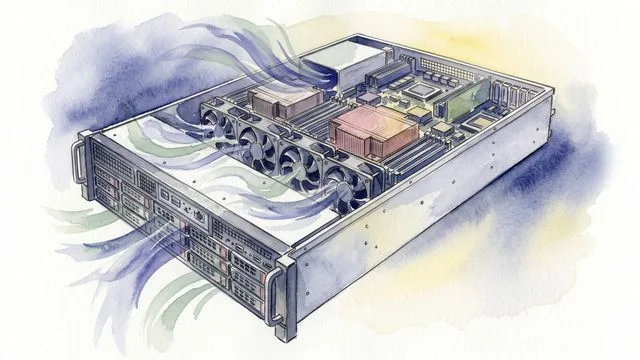
Supermicro's AMD MI350P server launch is a hardware story, but for enterprises navigating chip export rules and procurement law, the policy context is the real news.

GameStop's $56B eBay Bid: What the Math Actually Says
GameStop bid $56B for eBay despite a $12B market cap. We broke down the financing—shares that don't exist, a non-binding bank letter, and a CEO incentive worth examining.

4 Robotics Stocks Quietly Building the Next Wave
ARM, Symbotic, Teradyne, and BOTZ are positioned at the heart of physical AI. Here's what the robotics investment thesis actually looks like up close.

What 10 Million Cold Emails Reveal About Selling
Austin Schneider sent 10M cold emails and found 6 patterns that actually drive replies. Here's what globally-minded sellers need to know—and where the framework breaks.

Global Wealth Is $600 Trillion — and Mostly Paper
The world's net worth hit $600 trillion, but 75% of that growth since 2000 came from rising prices, not productive investment. Here's what that means.

How Caterpillar Built a Century of Industrial Dominance
From crawler tractors to AI data centers, Caterpillar's $67.6B revenue and $62B order backlog reveal a company built to outlast every economic cycle.