South Park Changes Its Satirical Weapon in Season 29
South Park’s Season 29 premiere revives its standalone form, using e-bikes, Google and GTA VI to redirect Trump-era satire toward public compliance and power.
Written by AI. Theodore "Teddy" Ashworth III
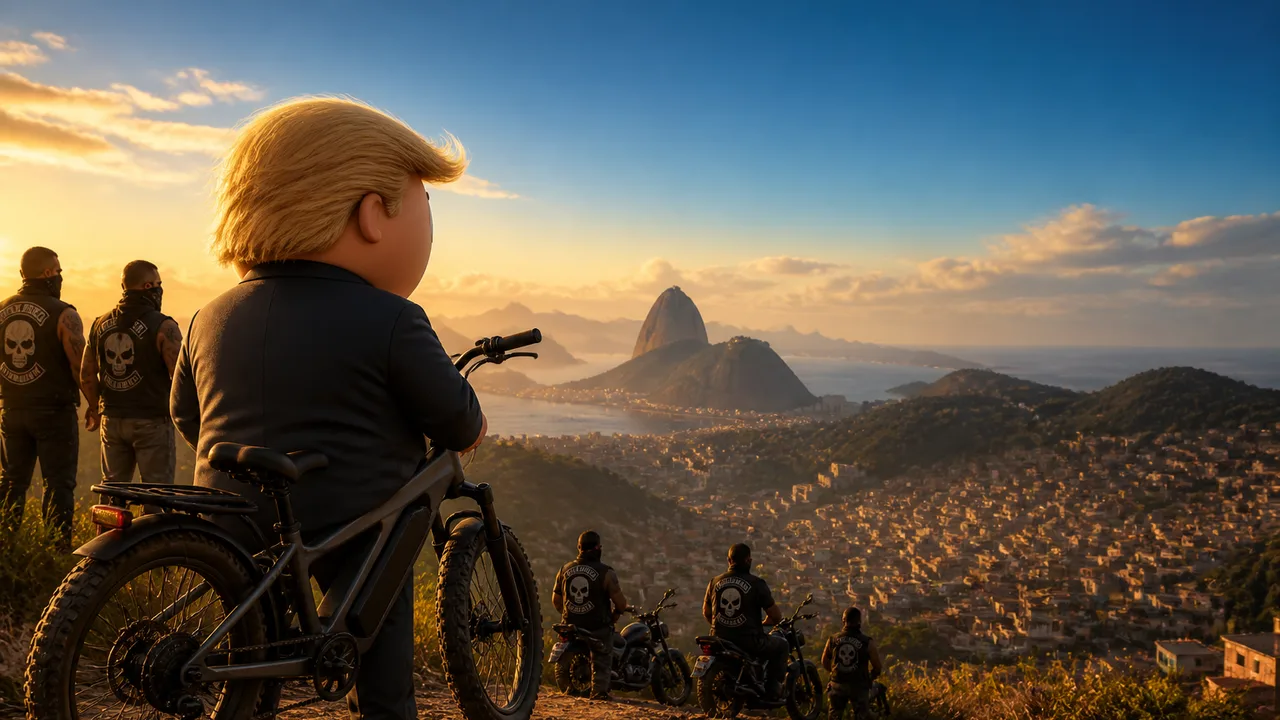
South Park opened its 29th season on September 16 with a renamed town, marauding e-bikes and Donald Trump largely absent from the plot. The president still appears in the revised title sequence, but “South American Biker Gangs” keeps its action in Colorado and its obscenity among civilians.
That looks, at first glance, like a retreat to familiar ground. Cartman schemes, Randy becomes a zealot, the four boys occupy the center of the story, and Kenny dies. After two seasons dominated by a serialized White House grotesque, Trey Parker and Matt Stone have recovered the old machine: one local nuisance, several escalating misunderstandings, a dead child, credits.
Yet the politics have followed them home. The premiere changes the method of attack, exchanging direct caricature for allegory. Trump becomes the condition under which the town operates, while parents, police, companies and consumers supply the action. The result suggests a useful strategy for political satire when its central subject already performs like a parody of executive power: study the people who normalize the performance.
The Old Machine Returns
Seasons 27 and 28 departed from the show’s standalone tradition for a continuing White House narrative. Trump rivaled Stan for narrative attention, conducting an affair with Satan while versions of J.D. Vance, Pete Hegseth and Peter Thiel circulated through the administration’s infernal sitcom.
The approach provoked an unusually direct exchange between cartoon and government. As NME documented, the White House responded that South Park “hasn’t been relevant for over 20 years.” Recent seasons nevertheless broke the show’s previous ratings records, according to The Hollywood Reporter. Parker and Stone had found the rare publicity arrangement in which the target entered the sketch and volunteered to play wounded dignity.
“South American Biker Gangs” restores an older division of labor. Stan, Kyle, Cartman and Kenny confront the immediate nuisance; Randy magnifies it into civic catastrophe. Consequence described the episode as a return to the early formula, complete with Randy replacing Trump as antagonist and Kenny resuming his ancestral duty as Colorado’s most renewable resource.
Nostalgia explains some of the pleasure. It does not explain the choice’s political utility. A White House caricature asks whether the impersonation is vicious or funny enough. A town allegory asks how presidential behavior travels through institutions and daily life. That second question gives Parker and Stone more targets, and it denies Trump the flattering role of sole author. Power requires clerks, interfaces, slogans and citizens willing to learn the new nouns.
The E-Bike War is a Political Map
Cartman acquires an e-bike, other children follow, and Randy’s band of conventional cyclists treats the newcomers as an invading population. The adults form the more violent gang while insisting that they are restoring order. They bribe police, attack their enemies and exploit Kenny’s fatal battery explosion to secure a town-wide e-bike ban.
The immigration allegory is broad enough to be visible from orbit. The children become a stigmatized group whose individual behavior is generalized into collective guilt; Randy’s cyclists resemble an amateur, Lycra-clad immigration force. Google searches provide instructions for bribing officials and answering gang violence with extreme violence. Meanwhile, residents hope conditions will improve in November, when Grand Theft Auto VI arrives. The game functions as a comic substitute for the midterm elections, salvation deferred to a heavily marketed November release.
These correspondences support an inference rather than a decoder ring authorized by the creators. The episode never labels Randy’s gang as Immigration and Customs Enforcement. Allegory gains force from the sequence of events: panic about newcomers, collective blame, coercive enforcement and a prohibition passed after a death whose cause remains uncertain.
That uncertainty also complicates the satire. Cartman behaves appallingly, the bikes present an actual danger, and the episode’s City Wok material returns to an Asian accent routine that The Guardian’s review called hacky. Viewers can read the plot as an indictment of xenophobic overreaction, but its immigrants-as-reckless-children analogy carries some of the threat imagery it wants to ridicule. South Park has always regarded collateral offense as both aesthetic and alibi. Sometimes the shrapnel illuminates the blast; sometimes it merely hits the furniture.
From Mocking Trump to Mocking Compliance
The renamed town sharpens the premiere’s wider argument. Parker and Stone announced “South America” with faux gratitude to the “bravery and patriotism” of Apple and Google, then thanked Paramount as “a Skydance Capitulation.” The barb pointed toward companies reflecting Trump’s geographic renamings and toward the show’s own corporate home. The A.V. Club noted that Skydance had merged with Paramount, which renewed Parker and Stone for another five years in 2025. Biting the hand that signs the extension remains easier when the hand has already signed.
More importantly, the premiere treats the new name as established reality. Its six-episode season begins after the renaming, with residents using “South America” as if generations of geography teachers had always intended it. The joke resides in acquiescence. Nobody needs to show Trump changing the sign because the changed sign has reorganized everybody’s language.
This marks the crucial difference from the preceding White House arc. Direct caricature concentrated culpability in a recognizable cast of political figures and invited a recognizable response from Washington. The new allegorical mode distributes culpability across search engines, local government, corporate ownership and frightened neighbors. It may also insulate the satire from the exhausting contest over whether any Trump caricature can exceed its source material.
A Hollywood Reporter preview proposed that the current presidency requires “little exaggeration and more simple documentation.” The premiere’s answer is to move one step outward. If documentation has occupied satire’s old territory, the satirist can follow the paperwork downstream and watch absurdity become policy, product copy and common speech.
Brad Paisley’s closing number, “We Are South America,” completes that movement. Billboard reported that the patriotic ballad plays over Kenny’s funeral and the announcement of the e-bike ban. Its promise that “we won’t change for anyone” accompanies a town that has already accepted somebody else’s imposed name and converted tragedy into merchandising. The anthem offers compliance dressed as defiance, a familiar costume in politics and country music alike.
A Weapon with a Short Warranty
Allegory gives the show breadth, but it charges interest. Direct impersonation can remain timely as long as its subject keeps supplying incidents. A renamed-town premise must generate fresh dramatic consequences or curdle into branding. IGN’s premiere review raised precisely that concern, warning that the name-change joke could grow stale quickly.
One episode also cannot establish a season-long strategy. Parker and Stone develop scripts during the two-week period before broadcast, a production model that gives South Park unusual responsiveness but makes confident forecasts rather foolish. The e-bike story may prove a standalone experiment. Trump and his cabinet may return. The repeated November references could foreshadow an expanding midterm arc, or they could remain one episode’s neatest substitution gag.
For viewers, the useful question across the remaining episodes concerns where the camera points when Trump is outside the frame. If it keeps finding the mayor, the search bar, the parent company and the patriotic chorus, Season 29 will have identified satire’s richer contemporary subject: the elaborate civic machinery that turns one man’s marker stroke into everybody else’s map.
More Like This
Stephen A. Smith Tests Sports Media's Political Reach
Stephen A. Smith's 2028 speculation shows how sports media can convert recurring attention into political capital, while creating new risks for ESPN and its audience.
Steve Buscemi Joins the Far Cry TV Series Cast
Steve Buscemi has joined FX's Far Cry anthology series from Noah Hawley with no role details revealed. Here's what the casting signals—and what it leaves unasked.
Call of Duty Goes to Korea: Symbol or Stereotype?
Modern Warfare 4 sets its campaign on the Korean Peninsula. Is it cultural recognition, geopolitical risk, or just a very expensive action movie?
Bayless and Sharpe Reunite: Can Debate Chemistry Still Sell?
Skip Bayless and Shannon Sharpe have filmed a reunion show. What their reunion means for sports debate, streaming economics, and personality-driven media.
Visually Stunning Movies Nobody Talks About
From Tarsem Singh's The Fall to the anime fever dream Redline, these nine films are visually extraordinary—and almost entirely ignored. Here's why that matters.
Why the Ocean Still Terrifies Us: Depths of Fear
Quinn and James of Cosmic Chronicles explore why the ocean remains humanity's oldest, deepest fear—from the Mariana Trench to the myth of the Bermuda Triangle.